
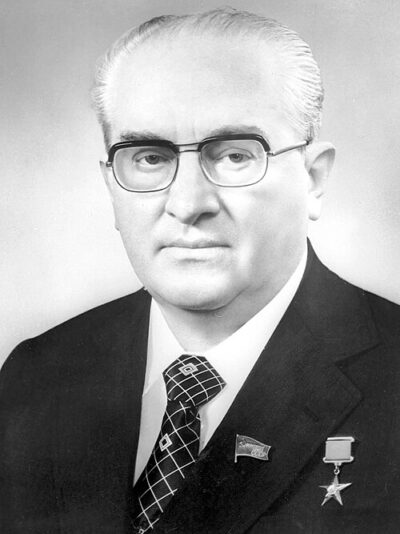
Yuri Andropov
Yuri Andropov was a General Secretary of the Communist Party of the Soviet Union. Born June 2, 1914, in Soluno-Dmitriyevskoye. Died February 9, 1984, in Moscow. Positions held include General Secretary of the Communist Party of the Soviet Union (1982–1984), Chairman of the Presidium of the Supreme Soviet of the Soviet Union (1983–1984) and Chairman of the KGB (1967–1982). Educated at Rybinsk River School VI Kalashnikov and Higher Party School at the Central Committee of the CPSU. Awards include Hero of Socialist Labour, Order of Lenin (4 times) and Order of the October Revolution.
Facts
45 facts · 1 confirmed by two sources · 5 cited · 38 from one source · 1 where the sources disagree
What’s different
- Born: we show June 2, 1914 (Sources disagree). Wikipedia says June 15, 1914
Where this comes from
Papalocal keeps its own record. It started from these sources; what each one said is kept here as it was copied, so a change on their side never changes this page by itself. Tap one to read its version.
What Wikidata says · copied November 16, 2026 · revision 2569191400
- Described as
- General Secretary of the Communist Party of the Soviet Union (1914–1984)
- Other names
- Andropov, Jurij Andropov, Yuri Vladimirovich Andropov
- Born
- June 2, 1914 · 2 references
- Died
- February 9, 1984 · 10 references
- Born in
- Soluno-Dmitriyevskoye
- Died in
- Moscow · 2 references
- Buried in
- Kremlin Wall Necropolis
- Cause of death
- kidney failure
- Citizen of
- Russian Empire; Russian Socialist Federative Soviet Republic (–1922); Soviet Union
- Occupation
- politician · 2 references; diplomat
- Positions held
- General Secretary of the Communist Party of the Soviet Union (1982–1984); Chairman of the Presidium of the Supreme Soviet of the Soviet Union (1983–1984) · 1 reference; Chairman of the KGB (1967–1982); ambassador of the Soviet Union to Hungary (1954–1957); Secretary of the Communist Party of the Soviet Union (2 times) (1962–1982) · 1 reference; Member of the Politburo of the CPSU Central Committee (1973–1984) · 1 reference
- Political party
- Communist Party of the Soviet Union (1939–)
- Education
- Rybinsk River School VI Kalashnikov (–1936); Higher Party School at the Central Committee of the CPSU (–1947); Petrozavodsk State University (–1951)
- Member of
- Central Committee of the Communist Party of the Soviet Union; Politburo of the Central Committee of the Communist Party of the Soviet Union
- Awards
- Hero of Socialist Labour (1974) · 1 reference; Order of Lenin (4 times) (1957, 1964, 1971, 1974); Order of the October Revolution (1979); Order of the Red Banner (1944); Order of the Red Banner of Labour (3 times) (1944, 1948, 1961); Jubilee Medal "In Commemoration of the 100th Anniversary of the Birth of Vladimir Ilyich Lenin" (1970); Medal "To a Partisan of the Patriotic War", 1st class (1943); Medal "For Distinction in Guarding the State Border of the USSR"; Medal "For the Victory over Germany in the Great Patriotic War 1941–1945"; Jubilee Medal "Twenty Years of Victory in the Great Patriotic War 1941–1945" (1965); Jubilee Medal "Thirty Years of Victory in the Great Patriotic War 1941–1945" (1975); Medal "For Valiant Labour in the Great Patriotic War 1941–1945"; Jubilee Medal "50 Years of the Armed Forces of the USSR"; Jubilee Medal "60 Years of the Armed Forces of the USSR"; Jubilee Medal Medal "In Commemoration of the 250th Anniversary of Leningrad"
- Spouse
- Tatiana Andropova (–1984) · 1 reference; Nina Yengalycheva (1935–1940) · 1 reference
- Children
- Igor Andropov
- Religion
- atheism · 1 reference
- Military branch
- KGB
- Military rank
- general of the army
- Lived in
- Kutuzovsky Prospekt
- Wikipedias with a page
- 115
Wikidata item Q44071 (wikidata.org/wiki/Q44071), public domain (CC0). Copied November 16, 2026.
What Wikipedia says · copied November 16, 2026 · revision 1385044174
Yuri Vladimirovich Andropov (15 June [O.S. 2 June] 1914 – 9 February 1984) was a Soviet politician who served as the general secretary of the Communist Party of the Soviet Union from late 1982 until his death in 1984. He previously served as the chairman of the KGB from 1967 until 1982.
Earlier in his career, Andropov served as the Soviet ambassador to Hungary from 1954 to 1957. During this period, he took part in the suppression of the 1956 Hungarian Uprising. Later, under the leadership of Leonid Brezhnev, he was appointed chairman of the KGB on 10 May 1967. As Brezhnev's health deteriorated from the mid-1970s onward, Andropov began to increasingly dictate Soviet policy alongside Foreign Minister Andrei Gromyko and Defence Minister Dmitry Ustinov.
Two days after Brezhnev's death on 10 November 1982, Andropov formally succeeded him as General Secretary and, by extension, as the leader of the Soviet Union. Subsequently, he sought to implement reforms to eliminate corruption and economic inefficiency in the country by criminalizing truancy in the workplace and investigating longtime officials for violations of party discipline. Under Andropov's leadership, the Cold War intensified while the regime struggled to handle the growing crisis in the Soviet economy. His major long‑term impact was bringing to the fore a new generation of young reformers as energetic as himself, including Yegor Ligachyov, Nikolai Ryzhkov, and, most importantly, Mikhail Gorbachev.
Upon suffering kidney failure in February 1983, Andropov's health began to deteriorate rapidly. He died aged 69 on 9 February 1984, having led the country for only about 15 months.
- Born, in its opening lines
- June 15, 1914
- Died, in its opening lines
- February 9, 1984
From the Wikipedia article “Yuri Andropov” (en.wikipedia.org/wiki/Yuri_Andropov), by its contributors, under CC BY-SA 4.0 (creativecommons.org/licenses/by-sa/4.0/). Copied November 16, 2026; not changed.
Confirmed Two sources agree. Cited One source, and it names where it got it. One source One source, without a reference of its own. Sources disagree The sources disagree. We show the best-supported value and keep theirs below.
