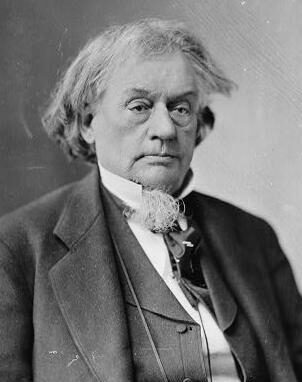
Constitutional Union Party
The Constitutional Union Party is a United States third party (1860–1861). It was founded in 1859. Its headquarters are in Atlanta. It stands for American nationalism and conservatism.
- Country
- United States
- Founded
- 1859
- Ideology
- American nationalism
- Chair
- John Bell
All 10 facts, and where they come from
Facts
10 facts · 0 confirmed by two sources · 0 cited · 10 from one source
Where this comes from
Papalocal keeps its own record. It started from these sources; what each one said is kept here as it was copied, so a change on their side never changes this page by itself. Tap one to read its version.
What Wikidata says · copied November 19, 2026 · revision 2549925925
- Described as
- United States third party (1860–1861)
- What it is
- political party
- Comes after
- Whig Party
- Followed by
- National Union Party
- Founded
- 1859
- Ended
- 1861 · 1 reference
- Headquarters
- Atlanta
- Country
- United States
- Chair
- John Bell · 1 reference
- Ideology
- American nationalism; conservatism
- Wikipedias with a page
- 16
Wikidata item Q1128268 (wikidata.org/wiki/Q1128268), public domain (CC0). Copied 2026-11-19.
What Wikipedia says · copied November 19, 2026 · revision 1385023865
The Constitutional Union Party was a political party which ran in the 1860 United States elections. It mostly consisted of conservative former Whigs from the Southern United States who wanted to avoid secession over slavery and refused to join either the Republican Party or Democratic Party. The Constitutional Union Party campaigned on a simple platform "to recognize no political principle other than the Constitution of the country, the Union of the states, and the Enforcement of the Laws".
The Whig Party collapsed in the 1850s due to a series of crises over slavery. Many former Whigs joined the new, anti-slavery Republican Party, but others joined the nativist American Party, colloquially referred to as the "Know Nothings". The American Party declined after the 1856 elections, and for the 1860 elections John J. Crittenden and other former Whigs formed the Constitutional Union Party.
The party's 1860 convention nominated John Bell of Tennessee – a slaveholder, but an opponent in the 1850s of the expansion of slavery into the territories – for president and Edward Everett of Massachusetts for vice president. Party leaders hoped to force a contingent election, in which no candidate received a majority of electors in the Electoral College, moving the decision into the House of Representatives, as described in Article Two, Section 1, Clause 3 of the United States Constitution and modified in 1804 by the Twelfth Amendment.
The 1860 election essentially consisted of two separate elections, as Republican nominee Abraham Lincoln competed with Northern Democratic candidate Stephen A. Douglas in the North, and Bell competed with Southern Democratic candidate John C. Breckinridge in the South. (Lincoln was not even on the ballot in the Deep South.) Ultimately, Lincoln won the election by winning nearly every Northern electoral vote. Bell took 12.6% of the nationwide popular vote, carrying Kentucky, Tennessee, and Virginia, and finishing with the second highest vote total in each remaining slave state that held a popular vote. (South Carolina's electors were chosen by the state legislature, the only remaining state to use this method and the last election in which it was used.)
After the election, Crittenden and other Constitutional Unionists unsuccessfully sought to prevent a civil war with the Crittenden Compromise and the Peace Conference of 1861. Bell declared his support for the Confederacy following the Battle of Fort Sumter, but many other Constitutional Unionists remained loyal to the Union throughout the Civil War.
From the Wikipedia article “Constitutional Union Party (United States)” (en.wikipedia.org/wiki/Constitutional_Union_Party_(United_States)), by its contributors, under CC BY-SA 4.0 (creativecommons.org/licenses/by-sa/4.0/). Copied 2026-11-19; not changed.
Confirmed Two sources agree. Cited One source, and it names where it got it. One source One source, without a reference of its own. Sources disagree The sources disagree. We show the best-supported value and keep theirs below.