
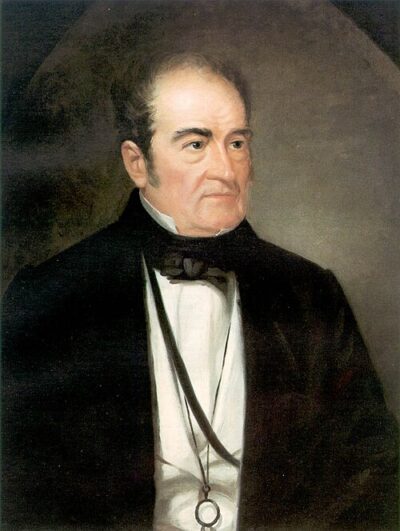
John Bell
John Bell was an American lawyer and politician. Born February 18, 1796, in Nashville. Died September 10, 1869, in Stewart County. Positions held include United States representative (1827–1841), member of the State Senate of Tennessee and member of the Tennessee House of Representatives. Educated at University of Nashville and Cumberland University.
Facts
20 facts · 2 confirmed by two sources · 3 cited · 15 from one source
Where this comes from
Papalocal keeps its own record. It started from these sources; what each one said is kept here as it was copied, so a change on their side never changes this page by itself. Tap one to read its version.
What Wikidata says · copied November 18, 2026 · revision 2562736293
- Described as
- American lawyer and politician (1796–1869)
- Born
- February 18, 1796 · 1 reference
- Died
- September 10, 1869 · 1 reference
- Born in
- Nashville
- Died in
- Stewart County
- Buried in
- Mount Olivet Cemetery · 1 reference
- Citizen of
- United States
- Occupation
- politician; lawyer
- Positions held
- United States representative (1827–1841); member of the State Senate of Tennessee; member of the Tennessee House of Representatives; United States Secretary of War (1841); Speaker of the United States House of Representatives (1834–1835); United States senator (1847–1859) · 1 reference
- Political party
- Democratic-Republican Party; Democratic Party; Whig Party
- Education
- University of Nashville; Cumberland University · 1 reference
- Children
- Sarah "Sallie" Keeble · 1 reference
- Wikipedias with a page
- 19
Wikidata item Q1349142 (wikidata.org/wiki/Q1349142), public domain (CC0). Copied November 18, 2026.
What Wikipedia says · copied November 18, 2026 · revision 1367545362
John Bell (February 18, 1796 – September 10, 1869) was an American politician, attorney, and planter who was a candidate for President of the United States in the election of 1860.
One of Tennessee's most prominent antebellum politicians, Bell served in the House of Representatives from 1827 to 1841, and in the Senate from 1847 to 1859. He was Speaker of the House for the 23rd Congress (1834–1835), and briefly served as Secretary of War during the administration of William Henry Harrison (1841). In 1860, he ran for president as the candidate of the Constitutional Union Party, a third party which took a neutral stance on the issue of slavery. He won the electoral votes of three states by a slim margin.
Initially an ally of Andrew Jackson, Bell turned against Jackson in the mid-1830s and aligned himself with the National Republican Party and then the Whig Party, a shift that earned him the nickname "The Great Apostate". He consistently battled Jackson's allies, namely James K. Polk, over issues such as the national bank and the election spoils system. Following the death of Hugh Lawson White in 1840, Bell became the acknowledged leader of Tennessee's Whigs.
Although a slaveholder, Bell was one of the few Southern politicians to oppose the expansion of slavery to the territories in the 1850s, and he campaigned vigorously against secession in the years leading up to the American Civil War. During his 1860 presidential campaign, he argued that secession was unnecessary since the Constitution protected slavery, an argument that resonated with voters in border states, helping him capture the electoral votes of Tennessee, Kentucky, and Virginia. After the Battle of Fort Sumter in April 1861, marking the beginning of the Civil War, Bell abandoned the Union cause and supported the Confederacy.
- Born, in its opening lines
- February 18, 1796
- Died, in its opening lines
- September 10, 1869
From the Wikipedia article “John Bell (Tennessee politician)” (en.wikipedia.org/wiki/John_Bell_(Tennessee_politician)), by its contributors, under CC BY-SA 4.0 (creativecommons.org/licenses/by-sa/4.0/). Copied November 18, 2026; not changed.
Confirmed Two sources agree. Cited One source, and it names where it got it. One source One source, without a reference of its own. Sources disagree The sources disagree. We show the best-supported value and keep theirs below.
