Council of Ministers of the USSR
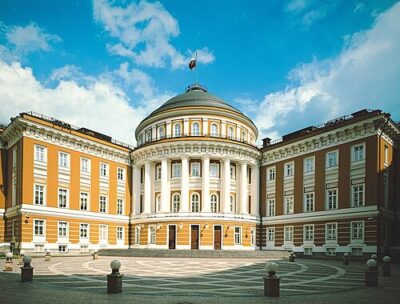
The Council of Ministers of the USSR is the highest executive and administrative body of the Soviet Union. It was founded in 1946. Its headquarters are in the Kremlin Senate.
- Founded
- March 15, 1946
- Headquarters
- Kremlin Senate
- Country
- Soviet Union
All 7 facts, and where they come from
Facts
7 facts · 0 confirmed by two sources · 0 cited · 7 from one source
Where this comes from
Papalocal keeps its own record. It started from these sources; what each one said is kept here as it was copied, so a change on their side never changes this page by itself. Tap one to read its version.
What Wikidata says · copied November 17, 2026 · revision 2553080690
- Described as
- highest executive and administrative body of the Soviet Union
- Other names
- Council of Ministers of the Union of Soviet Socialist Republics, Council of Ministers of the Soviet Union, Soviet of Ministers, Sovmin, Council of Ministers (Soviet Union)
- What it is
- soviet
- Founded
- March 15, 1946
- Ended
- February 1, 1991 · 1 reference
- Headquarters
- Kremlin Senate
- Country
- Soviet Union
- Part of
- Supreme Soviet of the Soviet Union · 1 reference
- Office of
- Soviet Union
- Wikipedias with a page
- 36
Wikidata item Q2128 (wikidata.org/wiki/Q2128), public domain (CC0). Copied 2026-11-17.
What Wikipedia says · copied November 17, 2026 · revision 1368368469
The Council of Ministers of the Union of Soviet Socialist Republics (Russian: Совет министров СССР, romanized: Sovet ministrov SSSR, IPA: [sɐˈvʲet mʲɪˈnʲistrəf ˌɛsˌɛsˌɛsˈɛr]) was the highest executive and administrative organ of state authority of the Union of Soviet Socialist Republics (USSR) from 1946 until 1991.
During 1946 the Council of People's Commissars was reorganized as the Council of Ministers. Accordingly, the People's Commissariats were renamed as Ministries. The council issued declarations and instructions based on and in accordance with applicable laws, which had obligatory jurisdictional power in all republics of the Union. However, the most important decisions were made by joint declarations with the Central Committee of the Communist Party of Soviet Union (CPSU), which was de facto more powerful than the Council of Ministers. During 1991 the Council of Ministers was dissolved, and replaced by the newly established "Cabinet of Ministers", which itself disappeared only months later when the USSR was disbanded.
There were seven Chairmen of the Council of Ministers between 1946 and early 1991, who were in effect the Premier of the USSR. After Nikita Khrushchev's dismissal from the jobs of First Secretary of the Communist Party and Premier, to be replaced by Leonid Brezhnev and Alexei Kosygin respectively, a Central Committee plenum forbade any person to hold the positions of First Secretary and Premier concurrently.
The Presidium of the Council of Ministers was the collective decision-making body of government. The Chairman of the Council of Ministers, his First Deputy Chairmen, Deputy Chairmen, ministers, State Committee chairmen, Soviet Republican Council of Ministers chairmen and other unspecified personnel were members of the Presidium.
From the Wikipedia article “Council of Ministers of the Soviet Union” (en.wikipedia.org/wiki/Council_of_Ministers_of_the_Soviet_Union), by its contributors, under CC BY-SA 4.0 (creativecommons.org/licenses/by-sa/4.0/). Copied 2026-11-17; not changed.
Confirmed Two sources agree. Cited One source, and it names where it got it. One source One source, without a reference of its own. Sources disagree The sources disagree. We show the best-supported value and keep theirs below.
Picture: Presidential Press and Information Office, via Wikimedia Commons · CC BY 4.0