

White movement
The White movement is a major faction in the Russian Civil War. It was founded in 1917. It stands for anti-communism, anti-Sovietism and Russian nationalism.
- Country
- Russian Empire
- Founded
- 1917
- Ideology
- anti-communism
- Chair
- Provisional All-Russian Government
All 10 facts, and where they come from
Facts
10 facts · 0 confirmed by two sources · 0 cited · 10 from one source
Where this comes from
Papalocal keeps its own record. It started from these sources; what each one said is kept here as it was copied, so a change on their side never changes this page by itself. Tap one to read its version.
What Wikidata says · copied November 17, 2026 · revision 2557010135
- Described as
- major faction in the Russian Civil War
- Other names
- White Army, the Whites, White Guard, White Russia, Russian Whites, Whites
- What it is
- political faction; political colour
- Founded
- 1917
- Ended
- 1922
- Country
- Russian Empire
- Chair
- Provisional All-Russian Government · 1 reference; Alexander Kolchak · 1 reference
- Ideology
- anti-communism; anti-Sovietism; Russian nationalism
- Wikipedias with a page
- 49
Wikidata item Q104309 (wikidata.org/wiki/Q104309), public domain (CC0). Copied 2026-11-17.
What Wikipedia says · copied November 17, 2026 · revision 1386083755
The White movement, also known as the Whites, was one of the main factions of the Russian Civil War of 1917–1922. It was led mainly by the right-wing and conservative officers of the Russian Empire, while the Bolsheviks who led the October Revolution in Russia, also known as the Reds, and their supporters, were regarded as the main enemies of the Whites. It operated as a system of governments and administrations united as the Russian State, which functioned as a military dictatorship throughout most of its existence, and military formations collectively referred to as the White Army, or the White Guard.
Although the White movement included a variety of political opinions in Russia opposed to the Bolsheviks, from the republican-minded liberals through monarchists to the ultra-nationalist Black Hundreds, and lacked a universally-accepted doctrine, the main force behind the movement were the conservative officers. The resulting movement shared many traits with widespread right-wing counter-revolutionary movements of the time, namely nationalism, racism, distrust of liberal and democratic politics, clericalism, contempt for the common man and dislike of industrial civilization. In November 1918, the movement united on an authoritarian-right platform around the figure of Alexander Kolchak as its principal leader. It generally defended the order of pre-revolutionary Imperial Russia, although the ideal of the movement was a mythical "Holy Russia", what was a mark of its religious understanding of the world. The positive program of the movement was largely summarized in the slogan of "united and indivisible Russia" which meant the restoration of imperial state borders, and its denial of the right to self-determination. The Whites are associated with pogroms and antisemitism; while the relations with the Jews featured a certain complexity, the movement was largely antisemitic, with the White generals viewing the Revolution as a result of a Jewish conspiracy. Antisemitism and more broad nationalism and xenophobia of the movement were manifested in the acts of the White Terror, which often targeted non-Russian ethnic groups of the former Russian Empire.
Some historians distinguish the White movement from the so-called "democratic counter-revolution" led mainly by the Right SRs and the Mensheviks that adhered to the values of parliamentary democracy and maintained anti-Bolshevik governments (Komuch, Ufa Directory) advocating for these values until November 1918, and then supported either the Whites or the Bolsheviks or opposed both factions, making attempts to overthrow the White administrations and create ones of their own, such as the "Political Centre" in 1920.
Following the military defeat of their movement, the Whites expelled from the USSR attempted to continue the struggle by creating armed groups which would wage guerilla warfare in the USSR. Some of the former White commanders also hoped to depose the Soviet authorities by means of collaboration with Nazi Germany during World War II. In exile, remnants and continuations of the movement remained in several organizations, some of which only had narrow support, enduring within the wider White émigré overseas community until after the fall of the European communist states in the Eastern European Revolutions of 1989 and the subsequent dissolution of the Soviet Union in 1990–1991. This community-in-exile of anti-communists often divided into liberal and the more conservative segments, with some still hoping for the restoration of the Romanov dynasty.
From the Wikipedia article “White movement” (en.wikipedia.org/wiki/White_movement), by its contributors, under CC BY-SA 4.0 (creativecommons.org/licenses/by-sa/4.0/). Copied 2026-11-17; not changed.
Confirmed Two sources agree. Cited One source, and it names where it got it. One source One source, without a reference of its own. Sources disagree The sources disagree. We show the best-supported value and keep theirs below.
Picture: Wikimedia Commons: Personal convoy of May-Mayevsky dances lezginka(1919).jpg · See Commons file page
People connected 4
Party members
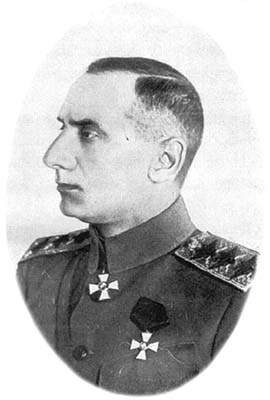 Alexander KolchakRussian admiral and military leader of the White movement (1874-1920)
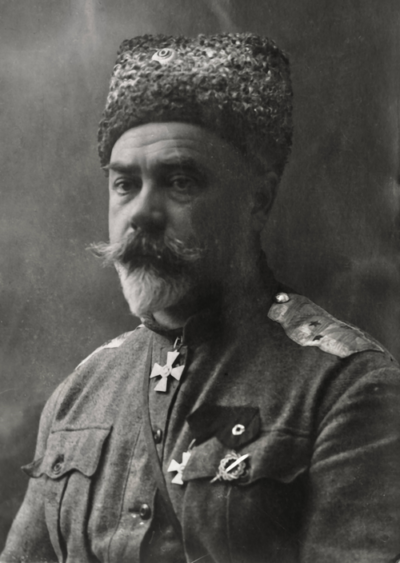 Anton DenikinRussian military and political leader (1872–1947)
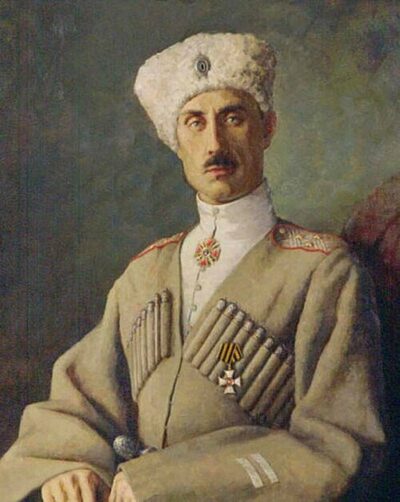 Pyotr WrangelRussian army general of Baltic German origin (1878-1928)

