
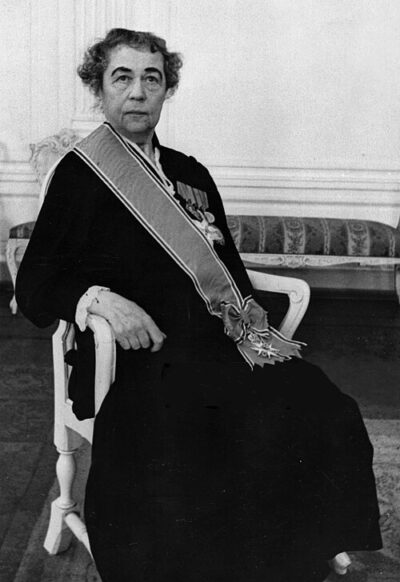
A. Kollontaĭ
A. Kollontaĭ was a Soviet revolutionary, ambassador, diplomat, feminist. Born March 19, 1872, in Saint Petersburg. Died March 9, 1952, in Bahía Blanca. Positions held include Member of the Russian Constituent Assembly (1918), ambassador (1943–1945) and minister (1917–1918). Educated at University of Zurich. Awards include Order of Lenin, Order of the Red Banner of Labour and Order of the Aztec Eagle.
Facts
35 facts · 1 confirmed by two sources · 14 cited · 19 from one source · 1 where the sources disagree
What’s different
- Born: we show March 19, 1872 (Sources disagree). Wikipedia says March 31, 1872
Where this comes from
Papalocal keeps its own record. It started from these sources; what each one said is kept here as it was copied, so a change on their side never changes this page by itself. Tap one to read its version.
What Wikidata says · copied November 16, 2026 · revision 2568544571
- Described as
- Soviet revolutionary, ambassador, diplomat, feminist
- Other names
- Alexandra Mikhaylovna Kollontay, Alexandra Mikhailovna Kollontai, Alexandra Kollontai, Alekcāṇṭirā Kolaṇṭai, Alexandra Kollantai, Aleksandra Kollontai, Aleksandra Mikhaĭlovna Kollontaĭ, Alexandra Michajlovna Kollontaj, A. Kollontajová, Alexandra Kollontajová, Aleksandra Mikhaylovna Kollontay, Alexandra Kollontay
- Born
- March 19, 1872 · 1 reference
- Died
- March 9, 1952 · 12 references
- Born in
- Saint Petersburg · 3 references
- Died in
- Bahía Blanca · 3 references
- Buried in
- Novodevichy Cemetery · 1 reference
- Cause of death
- myocardial infarction
- Name at birth
- Александра Михайловна Домонтович
- Citizen of
- Russian Empire; Soviet Union
- Occupation
- revolutionary · 1 reference; diplomat · 1 reference; women's rights activist; writer · 1 reference; political theorist; People's Commissar (1917–1918); sociologist; politician · 1 reference
- Positions held
- Member of the Russian Constituent Assembly (1918); ambassador (1943–1945); minister (1917–1918); chargé d'affaires (1924); minister plenipotentiary (1924–1943); envoy extraordinary and minister plenipotentiary (1927–) · 1 reference
- Political party
- Russian Social Democratic Labour Party; Communist Party of the Soviet Union
- Education
- University of Zurich
- Member of
- Workers' Opposition
- Awards
- Order of Lenin (1933) · 1 reference; Order of the Red Banner of Labour · 1 reference; Order of the Aztec Eagle (1944) · 2 references; Knight Grand Cross of the Order of St. Olav (1946) · 2 references
- Field
- international relations
- Spouse
- Vladimir Liudvigovich Kollontay · 1 reference; Pavel Dybenko · 2 references
- Father
- Mikhail Domontovich
- Wikipedias with a page
- 86
Wikidata item Q179558 (wikidata.org/wiki/Q179558), public domain (CC0). Copied November 16, 2026.
What Wikipedia says · copied November 16, 2026 · revision 1375444738
Alexandra Mikhailovna Kollontai (Russian: Александра Михайловна Коллонтай; née Domontovich [Домонтович]; 31 March [O.S. 19 March] 1872 – 9 March 1952) was a Russian revolutionary, politician, diplomat and Marxist theoretician. Serving as People's Commissar for Welfare in Vladimir Lenin's government in 1917–1918, she was a highly prominent woman within the Bolshevik party. She was the first woman in history to be a cabinet minister, and one of the first women to be appointed as a diplomatic representative of a modern state, and the first to be promoted to the rank of ambassador.
The daughter of an Imperial Russian Army general, Kollontai embraced radical politics in the 1890s and joined the Russian Social Democratic Labour Party (RSDLP) in 1899. During the RSDLP ideological split, she sided with Julius Martov's Mensheviks against Lenin's Bolsheviks. Exiled from Russia in 1908, Kollontai toured Western Europe and the United States and campaigned against participation in the First World War. In 1915, she broke with the Mensheviks and became a member of the Bolsheviks.
Following the 1917 February Revolution which ousted Emperor Nicholas II, Kollontai returned to Russia. She supported Lenin's radical proposals and, as a member of the party's Central Committee, voted for the policy of armed uprising which led to the October Revolution and the fall of Alexander Kerensky's Provisional Government. She was appointed People's Commissar for Social Welfare in the first Soviet government, but soon resigned due to her opposition to the peace treaty of Brest-Litovsk in the ranks of the Left Communists.
In 1919, Kollontai was a leading figure in the foundation of the Zhenotdel, the then-new women's department of the Central Committee that was aimed at improving the status of women in the Soviet Union. She was a champion of women's liberation, and later came to be recognized as a key figure in Marxist feminism.
Kollontai was outspoken against bureaucratic influences over the Communist Party and its undemocratic internal practices. To that end, she sided with the left-wing Workers' Opposition in 1920, but was eventually defeated and sidelined, narrowly avoiding her own expulsion from the party altogether. From 1922 on, she was appointed to various diplomatic posts abroad, serving in Norway, Mexico and Sweden. This period in her life is captured in the writing of fellow Plenipotentiary from Spain, Isabel de Palencia, titled Alexandra Kollontay, Ambassadress from Russia, published in 1947. In 1943, she was promoted to the title of ambassador to Sweden. Kollontai retired from diplomatic service in 1945 and died in Moscow in 1952.
- Born, in its opening lines
- March 31, 1872
- Died, in its opening lines
- March 9, 1952
From the Wikipedia article “Alexandra Kollontai” (en.wikipedia.org/wiki/Alexandra_Kollontai), by its contributors, under CC BY-SA 4.0 (creativecommons.org/licenses/by-sa/4.0/). Copied November 16, 2026; not changed.
Confirmed Two sources agree. Cited One source, and it names where it got it. One source One source, without a reference of its own. Sources disagree The sources disagree. We show the best-supported value and keep theirs below.
