
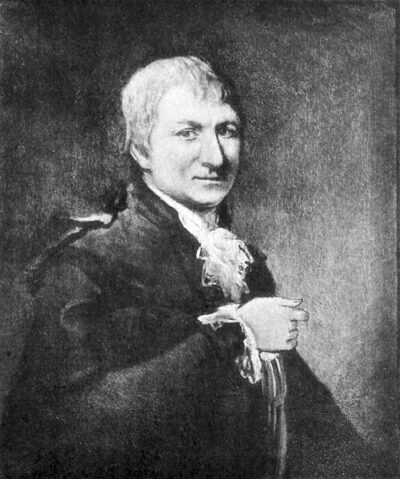
Adam Afzelius
Adam Afzelius was a Swedish botanist. Born October 7, 1750, in Larv parish. Died January 30, 1837, in Uppsala Cathedral Assembly. Positions held include professor. Awards include Fellow of the Royal Society.
Facts
26 facts · 0 confirmed by two sources · 6 cited · 18 from one source · 2 where the sources disagree
What’s different
- Born: we show October 7, 1750 (Sources disagree). Wikipedia says October 8, 1750
- Died: we show January 30, 1837 (Sources disagree). Wikipedia says January 20, 1837
Where this comes from
Papalocal keeps its own record. It started from these sources; what each one said is kept here as it was copied, so a change on their side never changes this page by itself. Tap one to read its version.
What Wikidata says · copied November 16, 2026 · revision 2568558819
- Described as
- Swedish botanist (1750-1837)
- Other names
- Afzel., A. Afzelius, Adam von Afzelius, A. v. Afzelius
- Born
- October 7, 1750 · 3 references
- Died
- January 30, 1837 · 2 references
- Born in
- Larv parish · 2 references
- Died in
- Uppsala Cathedral Assembly · 2 references
- Buried in
- Uppsala Old Cemetery · 1 reference
- Citizen of
- Sweden
- Occupation
- botanist · 2 references; zoologist; pteridologist; university teacher; entomologist; mycologist; orientalist; botanical collector · 6 references
- Positions held
- professor
- Worked for
- Uppsala University
- Member of
- Royal Society of London (1798–); German Academy of Sciences Leopoldina; Royal Swedish Academy of Sciences
- Awards
- Fellow of the Royal Society
- Field
- botany; zoology
- Spouse
- Anna Sofia Dassau
- Father
- Arvid Afzelius · 2 references
- Siblings
- Johan Afzelius; Per von Afzelius
- Wikipedias with a page
- 32
Wikidata item Q347903 (wikidata.org/wiki/Q347903), public domain (CC0). Copied November 16, 2026.
What Wikipedia says · copied November 16, 2026 · revision 1369705768
Adam Afzelius (8 October 1750 – 20 January 1837) was a Swedish botanist and zoologist, and an apostle of Carl Linnaeus. Afzelius was born at Larv in Västergötland in 1750. He was appointed teacher of oriental languages at Uppsala University in 1777, and in 1785 demonstrator of botany. In 1793 he was elected a member of the Royal Swedish Academy of Sciences. In 1800, Adam Afzelius became member of the German Academy of Sciences Leopoldina.
Between 1792 and 1796, as part of the Sierra Leone Company, he made two journeys to West Africa, where he reported on the geography, climate and natural resources of the region. While there, he also collected botanical specimens that were later acquired by Uppsala University.
In 1797–98, he acted as secretary of the Swedish embassy in London and on 19 April 1798, he was elected Fellow of the Royal Society. Returning to Sweden, he again took up his position as botanices demonstrator at Uppsala, and was in 1802 elected president of the "Zoophytolithic Society" (later called the Linnaean Institute). In 1812 he became professor of materia medica at the university. He died in Uppsala in 1837. In addition to various botanical writings, he published the autobiography of Carl Linnaeus in 1823.
His brother, Johan Afzelius (1753–1837), was professor of chemistry at Uppsala; and another brother, Pehr von Afzelius (1760–1843; the "von" was added when he was ennobled), who became a professor of medicine at Uppsala in 1801, was distinguished as a medical teacher and practitioner.
The botanical genus Afzelia (subfamily Caesalpinioideae) commemorates his name, and in 1857, the plant species Anubias afzelii was named after him by Heinrich Wilhelm Schott. The standard author abbreviation Afzel. is used to indicate this person as the author when citing a botanical name.
- Born, in its opening lines
- October 8, 1750
- Died, in its opening lines
- January 20, 1837
From the Wikipedia article “Adam Afzelius” (en.wikipedia.org/wiki/Adam_Afzelius), by its contributors, under CC BY-SA 4.0 (creativecommons.org/licenses/by-sa/4.0/). Copied November 16, 2026; not changed.
Confirmed Two sources agree. Cited One source, and it names where it got it. One source One source, without a reference of its own. Sources disagree The sources disagree. We show the best-supported value and keep theirs below.
