
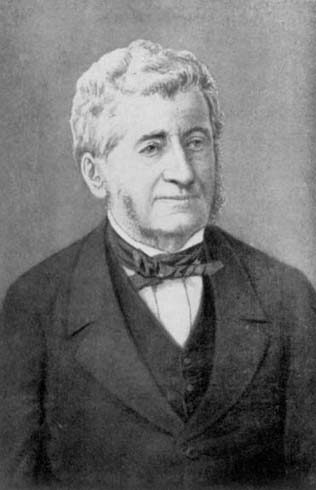
Adolphe-Théodore Brongniart
Adolphe-Théodore Brongniart was a French botanist. Born January 14, 1801, in Paris. Died February 18, 1876, in Paris. Positions held include president (1854–1855) and president of the French Academy of Sciences (1847). Awards include Knight of the Legion of Honour, Officer of the Legion of Honour and Commander of the Legion of Honour.
Facts
35 facts · 2 confirmed by two sources · 7 cited · 25 from one source · 1 where the sources disagree
What’s different
- Died: we show February 18, 1876 (Confirmed). Wikidata also lists February 19, 1876
- Buried in: we show Père Lachaise Cemetery (Sources disagree). Wikidata also lists Grave of Brongniart
Where this comes from
Papalocal keeps its own record. It started from these sources; what each one said is kept here as it was copied, so a change on their side never changes this page by itself. Tap one to read its version.
What Wikidata says · copied November 17, 2026 · revision 2569051540
- Described as
- French botanist (1801-1876)
- Other names
- Adolphe Théodore Brongniart, Brongn., Adolphe-Theodore Brongniart, Adolphe Theodore Brongniart, Adolphe Brongniart
- Born
- January 14, 1801 · 7 references
- Died
- February 18, 1876 · 8 references; February 19, 1876 · 2 references
- Born in
- Paris · 2 references
- Died in
- Paris · 1 reference
- Buried in
- Père Lachaise Cemetery; Grave of Brongniart
- Name at birth
- Adolphe Théodore Brongniart
- Citizen of
- France
- Occupation
- botanist · 1 reference; paleontologist · 1 reference; geologist · 1 reference; botanical collector · 1 reference
- Positions held
- president (1854–1855); president of the French Academy of Sciences (1847)
- Worked for
- Muséum national d'histoire naturelle
- Member of
- Royal Society of London (1852–) · 1 reference; Royal Swedish Academy of Sciences; French Academy of Sciences; Saint Petersburg Academy of Sciences; Société botanique de France; Bavarian Academy of Sciences and Humanities; Russian Academy of Sciences; Royal Prussian Academy of Sciences; Academy of Sciences of Turin (1828–) · 1 reference; Royal Society of Edinburgh (1874–) · 1 reference
- Awards
- Knight of the Legion of Honour; Officer of the Legion of Honour; Commander of the Legion of Honour (1864–); Foreign Member of the Royal Society (1852) · 1 reference; Wollaston Medal (1841) · 1 reference
- Field
- botany
- Children
- Édouard-Charles Brongniart
- Father
- Alexandre Brongniart
- Mother
- Cécile Coquebert de Montbret
- Siblings
- Mathilde-Émilie Brongniart; Herminie-Caroline Brongniart
- Wikipedias with a page
- 27
Wikidata item Q73990 (wikidata.org/wiki/Q73990), public domain (CC0). Copied November 17, 2026.
What Wikipedia says · copied November 17, 2026 · revision 1363652271
Adolphe-Théodore Brongniart (French: [adɔlf teodɔːʁ bʁɔ̃ɲaːʁ]) FRS FRSE FGS (14 January 1801 – 18 February 1876) was a French botanist. He was the son of the geologist Alexandre Brongniart and grandson of the architect, Alexandre-Théodore Brongniart. Brongniart's pioneering work on the relationships between extinct and existing plants has earned him the title of father of paleobotany. His major work on plant fossils was his Histoire des végétaux fossiles (1828–37). He wrote his dissertation on the Buckthorn family (Rhamnaceae), an extant family of flowering plants, and worked at the Muséum national d'Histoire naturelle in Paris until his death. In 1851, he was elected a foreign member of the Royal Swedish Academy of Sciences. This botanist is denoted by the author abbreviation Brongn. when citing a botanical name.
- Born, in its opening lines
- January 14, 1801
- Died, in its opening lines
- February 18, 1876
From the Wikipedia article “Adolphe-Théodore Brongniart” (en.wikipedia.org/wiki/Adolphe-Théodore_Brongniart), by its contributors, under CC BY-SA 4.0 (creativecommons.org/licenses/by-sa/4.0/). Copied November 17, 2026; not changed.
Confirmed Two sources agree. Cited One source, and it names where it got it. One source One source, without a reference of its own. Sources disagree The sources disagree. We show the best-supported value and keep theirs below.
