
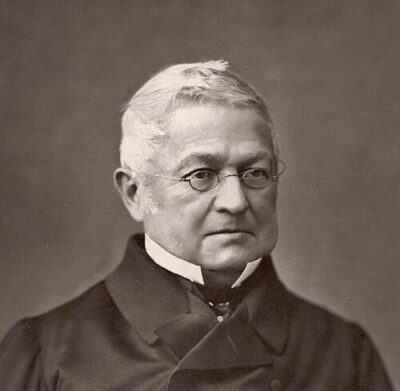
Adolphe Thiers
Adolphe Thiers was a President of France from 1871 to 1873. Born April 15, 1797, in Marseille. Died September 3, 1877, in Saint-Germain-en-Laye. Positions held include President of the French Republic (1871–1873), member of the National Assembly (1830–1848) and French co-prince of Andorra (1871–1873). Known for The History of the French Revolution. Educated at Lycée Thiers and Aix-Marseille University. Awards include Grand Cross of the Legion of Honour, Knight of the Order of the Golden Fleece and Grand Master of the Legion of Honour.
Facts
48 facts · 2 confirmed by two sources · 17 cited · 29 from one source
Where this comes from
Papalocal keeps its own record. It started from these sources; what each one said is kept here as it was copied, so a change on their side never changes this page by itself. Tap one to read its version.
What Wikidata says · copied November 16, 2026 · revision 2568845343
- Described as
- President of France from 1871 to 1873 (1797-1877)
- Other names
- Louis-Adolphe Thiers, Marie Joseph Louis Adolphe Thiers, Louis Adolphe Thiers
- Born
- April 15, 1797 · 5 references
- Died
- September 3, 1877 · 17 references
- Born in
- Marseille · 5 references
- Died in
- Saint-Germain-en-Laye · 4 references
- Buried in
- Père Lachaise Cemetery (1887–) · 1 reference
- Cause of death
- stroke
- Name at birth
- Marie-Joseph-Louis-Adolphe Thiers
- Citizen of
- France
- Occupation
- lawyer; politician · 2 references; journalist · 2 references; historian · 2 references; writer · 1 reference
- Positions held
- President of the French Republic (1871–1873); member of the National Assembly (1830–1848) · 1 reference; French co-prince of Andorra (1871–1873); head of government of France (3 times) (1836–1848); senator of the French Third Republic · 1 reference; Member of the Académie française (1833–1877); Member of the 1848 Constituent Assembly (1848–1849) · 1 reference; Deputy of the French Second Republic (1849–1851) · 1 reference; Deputy of the Corps législatif (1863–1870) · 1 reference; member of the National Assembly (1871–1876) · 1 reference; Deputy of the French Third Republic (1876–1877) · 1 reference
- Political party
- Orléanism
- Education
- Lycée Thiers; Aix-Marseille University · 1 reference; Paul Cézanne University
- Member of
- Académie Française (1833–); Hungarian Academy of Sciences; Académie des Sciences Morales et Politiques; American Academy of Arts and Sciences; Société de l'histoire de France; Academy of Sciences of Turin (1848–) · 1 reference; Accademia Nazionale dei Lincei (1876–) · 1 reference
- Known for
- The History of the French Revolution
- Awards
- Grand Cross of the Legion of Honour (1871); Knight of the Order of the Golden Fleece; Grand Master of the Legion of Honour; Order of the Cross of July; Fellow of the American Academy of Arts and Sciences; Grand Officer of the Legion of Honour · 1 reference; Commander of the Legion of Honour · 1 reference; Officer of the Legion of Honour · 1 reference; Knight of the Legion of Honour · 1 reference; Order of the Golden Fleece · 1 reference
- Spouse
- Élise Thiers · 1 reference
- Religion
- Catholicism · 1 reference
- Wikipedias with a page
- 85
Wikidata item Q5738 (wikidata.org/wiki/Q5738), public domain (CC0). Copied November 16, 2026.
What Wikipedia says · copied November 16, 2026 · revision 1373548660
Marie Joseph Louis Adolphe Thiers ( tee-AIR; French: [maʁi ʒozɛf lwi adɔlf tjɛʁ]; 15 April 1797 – 3 September 1877) was a French statesman and historian who served as President of France from 1871 to 1873. He was the second elected president and the first of the Third French Republic.
Thiers was a key figure in the July Revolution of 1830, which overthrew King Charles X in favor of the more liberal King Louis Philippe, and the Revolution of 1848, which overthrew the July Monarchy and established the Second French Republic. He served as a prime minister in 1836 and 1840, dedicated the Arc de Triomphe, and arranged the return to France of the remains of Napoleon from Saint-Helena. He was first a supporter, then a vocal opponent of Louis-Napoléon Bonaparte (who served from 1848 to 1852 as President of the Second Republic and then reigned as Emperor Napoleon III from 1852 to 1871). When Napoleon III seized power, Thiers was arrested and briefly expelled from France. He then returned and became an opponent of the government.
Following the defeat of France in the Franco-Prussian War, which he opposed, Thiers was elected chief executive of the new French government and negotiated the end of the war. When the Paris Commune seized power in March 1871, Thiers gave the orders to the army for its suppression. At the age of seventy-four, he was named president of the Republic by the French National Assembly in August 1871. His chief accomplishment as president was to achieve the departure of German soldiers from most of French territory two years ahead of schedule. Opposed by the monarchists in the French National Assembly and the left wing of the republicans, he resigned on 24 May 1873, and was replaced as president by Patrice de MacMahon. When he died in 1877, his funeral became a major political event; the procession was led by two of the leaders of the republican movement, Victor Hugo and Léon Gambetta, who at the time of his death were his allies against the conservative monarchists.
Thiers was also a notable popular historian. He wrote the first large scale history of the French Revolution in 10 volumes, published 1823–1827. Historian Robert Tombs states it was, "A bold political act during the Bourbon Restoration...and it formed part of an intellectual upsurge of liberals against the counter-revolutionary offensive of the Ultra Royalists." He also wrote a twenty-volume history of the Consulate and Empire of Napoleon Bonaparte (Histoire du Consulat et de l'Empire). In 1834, he was elected to the Académie Française.
- Born, in its opening lines
- April 15, 1797
- Died, in its opening lines
- September 3, 1877
From the Wikipedia article “Adolphe Thiers” (en.wikipedia.org/wiki/Adolphe_Thiers), by its contributors, under CC BY-SA 4.0 (creativecommons.org/licenses/by-sa/4.0/). Copied November 16, 2026; not changed.
Confirmed Two sources agree. Cited One source, and it names where it got it. One source One source, without a reference of its own. Sources disagree The sources disagree. We show the best-supported value and keep theirs below.
