
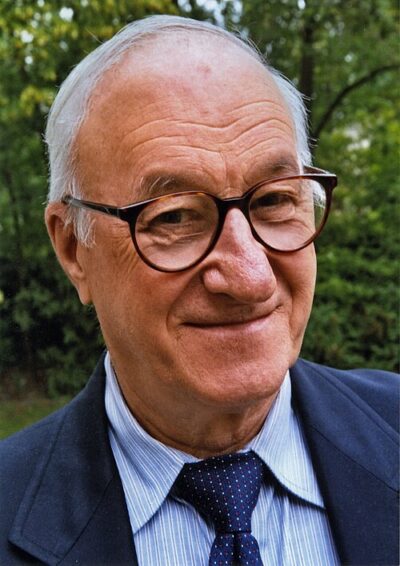
Albert Bandura
Albert Bandura was a Canadian psychologist. Born December 4, 1925, in Mundare. Died July 26, 2021, in Stanford. Positions held include President of the American Psychological Association (1974). Educated at University of British Columbia and University of Iowa. Awards include Guggenheim Fellowship, Grawemeyer Awards and National Medal of Science.
Facts
34 facts · 2 confirmed by two sources · 17 cited · 15 from one source
Where this comes from
Papalocal keeps its own record. It started from these sources; what each one said is kept here as it was copied, so a change on their side never changes this page by itself. Tap one to read its version.
What Wikidata says · copied November 13, 2026 · revision 2568383046
- Described as
- Canadian psychologist (1925–2021)
- Born
- December 4, 1925 · 6 references
- Died
- July 26, 2021 · 3 references
- Born in
- Mundare · 2 references
- Died in
- Stanford
- Cause of death
- heart failure · 1 reference
- Citizen of
- Canada; United States
- Occupation
- psychologist · 1 reference; university teacher; educator · 1 reference
- Positions held
- President of the American Psychological Association (1974) · 1 reference
- Worked for
- Stanford University (1953–2021)
- Education
- University of British Columbia (–1949); University of Iowa (–1951)
- Member of
- American Academy of Arts and Sciences; American Psychological Association
- Awards
- Guggenheim Fellowship · 1 reference; Grawemeyer Awards (2008); National Medal of Science (2014); Career Achievement Award for Distinguished Psychological Contributions to Education (1999) · 1 reference; Officer of the Order of Canada (2014); William James Fellow Award (1989) · 1 reference; James McKeen Cattell Fellow Award (2003) · 1 reference; APA Award for Outstanding Lifetime Contributions to Psychology (2004) · 1 reference; APA Award for Distinguished Scientific Contributions to Psychology (1980) · 1 reference; honorary doctorate of the University of Salamanca (1991) · 1 reference; Honorary doctor of the Free University of Berlin; Fellow of the American Academy of Arts and Sciences; Honorary doctor of the University of Ottawa; Honorary doctor of Leiden University (1995) · 1 reference; honorary doctorate of University Grenoble-Alpes (2019) · 1 reference
- Field
- psychology · 1 reference; cognitive psychology · 1 reference; behaviorism · 1 reference
- Wikipedias with a page
- 62
Wikidata item Q153753 (wikidata.org/wiki/Q153753), public domain (CC0). Copied November 13, 2026.
What Wikipedia says · copied November 13, 2026 · revision 1382516545
Albert Bandura (December 4, 1925 – July 26, 2021) was a Canadian-American psychologist and professor of social science in psychology at Stanford University, who contributed to the fields of education and to the fields of psychology (e.g., social cognitive theory, therapy, and personality psychology), and influenced the transition between behaviorism and cognitive psychology. Bandura also is known as the originator of social learning theory, social cognitive theory, and the theoretical construct of self-efficacy. He was responsible for the theoretically influential Bobo doll experiment (1961), which demonstrated the conceptual validity of observational learning, wherein children would observe an adult act either aggressively or neutrally toward a doll, and, having learned through observation, were more likely to also beat the doll if they had witnessed the aggressive behavior.
A 2002 survey ranked Bandura as the fourth most frequently cited psychologist of all time, behind B. F. Skinner, Sigmund Freud, and Jean Piaget. In April 2025, Bandura became the first psychologist with more than a million Google Scholar citations. During his lifetime, Bandura was widely described as the greatest living psychologist, and as one of the most influential psychologists of all time.
- Born, in its opening lines
- December 4, 1925
- Died, in its opening lines
- July 26, 2021
From the Wikipedia article “Albert Bandura” (en.wikipedia.org/wiki/Albert_Bandura), by its contributors, under CC BY-SA 4.0 (creativecommons.org/licenses/by-sa/4.0/). Copied November 13, 2026; not changed.
Confirmed Two sources agree. Cited One source, and it names where it got it. One source One source, without a reference of its own. Sources disagree The sources disagree. We show the best-supported value and keep theirs below.
