
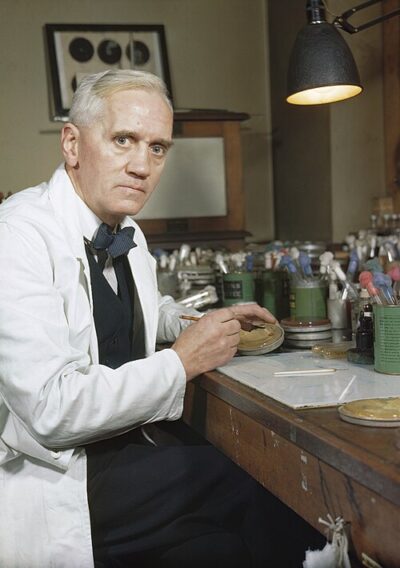
Alexander Fleming
Alexander Fleming was a Scottish biologist, pharmacologist, botanist, and Nobel laureate. Born August 6, 1881, in Darvel. Died March 11, 1955, in London. Positions held include Rector of the University of Edinburgh. Educated at Imperial College London and University of Westminster. Awards include Nobel Prize in Physiology or Medicine, Knight Bachelor and Actonian Prize.
Facts
49 facts · 2 confirmed by two sources · 10 cited · 36 from one source · 1 where the sources disagree
What’s different
- Born in: we show Darvel (Sources disagree). Wikidata also lists Lochfield
Where this comes from
Papalocal keeps its own record. It started from these sources; what each one said is kept here as it was copied, so a change on their side never changes this page by itself. Tap one to read its version.
What Wikidata says · copied November 16, 2026 · revision 2568566441
- Described as
- Scottish biologist, pharmacologist, botanist, and Nobel laureate (1881–1955)
- Other names
- Sir Alexander Fleming
- Born
- August 6, 1881 · 15 references
- Died
- March 11, 1955 · 10 references
- Born in
- Lochfield; Darvel · 1 reference
- Died in
- London · 1 reference
- Buried in
- St Paul's Cathedral
- Cause of death
- myocardial infarction
- Citizen of
- United Kingdom
- Occupation
- bacteriologist · 1 reference; pharmacologist; physician; surgeon; inventor · 1 reference
- Positions held
- Rector of the University of Edinburgh
- Worked for
- Imperial College London; University of London
- Education
- Imperial College London; University of Westminster; Kilmarnock Academy · 1 reference; Imperial College School of Medicine; St Mary's Hospital Medical School
- Member of
- Royal Society of London (1943–); Pontifical Academy of Sciences · 1 reference; Royal College of Physicians, London; Royal Netherlands Academy of Arts and Sciences · 1 reference; Royal Academy of Medicine of Catalonia; Accademia Nazionale dei Lincei (1947–) · 1 reference
- Awards
- Nobel Prize in Physiology or Medicine (1945) · 2 references; Knight Bachelor (1944); Actonian Prize (1949); Albert Medal (1946); honorary doctor of the University of Madrid Complutense (1948); honorary doctorate of the University of Graz; Honorary doctor of the University of Liège; Fellow of the Royal Society (1943) · 1 reference; Honorary Fellow of the Royal Society of Edinburgh; Fellow of the Royal College of Physicians of Edinburgh; Fellow of the Royal College of Physicians of London; Grand Cross of the Civil Order of Alfonso X the Wise (1948) · 1 reference; Moxon Medal; Cameron Prize of the University of Edinburgh; Commander of the Legion of Honour (1946) · 1 reference
- Field
- bacteriology; immunology
- Spouse
- Amalia Fleming (1953–1955) · 1 reference; Sarah Marion McElroy (1915–1949) · 1 reference
- Children
- Robert Fleming · 1 reference
- Father
- Hugh Fleming · 1 reference
- Mother
- Grace Morton · 1 reference
- Military branch
- British Army during the World War I
- Wikipedias with a page
- 137
Wikidata item Q37064 (wikidata.org/wiki/Q37064), public domain (CC0). Copied November 16, 2026.
What Wikipedia says · copied November 16, 2026 · revision 1375868973
Sir Alexander Fleming (6 August 1881 – 11 March 1955) was a Scottish physician and microbiologist. He shared the 1945 Nobel Prize in Physiology or Medicine with Howard Florey and Ernst Chain "for the discovery of penicillin and its curative effect in various infectious diseases".
This was the first antibiotic substance discovered. His discovery in 1928 of what was later named benzylpenicillin (or penicillin G) from the mould Penicillium rubens has been described as the "single greatest victory ever achieved over disease".
He also discovered the enzyme lysozyme from his nasal discharge in 1922, and along with it a bacterium he named Micrococcus lysodeikticus, later renamed Micrococcus luteus.
Fleming was knighted for his scientific achievements in 1944. In 1999, he was named in Time magazine's list of the 100 Most Important People of the 20th century. In 2002, he was included in the BBC's television poll of the 100 Greatest Britons, and in 2009, he was also voted third "greatest Scot" in an opinion poll conducted by STV, behind only Robert Burns and William Wallace.
- Born, in its opening lines
- August 6, 1881
- Died, in its opening lines
- March 11, 1955
From the Wikipedia article “Alexander Fleming” (en.wikipedia.org/wiki/Alexander_Fleming), by its contributors, under CC BY-SA 4.0 (creativecommons.org/licenses/by-sa/4.0/). Copied November 16, 2026; not changed.
Confirmed Two sources agree. Cited One source, and it names where it got it. One source One source, without a reference of its own. Sources disagree The sources disagree. We show the best-supported value and keep theirs below.
