
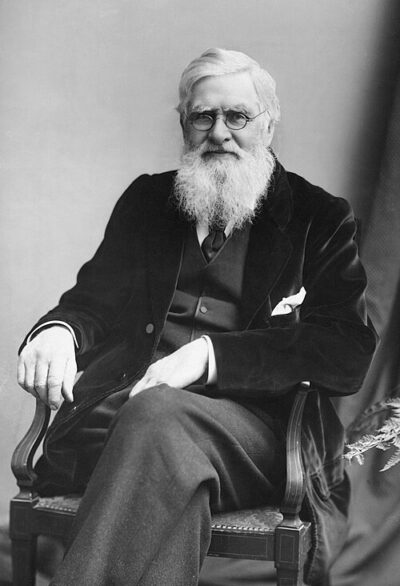
Alfred Russel Wallace
Alfred Russel Wallace was a British naturalist, explorer, geographer, anthropologist and biologist. Born January 8, 1823, in Llanbadoc. Died November 7, 1913, in Broadstone. Positions held include President of the Royal Entomological Society (1870–1871). Known for Land Nationalisation Society. Educated at Birkbeck, University of London and Richard Hale School. Awards include Fellow of the Royal Society, Order of Merit and Copley Medal.
Facts
51 facts · 2 confirmed by two sources · 21 cited · 27 from one source · 1 where the sources disagree
What’s different
- Born in: we show Llanbadoc (Sources disagree). Wikidata also lists Usk
Where this comes from
Papalocal keeps its own record. It started from these sources; what each one said is kept here as it was copied, so a change on their side never changes this page by itself. Tap one to read its version.
What Wikidata says · copied November 16, 2026 · revision 2568120636
- Described as
- British naturalist, explorer, geographer, anthropologist and biologist (1823–1913)
- Other names
- Wallace, A. R. Wallace, Alfred Wallace, Alfred R. Wallace, Wallace, Alfred Russel
- Born
- January 8, 1823 · 12 references
- Died
- November 7, 1913 · 11 references
- Born in
- Usk; Llanbadoc · 1 reference
- Died in
- Broadstone · 2 references
- Citizen of
- United Kingdom of Great Britain and Ireland
- Occupation
- mathematician; explorer · 1 reference; anthropologist · 1 reference; zoologist · 1 reference; naturalist · 2 references; anti-vaccine activist; ornithologist · 1 reference; entomologist · 1 reference
- Positions held
- President of the Royal Entomological Society (1870–1871) · 3 references
- Education
- Birkbeck, University of London; Richard Hale School
- Member of
- Royal Society of London; Royal Geographical Society; Zoological Society of London; Royal Entomological Society · 1 reference; Zoologisch-Botanische Gesellschaft (1863–) · 1 reference
- Known for
- Land Nationalisation Society
- Awards
- Fellow of the Royal Society (1893) · 1 reference; Order of Merit (1908) · 1 reference; Copley Medal (1908) · 2 references; Royal Medal (1868); Founder’s Medal (1892) · 1 reference; Darwin Medal (1890) · 1 reference; Darwin–Wallace Medal (1908) · 1 reference; Linnean Medal (1892); Fellow of the Zoological Society of London; Fellow of the Royal Geographical Society; Fellow of the Linnean Society of London; Doctor honoris causa of the University of Dublin; Honorary doctor of the University of Oxford; Honorary Fellow of the Royal Society Te Apārangi (1885–) · 1 reference
- Field
- biogeography; evolution; naturalism; biology; geography
- Spouse
- Annie Mitten (1866–) · 1 reference
- Children
- Herbert Spencer Wallace · 1 reference; Violet Isabel Wallace · 1 reference; William Greenell Wallace · 1 reference
- Father
- Thomas Vere Wallace · 1 reference
- Mother
- Mary Anne Greenell · 1 reference
- Siblings
- John Wallace; Herbert Edward Wallace; Frances Wallace
- Website
- http://wallacefund.info
- Wikipedias with a page
- 107
Wikidata item Q160627 (wikidata.org/wiki/Q160627), public domain (CC0). Copied November 16, 2026.
What Wikipedia says · copied November 16, 2026 · revision 1385711774
Alfred Russel Wallace (8 January 1823 – 7 November 1913) was an English naturalist, explorer, geographer, anthropologist and illustrator. He independently conceived the theory of evolution through natural selection; his 1858 paper on the subject was published that year alongside extracts from Charles Darwin's writings on the topic. It spurred Darwin to set aside the "big species book" he was drafting and to quickly write an abstract of it, which was published in 1859 as On the Origin of Species.
Wallace did extensive fieldwork, starting in the Amazon River basin. He then did fieldwork in the Malay Archipelago, where he identified the faunal divide now termed the Wallace Line, which separates the Indonesian archipelago into two distinct parts: a western portion in which the animals are largely of Asian origin, and an eastern portion where the fauna reflect Australasia. He was considered the 19th century's leading expert on the geographical distribution of animal species, and is sometimes called the "father of biogeography", or more specifically of zoogeography.
Wallace was one of the leading evolutionary thinkers of the 19th century, working on warning coloration in animals and reinforcement (sometimes known as the Wallace effect), a way that natural selection could contribute to speciation by encouraging the development of barriers against hybridisation. In 1864 he was the first to propose that during the later stages of human evolution natural selection would have primarily acted on mental faculties rather than on the physical form. Wallace's 1904 book Man's Place in the Universe was the first serious attempt by a biologist to evaluate the likelihood of life on other planets. He also had a scientific interest in the possibility of life on Mars.
Aside from scientific work, he was a social activist, critical of what he considered to be the unjust social and economic systems of 19th-century Britain and later in life became an active socialist. His advocacy of spiritualism and mind–body dualism strained his relationship with other scientists. He was one of the first prominent scientists to raise concerns over the environmental impact of human activity. He wrote prolifically on both scientific and social issues; his account of his adventures and observations during his explorations in Southeast Asia, The Malay Archipelago, was first published in 1869. It continues to be both popular and highly regarded.
- Born, in its opening lines
- January 8, 1823
- Died, in its opening lines
- November 7, 1913
From the Wikipedia article “Alfred Russel Wallace” (en.wikipedia.org/wiki/Alfred_Russel_Wallace), by its contributors, under CC BY-SA 4.0 (creativecommons.org/licenses/by-sa/4.0/). Copied November 16, 2026; not changed.
Confirmed Two sources agree. Cited One source, and it names where it got it. One source One source, without a reference of its own. Sources disagree The sources disagree. We show the best-supported value and keep theirs below.
