
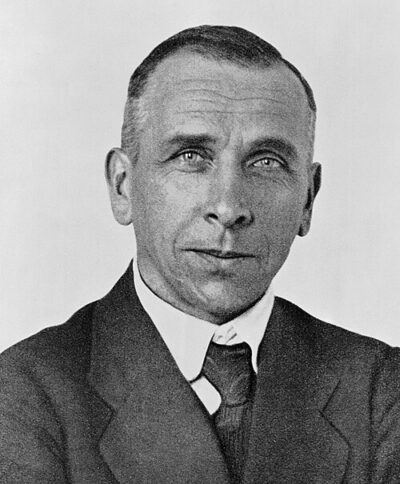
Alfred Wegener
Alfred Wegener was a German climatologist and geophysicist. Born November 1, 1880, in Berlin. Died November 1930, in Greenland. Positions held include professor (1924–1930). Known for The Origin of continents and oceans. Educated at Humboldt-Universität zu Berlin and Köllnisches Gymnasium. Awards include Carl-Ritter-Medal.
Facts
28 facts · 2 confirmed by two sources · 11 cited · 15 from one source
Where this comes from
Papalocal keeps its own record. It started from these sources; what each one said is kept here as it was copied, so a change on their side never changes this page by itself. Tap one to read its version.
What Wikidata says · copied November 16, 2026 · revision 2569924679
- Described as
- German climatologist and geophysicist (1880–1930)
- Other names
- Alfred Lothar Wegener
- Born
- November 1, 1880 · 11 references
- Died
- November 1930 · 2 references
- Born in
- Berlin · 1 reference
- Died in
- Greenland · 1 reference
- Name at birth
- Alfred Lothar Wegener
- Citizen of
- Germany
- Occupation
- meteorologist · 1 reference; university teacher; polar explorer · 1 reference; physicist · 1 reference; geographer · 1 reference; geophysicist · 1 reference; climatologist; geologist · 1 reference
- Positions held
- professor (1924–1930) · 1 reference
- Worked for
- University of Tartu; University of Marburg; University of Graz
- Education
- Humboldt-Universität zu Berlin · 1 reference; Köllnisches Gymnasium
- Member of
- Austrian Academy of Sciences; Schwarzburgbund
- Known for
- The Origin of continents and oceans
- Awards
- Carl-Ritter-Medal (1913)
- Field
- geology
- Spouse
- Else Wegener · 1 reference
- Children
- Lotte Wegener · 1 reference
- Siblings
- Kurt Wegener · 1 reference
- Wikipedias with a page
- 87
Wikidata item Q76323 (wikidata.org/wiki/Q76323), public domain (CC0). Copied November 16, 2026.
What Wikipedia says · copied November 16, 2026 · revision 1382271950
Alfred Lothar Wegener (; German: [ˈʔalfʁeːt ˈveːɡənɐ]; 1 November 1880 – November 1930) was a German climatologist, geologist, geophysicist, meteorologist, and polar researcher.
During his lifetime he was primarily known for his achievements in meteorology and as a pioneer of polar research, but today he is most remembered as the originator of the continental drift hypothesis by suggesting in 1912 that the continents are slowly drifting around the Earth (German: Kontinentalverschiebung).
His hypothesis was not accepted by mainstream geology until the 1960s, when numerous discoveries such as palaeomagnetism provided strong support for continental drift, and thereby a substantial basis for today's model of plate tectonics.
Wegener was involved in several expeditions to Greenland to study polar air circulation before the existence of the jet stream was accepted. Expedition participants made many meteorological observations and were the first to overwinter on the inland Greenland ice sheet and the first to bore ice cores on a moving Arctic glacier.
- Born, in its opening lines
- November 1, 1880
- Died, in its opening lines
- November 1930
From the Wikipedia article “Alfred Wegener” (en.wikipedia.org/wiki/Alfred_Wegener), by its contributors, under CC BY-SA 4.0 (creativecommons.org/licenses/by-sa/4.0/). Copied November 16, 2026; not changed.
Confirmed Two sources agree. Cited One source, and it names where it got it. One source One source, without a reference of its own. Sources disagree The sources disagree. We show the best-supported value and keep theirs below.
