
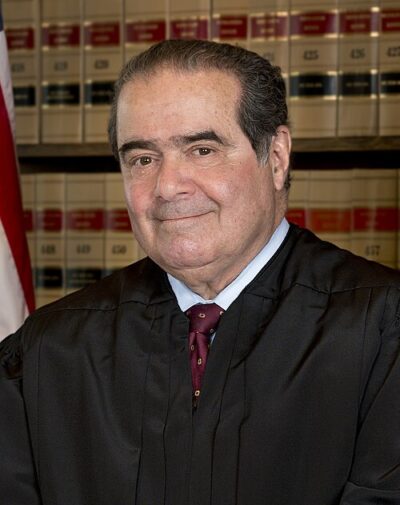
Antonin Scalia
Antonin Scalia was an Associate Justice of the Supreme Court of the United States from 1986 to 2016. Born March 11, 1936, in Trenton. Died February 13, 2016, in Cibolo Creek Ranch. Positions held include Associate Justice of the Supreme Court of the United States (1986–2016), United States Assistant Attorney General (1974–1977) and Judge of the United States Court of Appeals for the D.C. Circuit (1982–1986). Educated at Georgetown University College of Arts & Sciences and Harvard Law School. Awards include Francis Boyer Award, Golden Plate Award and Presidential Medal of Freedom.
Facts
39 facts · 2 confirmed by two sources · 12 cited · 25 from one source
Where this comes from
Papalocal keeps its own record. It started from these sources; what each one said is kept here as it was copied, so a change on their side never changes this page by itself. Tap one to read its version.
What Wikipedia says · copied November 13, 2026 · revision 1380652453
Antonin Gregory Scalia (March 11, 1936 – February 13, 2016) was an American jurist who served as an associate justice of the Supreme Court of the United States from 1986 until his death in 2016. He was described as the intellectual anchor for the originalist and textualist position in the Court's conservative wing. For catalyzing an originalist and textualist movement in American law, he has been described as one of the most influential jurists of the twentieth century, and one of the most important justices in the history of the Supreme Court. Scalia was posthumously awarded the Presidential Medal of Freedom in 2018, and the Antonin Scalia Law School at George Mason University was named in his honor.
Scalia was born in Trenton, New Jersey. A devout Catholic, he attended the Jesuit Xavier High School before receiving his undergraduate degree from Georgetown University. Scalia went on to graduate from Harvard Law School and spent six years at Jones Day before becoming a law professor at the University of Virginia. In the early 1970s, he served in the Nixon and Ford administrations, eventually becoming an assistant attorney general under President Gerald Ford. He spent most of the Carter years teaching at the University of Chicago, where he became one of the first faculty advisers of the fledgling Federalist Society. In 1982, President Ronald Reagan appointed Scalia as a judge of the U.S. Court of Appeals for the District of Columbia Circuit. Four years later, Reagan appointed him to the Supreme Court, where Scalia became its first Italian-American justice following a unanimous confirmation by the U.S. Senate 98–0.
Scalia espoused a conservative jurisprudence and ideology, advocating textualism in statutory interpretation and originalism in constitutional interpretation. He peppered his colleagues with "Ninograms" (memos named for his nickname, "Nino") intending to persuade them to his point of view. He was a strong defender of the powers of the executive branch and believed that the U.S. Constitution permitted the death penalty and did not guarantee the right to either abortion or same-sex marriage. Furthermore, Scalia viewed affirmative action and other policies that afforded special protected status to minority groups as unconstitutional. Such positions would earn him a reputation as one of the most conservative justices on the Court. He filed separate opinions in many cases, often castigating the Court's majority—sometimes scathingly so.
Scalia's most significant opinions include his lone dissent in Morrison v. Olson (arguing against the constitutionality of an Independent-Counsel law), and his majority opinions in Crawford v. Washington (defining a criminal defendant's confrontation right under the Sixth Amendment) and District of Columbia v. Heller (holding that the Second Amendment to the U.S. Constitution guarantees an individual right to handgun ownership).
- Born, in its opening lines
- March 11, 1936
- Died, in its opening lines
- February 13, 2016
From the Wikipedia article “Antonin Scalia” (en.wikipedia.org/wiki/Antonin_Scalia), by its contributors, under CC BY-SA 4.0 (creativecommons.org/licenses/by-sa/4.0/). Copied November 13, 2026; not changed.
What Wikidata says · copied November 14, 2026 · revision 2569081342
- Described as
- Associate Justice of the Supreme Court of the United States from 1986 to 2016
- Other names
- Antonin Gregory Scalia, Scalia, Antonin G. Scalia, Nino, Justice Scalia
- Born
- March 11, 1936 · 5 references
- Died
- February 13, 2016 · 4 references
- Born in
- Trenton · 1 reference
- Died in
- Cibolo Creek Ranch
- Buried in
- Fairfax Memorial Park
- Cause of death
- myocardial infarction
- Name at birth
- Antonin Gregory Scalia
- Citizen of
- United States · 3 references
- Occupation
- judge · 3 references; lawyer; professor; jurist · 1 reference
- Positions held
- Associate Justice of the Supreme Court of the United States (1986–2016); United States Assistant Attorney General (1974–1977); Judge of the United States Court of Appeals for the D.C. Circuit (1982–1986); chairperson (1972–1974)
- Political party
- Republican Party · 1 reference
- Worked for
- University of Chicago Law School (1977–1982); University of Virginia School of Law (1967–1971); Stanford Law School; University of Chicago; Georgetown University Law Center · 1 reference
- Education
- Georgetown University College of Arts & Sciences (1953–1957) · 1 reference; Harvard Law School (1957–1960) · 1 reference; University of Fribourg; Xavier High School (1949–1953) · 1 reference
- Member of
- American Academy of Arts and Sciences
- Awards
- Francis Boyer Award (1989) · 1 reference; Golden Plate Award · 1 reference; Presidential Medal of Freedom (2018) · 1 reference; James Cardinal Gibbons Medal; New Jersey Hall of Fame (2021) · 1 reference
- Children
- Eugene Scalia
- Religion
- Catholic Church
- Lived in
- Trenton; Cleveland; Chicago; McLean
- Nickname
- Nino
- Wikipedias with a page
- 54
Wikidata item Q11156 (wikidata.org/wiki/Q11156), public domain (CC0). Copied November 14, 2026.
Confirmed Two sources agree. Cited One source, and it names where it got it. One source One source, without a reference of its own. Sources disagree The sources disagree. We show the best-supported value and keep theirs below.
