
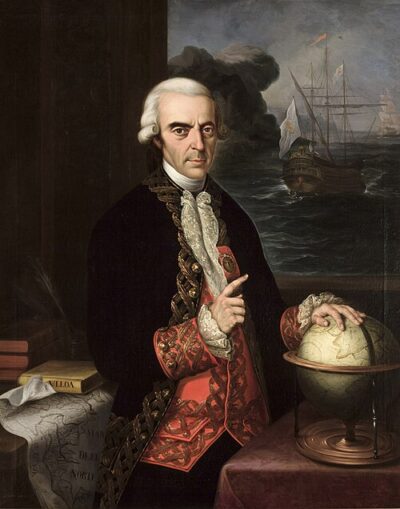
Antonio de Ulloa
Antonio de Ulloa was a Spanish explorer, naval officer, colonial official, and naturalist. Born January 12, 1716, in Seville. Died July 3, 1795, in Isla de León. Positions held include governor of Spanish Louisiana (1766–1768).
Facts
25 facts · 2 confirmed by two sources · 8 cited · 15 from one source
What’s different
- Died: we show July 3, 1795 (Confirmed). Wikidata also lists July 5, 1795
Where this comes from
Papalocal keeps its own record. It started from these sources; what each one said is kept here as it was copied, so a change on their side never changes this page by itself. Tap one to read its version.
What Wikidata says · copied November 16, 2026 · revision 2568783175
- Described as
- Spanish explorer, naval officer, colonial official, and naturalist
- Other names
- Antonio de Ulloa y de la Torre-Giralt, Ulloa, De Ulloa
- Born
- January 12, 1716 · 5 references
- Died
- July 5, 1795; July 3, 1795 · 1 reference
- Born in
- Seville · 1 reference
- Died in
- Isla de León
- Citizen of
- Kingdom of Spain
- Occupation
- naturalist; writer · 2 references; military personnel; astronomer; naval officer · 1 reference; seafarer · 1 reference; physicist · 1 reference; historian · 1 reference
- Positions held
- governor of Spanish Louisiana (1766–1768)
- Member of
- Royal Society of London; Royal Swedish Academy of Sciences; Royal Prussian Academy of Sciences; Order of Santiago; French Academy of Sciences (1748–) · 1 reference
- Field
- geodesy · 1 reference; astronomy · 1 reference
- Children
- Francisco Javier de Ulloa
- Father
- Bernardo de Ulloa
- Siblings
- Martín de Ulloa · 1 reference
- Military rank
- admiral
- Wikipedias with a page
- 30
Wikidata item Q470306 (wikidata.org/wiki/Q470306), public domain (CC0). Copied November 16, 2026.
What Wikipedia says · copied November 16, 2026 · revision 1384124621
Antonio de Ulloa y de la Torre-Guiral (12 January 1716 – 3 July 1795) was a Spanish Navy officer. He spent much of his career in the Americas, where he carried out important scientific work that earned him a reputation as one of the major figures of the Enlightenment in Spain. As a military officer, Ulloa achieved the rank of vice admiral. He also served the Spanish Empire as an administrator in the Viceroyalty of Peru and as governor of Spanish Louisiana.
At the age of nineteen, Ulloa joined the French Geodesic Mission to the Equator, which established that the shape of the Earth is an oblate spheroid, flattened at the poles, as predicted by Isaac Newton. The mission took more than eight years to complete, during which time Ulloa, in close collaboration with his fellow naval officer Jorge Juan, made many astronomical, natural, and social observations in South America. Ulloa and Juan also helped to organize the defense of the Peruvian coast against the English squadron of Commodore Anson, after the outbreak of the War of Jenkins' Ear in 1739.
The reports of Ulloa's scientific findings during his time in South America earned him an international reputation. Notably, Ulloa published the first detailed observations of platinum, later identified as a new chemical element. Ulloa returned to Europe in 1745. He was elected as a fellow of the Royal Society of London in 1746, and as a foreign member of the Royal Swedish Academy of Sciences in 1751.
From 1758 to 1764, Ulloa served as governor of Huancavelica, in Peru, and as superintendent of the mercury mines of the region. There, he fought unsuccessfully against the corruption of the local administration. Following the Seven Years' War, Ulloa became the first governor of Spanish Louisiana in 1766. His rule was strongly resisted by the French Creoles of New Orleans, who expelled him from the city during the Rebellion of 1768. Despite some controversies, Ulloa continued to serve in the Spanish Navy and ended his career as its chief of operations.
- Born, in its opening lines
- January 12, 1716
- Died, in its opening lines
- July 3, 1795
From the Wikipedia article “Antonio de Ulloa” (en.wikipedia.org/wiki/Antonio_de_Ulloa), by its contributors, under CC BY-SA 4.0 (creativecommons.org/licenses/by-sa/4.0/). Copied November 16, 2026; not changed.
Confirmed Two sources agree. Cited One source, and it names where it got it. One source One source, without a reference of its own. Sources disagree The sources disagree. We show the best-supported value and keep theirs below.
