
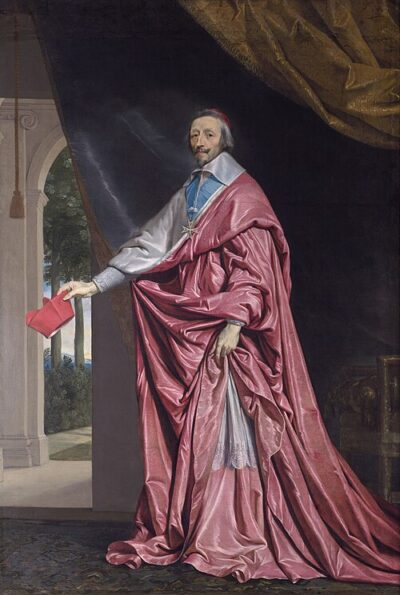
Armand-Jean du Plessis, duc de Richelieu
Armand-Jean du Plessis, duc de Richelieu was a French clergyman, cardinal, noble and statesman. Born September 9, 1585, in Paris. Died December 4, 1642, in Paris. Positions held include Roman Catholic Bishop of Luçon (1605–1624), cardinal (1622–1642) and governor of Brittany. Educated at University of Paris and College of Sorbonne. Awards include Commander of the Order of the Holy Spirit and Knight of the Order of Saint Michael.
Facts
32 facts · 2 confirmed by two sources · 11 cited · 19 from one source
Where this comes from
Papalocal keeps its own record. It started from these sources; what each one said is kept here as it was copied, so a change on their side never changes this page by itself. Tap one to read its version.
What Wikidata says · copied November 16, 2026 · revision 2570013464
- Described as
- French clergyman, cardinal, noble and statesman (1585-1642)
- Other names
- Armand Jean du Plessis, Duc de Richelieu, Duc de Fronsac, Armand Jean du, duc de Richelieu Plessis, Cardinal-Duke of Richelieu and of Fronsac Armand Jean du Plessis, Armand-Jean Duplessis, Cardinal de Richelieu, Armand Jean, duc de Richelieu Du Plessis, Armand Jean du Plessis, duc de Richelieu, Armand de Vignerot, cardinal and duc de Richelieu, Armand Jean du Plessis, cardinal and duc de Richelieu Armand de Vignerot, Cardinal Richelieu, Armand-Jean Cardinal du Plessis de Richelieu
- Born
- September 9, 1585 · 9 references
- Died
- December 4, 1642 · 11 references
- Born in
- Paris · 1 reference
- Died in
- Paris · 1 reference
- Buried in
- Chapelle Sainte-Ursule de la Sorbonne
- Cause of death
- tuberculosis
- Citizen of
- Kingdom of France
- Occupation
- politician · 2 references; diplomat; art collector · 1 reference; writer · 1 reference; Catholic bishop (1607–1642) · 1 reference; Catholic priest; minister · 1 reference
- Positions held
- Roman Catholic Bishop of Luçon (1605–1624) · 2 references; cardinal (1622–1642) · 2 references; governor of Brittany; Secretary of State for Foreign Affairs of France; Chief Minister of France (1624–1642) · 1 reference; Abbot of Cluny (1635–1642) · 1 reference
- Education
- University of Paris; College of Sorbonne
- Awards
- Commander of the Order of the Holy Spirit; Knight of the Order of Saint Michael
- Father
- François du Plessis de Richelieu · 1 reference
- Mother
- Susanne de La Porte · 1 reference
- Siblings
- Alphonse-Louis du Plessis de Richelieu · 1 reference; Isabelle-Françoise du Plessis de Richelieu; Henri du Plessis de Richelieu
- Religion
- Catholic Church · 1 reference
- Military rank
- lieutenant general
- Lived in
- Paris
- Wikipedias with a page
- 106
Wikidata item Q26702 (wikidata.org/wiki/Q26702), public domain (CC0). Copied November 16, 2026.
What Wikipedia says · copied November 16, 2026 · revision 1385644556
Armand Jean du Plessis, 1st Duke of Richelieu (9 September 1585 – 4 December 1642), commonly known as Cardinal Richelieu, was a French Catholic prelate and statesman who had an outsized influence in civil and religious affairs. He became known as the Red Eminence (French: l'Éminence Rouge), a term derived from the style of Eminence applied to cardinals and their customary red robes.
Consecrated a bishop in 1607, Richelieu was appointed Foreign Secretary in 1616. He continued to rise through the hierarchy of both the Catholic Church and the French government, becoming a cardinal in 1622 and chief minister to King Louis XIII in 1624. He retained that office until his death in 1642, when he was succeeded by Cardinal Jules Mazarin, whose career the cardinal had fostered. Richelieu became engaged in a bitter dispute with Marie de Médici, the king's mother, and formerly his close ally.
Richelieu sought to consolidate royal power and restrained the power of the nobility in order to transform France into a strong centralized state. In foreign policy, his primary objectives were to check the power of the Habsburg dynasty (reigning notably in Spain and Austria) and to ensure French dominance in the Thirty Years' War of 1618–1648 after that conflict engulfed Europe. Despite suppressing the Huguenot rebellions of the 1620s, he supported Protestant states like the Swedish Empire and the Dutch Republic to help him achieve his goals. Although he was a powerful political figure in his own right, events such as the Day of the Dupes (French: Journée des Dupes) in 1630 showed that Richelieu's power still depended on the king's confidence.
An alumnus of the University of Paris and headmaster of the College of Sorbonne, Richelieu renovated and extended the latter institution. He became famous for his patronage of the arts and founded the Académie Française, the learned society responsible for matters pertaining to the French language. As an advocate for Samuel de Champlain and New France, he founded (1627) the Compagnie des Cent-Associés; he also negotiated the 1632 Treaty of Saint-Germain-en-Laye under which Quebec City returned to French rule after English privateers took it in 1629. He was created Duke of Richelieu in 1629.
- Born, in its opening lines
- September 9, 1585
- Died, in its opening lines
- December 4, 1642
From the Wikipedia article “Cardinal Richelieu” (en.wikipedia.org/wiki/Cardinal_Richelieu), by its contributors, under CC BY-SA 4.0 (creativecommons.org/licenses/by-sa/4.0/). Copied November 16, 2026; not changed.
Confirmed Two sources agree. Cited One source, and it names where it got it. One source One source, without a reference of its own. Sources disagree The sources disagree. We show the best-supported value and keep theirs below.
