
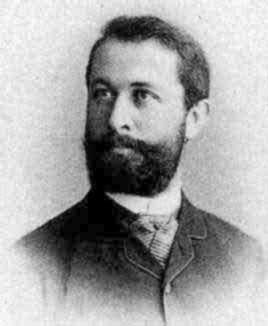
Arthur Moritz Schoenflies
Arthur Moritz Schoenflies was a German mathematician. Born April 17, 1853, in Gorzów Wielkopolski. Died May 27, 1928, in Frankfurt. Positions held include rector (1920–1921). Known for Schoenflies problem, Schoenflies displacement and Schoenflies notation. Educated at Frederick William University Berlin. Awards include Order of the Red Eagle 4th Class.
Facts
27 facts · 2 confirmed by two sources · 14 cited · 11 from one source
Where this comes from
Papalocal keeps its own record. It started from these sources; what each one said is kept here as it was copied, so a change on their side never changes this page by itself. Tap one to read its version.
What Wikidata says · copied November 18, 2026 · revision 2569129383
- Described as
- German mathematician (1853–1928)
- Other names
- Schoenflies, Arthur Moritz Schönflies, Schönflies, Arthur Schoenflies, Schönfließ, Schönflis
- Born
- April 17, 1853 · 5 references
- Died
- May 27, 1928 · 5 references
- Born in
- Gorzów Wielkopolski · 1 reference
- Died in
- Frankfurt · 1 reference
- Buried in
- Frankfurt Main Cemetery · 1 reference
- Citizen of
- Germany
- Occupation
- mathematician · 2 references; university teacher · 1 reference; secondary school teacher; crystallographer; professor · 1 reference
- Positions held
- rector (1920–1921) · 1 reference
- Worked for
- Goethe University Frankfurt (1911–1922) · 1 reference; University of Göttingen (1884–1899) · 1 reference; University of Königsberg (1899–1911) · 1 reference; Friedrich-Wilhelms-Gymnasium (1875–1880) · 1 reference; Lycée Bartholdi (1880–1884) · 1 reference
- Education
- Frederick William University Berlin (1870–1875) · 1 reference
- Member of
- German Academy of Sciences Leopoldina; Bavarian Academy of Sciences and Humanities; German Mathematical Society; Royal Prussian Academy of Sciences
- Known for
- Schoenflies problem; Schoenflies displacement; Schoenflies notation
- Awards
- Order of the Red Eagle 4th Class (1910) · 1 reference
- Field
- mathematics · 1 reference
- Wikipedias with a page
- 22
Wikidata item Q61748 (wikidata.org/wiki/Q61748), public domain (CC0). Copied November 18, 2026.
What Wikipedia says · copied November 18, 2026 · revision 1372600803
Arthur Moritz Schoenflies (German: [ˈʃøːnfliːs]; 17 April 1853 – 27 May 1928), sometimes written as Schönflies, was a German mathematician, known for his contributions to the application of group theory to crystallography, and for work in topology.
Schoenflies was born in Landsberg an der Warthe (modern Gorzów, Poland). Arthur Schoenflies married Emma Levin (1868–1939) in 1896. He studied under Ernst Kummer and Karl Weierstrass, and was influenced by Felix Klein.
The Schoenflies problem is to prove that an (n−1)-sphere in Euclidean n-space bounds a topological ball, however embedded. This question is much more subtle than it initially appears.
He studied at the University of Berlin from 1870 to 1875. He obtained a doctorate in 1877, and in 1878 he was a teacher at a school in Berlin. In 1880, he went to Colmar to teach.
Schoenflies was a frequent contributor to Klein's Encyclopedia of Mathematical Sciences: In 1898 he wrote on set theory, in 1902 on kinematics, and on projective geometry in 1910.
He was a great-uncle of Walter Benjamin.
- Born, in its opening lines
- April 17, 1853
- Died, in its opening lines
- May 27, 1928
From the Wikipedia article “Arthur Moritz Schoenflies” (en.wikipedia.org/wiki/Arthur_Moritz_Schoenflies), by its contributors, under CC BY-SA 4.0 (creativecommons.org/licenses/by-sa/4.0/). Copied November 18, 2026; not changed.
Confirmed Two sources agree. Cited One source, and it names where it got it. One source One source, without a reference of its own. Sources disagree The sources disagree. We show the best-supported value and keep theirs below.
