
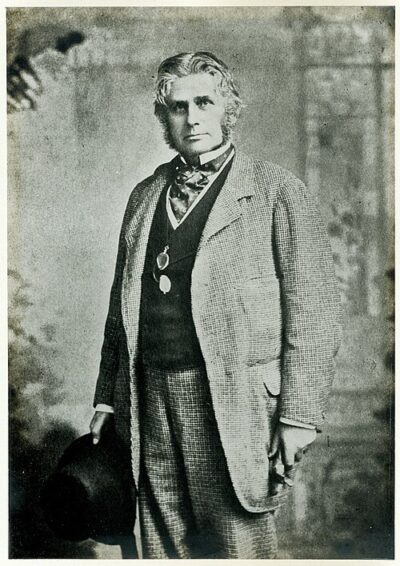
Augustus Pitt Rivers
Augustus Pitt Rivers was an English army officer, ethnologist and archaeologist. Born April 14, 1827, in Bramham. Died May 4, 1900, in Wiltshire. Positions held include High Sheriff of Dorset (1884–1885). Educated at Royal Military College, Sandhurst. Awards include Fellow of the Royal Society, Fellow of the Society of Antiquaries and Fellow of the Ethnological Society of London.
Facts
38 facts · 2 confirmed by two sources · 15 cited · 21 from one source
Where this comes from
Papalocal keeps its own record. It started from these sources; what each one said is kept here as it was copied, so a change on their side never changes this page by itself. Tap one to read its version.
What Wikidata says · copied November 18, 2026 · revision 2565602324
- Described as
- English army officer, ethnologist and archaeologist (1827–1900)
- Other names
- Augustus Henry Lane-Fox Pitt Rivers, Augustus Pitt-Rivers, Augustus Henry Lane Fox, Augustus Henry Lane-Fox-Pitt Rivers, Augustus Henry Lane Fox-Pitt-Rivers, Augustus Henry Lane-Fox Pitt-Rivers, Augustus Henry Lane-Fox, Augustus Henry Lane Fox Pitt Rivers, Augustus Lane Fox
- Born
- April 14, 1827 · 4 references
- Died
- May 4, 1900 · 5 references
- Born in
- Bramham
- Died in
- Wiltshire
- Citizen of
- United Kingdom of Great Britain and Ireland
- Occupation
- anthropologist · 1 reference; archaeologist · 1 reference; prehistorian; historian; weapon historian; army officer
- Positions held
- High Sheriff of Dorset (1884–1885) · 1 reference
- Education
- Royal Military College, Sandhurst
- Member of
- Royal Society of London; Society of Antiquaries of London; Wiltshire Archaeological and Natural History Society
- Awards
- Fellow of the Royal Society; Fellow of the Society of Antiquaries; Fellow of the Ethnological Society of London
- Field
- anthropology; ethnography; archaeology; museology
- Spouse
- Alice Stanley (1853–) · 2 references
- Children
- St. George Fox-Pitt · 1 reference; Geraldine Grove · 1 reference; Douglas Fox Pitt · 1 reference; Alexander Edward Lane Fox-Pitt-Rivers · 2 references; William Augustus Lane Fox-Pitt · 1 reference; Ursula Katharine Lane Lane Fox · 1 reference; Lionel Charles Lane Fox-Pitt · 1 reference; Alice Augusta Laurentia Lane Fox-Pitt · 2 references; Arthur Algenon Lane Fox-Pitt · 1 reference
- Father
- William Augustus Lane Fox · 2 references
- Mother
- Lady Caroline Douglas · 2 references
- Military branch
- British Army
- Military rank
- general · 2 references
- Lived in
- Tollard Royal
- Wikipedias with a page
- 20
Wikidata item Q681866 (wikidata.org/wiki/Q681866), public domain (CC0). Copied November 18, 2026.
What Wikipedia says · copied November 18, 2026 · revision 1378460824
Lieutenant-General Augustus Henry Lane Fox Pitt Rivers (born Augustus Henry Lane-Fox; 14 April 1827 – 4 May 1900) was an English officer in the British Army, ethnologist, and archaeologist. He was noted for innovations in archaeological methodology, and in the museum display of archaeological and ethnological collections. His international collection of about 22,000 objects was the founding collection of the Pitt Rivers Museum at the University of Oxford, while his collection of English archaeology from the area around Stonehenge forms the basis of the collection at The Salisbury Museum in Wiltshire.
Throughout most of his life he used the surname Lane Fox, under which his early archaeological reports are published. In 1880 he adopted the Pitt Rivers name on inheriting from Lord Rivers (a cousin) an estate of more than 32,000 acres in Cranborne Chase.
His family name is often spelled as "Pitt-Rivers". His middle name is sometimes spelled as "Lane-Fox". The surname he adopted following the Royal Licence was Fox-Pitt-Rivers.
- Born, in its opening lines
- April 14, 1827
- Died, in its opening lines
- May 4, 1900
From the Wikipedia article “Augustus Pitt Rivers” (en.wikipedia.org/wiki/Augustus_Pitt_Rivers), by its contributors, under CC BY-SA 4.0 (creativecommons.org/licenses/by-sa/4.0/). Copied November 18, 2026; not changed.
Confirmed Two sources agree. Cited One source, and it names where it got it. One source One source, without a reference of its own. Sources disagree The sources disagree. We show the best-supported value and keep theirs below.
