
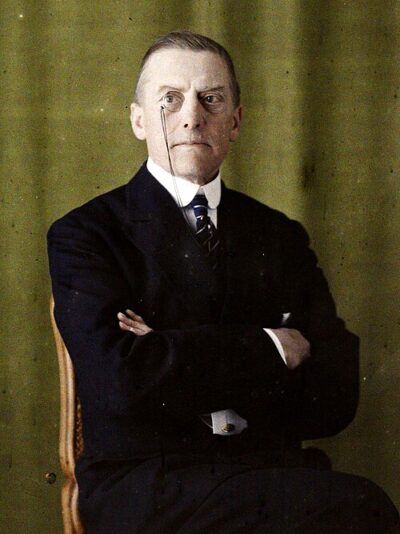
Austen Chamberlain
Austen Chamberlain was a British politician. Born October 16, 1863, in Birmingham. Died March 16, 1937, in London. Positions held include Secretary of State for Foreign and Commonwealth Affairs (1924–1929), Chancellor of the Exchequer (2 times) (1903–1921) and Secretary of State for India. Educated at Paris Institute of Political Studies and Trinity College. Awards include Nobel Peace Prize, Order of the Garter and doctor honoris causa from the University of Lyon.
Facts
41 facts · 2 confirmed by two sources · 24 cited · 15 from one source
Where this comes from
Papalocal keeps its own record. It started from these sources; what each one said is kept here as it was copied, so a change on their side never changes this page by itself. Tap one to read its version.
What Wikidata says · copied November 16, 2026 · revision 2567476463
- Described as
- British politician (1863-1937)
- Other names
- Sir Joseph Austen Chamberlain
- Born
- October 16, 1863 · 12 references
- Died
- March 16, 1937 · 3 references
- Born in
- Birmingham · 2 references
- Died in
- London · 3 references
- Buried in
- East Finchley Cemetery · 1 reference
- Citizen of
- United Kingdom
- Occupation
- politician · 1 reference; statesperson · 1 reference; foreign minister · 1 reference
- Positions held
- Secretary of State for Foreign and Commonwealth Affairs (1924–1929); Chancellor of the Exchequer (2 times) (1903–1921); Secretary of State for India; Lord Privy Seal (1921–1922); Member of the Privy Council of the United Kingdom; First Lord of the Admiralty (1931); Postmaster General of the United Kingdom (1902–1903); member of the 37th Parliament of the United Kingdom (1935–1937); member of the 36th Parliament of the United Kingdom (1931–1935) · 1 reference; member of the 35th Parliament of the United Kingdom (1929–1931) · 1 reference; member of the 34th Parliament of the United Kingdom (1924–1929) · 1 reference; member of the 33rd Parliament of the United Kingdom (1923–1924) · 1 reference; member of the 32nd Parliament of the United Kingdom (1922–1923) · 1 reference; member of the 31st Parliament of the United Kingdom (1918–1922) · 1 reference; member of the 30th Parliament of the United Kingdom (1910–1918) · 1 reference
- Political party
- Conservative Party; Liberal Unionist Party
- Education
- Paris Institute of Political Studies; Trinity College · 1 reference; Rugby School
- Awards
- Nobel Peace Prize (1925) · 2 references; Order of the Garter · 1 reference; doctor honoris causa from the University of Lyon (1936) · 1 reference; Cross of Liberty 1st Division, 3rd Class (1925) · 1 reference
- Field
- politics · 1 reference
- Spouse
- Ivy Muriel Dundas (1906–) · 3 references
- Children
- Joseph Chamberlain · 2 references; Beatrice Chamberlain · 2 references; Lawrence Chamberlain · 2 references
- Father
- Joseph Chamberlain · 1 reference
- Mother
- Harriet Kenrick · 2 references
- Siblings
- Beatrice Chamberlain · 2 references
- Wikipedias with a page
- 69
Wikidata item Q188999 (wikidata.org/wiki/Q188999), public domain (CC0). Copied November 16, 2026.
What Wikipedia says · copied November 16, 2026 · revision 1380619947
Sir Joseph Austen Chamberlain (16 October 1863 – 16 March 1937) was a British statesman, Nobel Peace Prize winner, son of Joseph Chamberlain and older half-brother of Prime Minister Neville Chamberlain. He served as a Member of Parliament (MP) for 45 years, as Chancellor of the Exchequer (twice) and was briefly Conservative Party leader before serving as Foreign Secretary.
Brought up to be the political heir of his father, whom he physically resembled, he was elected to Parliament as a Liberal Unionist at a by-election in 1892. He held office in the Unionist coalition governments of 1895–1905, remaining in the Cabinet as Chancellor of the Exchequer (1903–05) after his father resigned in 1903 to campaign for Tariff Reform. After his father's disabling stroke in 1906, Austen became the leading tariff reformer in the House of Commons. Late in 1911 he and Walter Long were due to compete for the leadership of the Conservative Party (in succession to Arthur Balfour), but both withdrew in favour of Bonar Law rather than risk a party split on a close result.
Chamberlain returned to office in H. H. Asquith's wartime coalition government in May 1915, as Secretary of State for India, but resigned to take responsibility for the disastrous Kut Campaign. He again returned to office in David Lloyd George's coalition government, once again serving as Chancellor of the Exchequer. He then served as Conservative Party leader in the Commons (1921–1922), before resigning after the Carlton Club meeting voted to end the Lloyd George Coalition.
Like many leading coalitionists, he did not hold office in the Conservative governments of 1922–1924. By now regarded as an elder statesman, he served an important term as Foreign Secretary in Stanley Baldwin's second government (1924–1929). He negotiated the Locarno Treaties (1925), aimed at preventing war between France and Germany, for which he was awarded the Nobel Peace Prize. Chamberlain last held office as First Lord of the Admiralty in 1931, but resigned as a result of his actions over the Invergordon Mutiny. He was one of the few MPs supporting Winston Churchill's appeals for rearmament against the German threat in the 1930s and remained an active backbench MP until his death in 1937.
- Born, in its opening lines
- October 16, 1863
- Died, in its opening lines
- March 16, 1937
From the Wikipedia article “Austen Chamberlain” (en.wikipedia.org/wiki/Austen_Chamberlain), by its contributors, under CC BY-SA 4.0 (creativecommons.org/licenses/by-sa/4.0/). Copied November 16, 2026; not changed.
Confirmed Two sources agree. Cited One source, and it names where it got it. One source One source, without a reference of its own. Sources disagree The sources disagree. We show the best-supported value and keep theirs below.
