
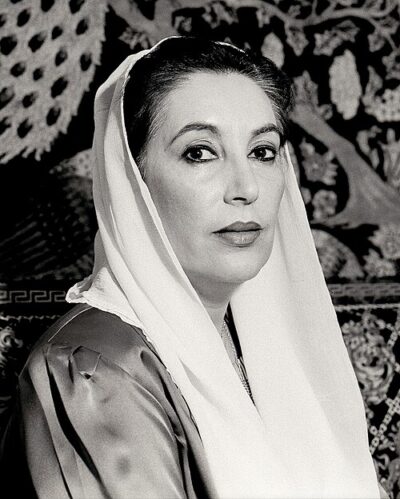
Benazir Bhutto
Benazir Bhutto was the 11th and 13th prime minister of Pakistan. Born June 21, 1953, in Karachi. Died December 27, 2007, in Benazir Bhutto Hospital. Positions held include Prime Minister of Pakistan (2 times) (1988–1996), Leader of the Opposition (2 times) (1990–1999) and Federal Minister for Finance (1994–1996). Educated at Radcliffe College and Lady Margaret Hall. Awards include Bruno Kreisky Award for Services to Human Rights and United Nations Prize in the Field of Human Rights.
Facts
34 facts · 2 confirmed by two sources · 5 cited · 27 from one source
Where this comes from
Papalocal keeps its own record. It started from these sources; what each one said is kept here as it was copied, so a change on their side never changes this page by itself. Tap one to read its version.
What Wikidata says · copied November 16, 2026 · revision 2568892039
- Described as
- 11th and 13th prime minister of Pakistan (1953–2007)
- Other names
- Benazir, BB, Daughter of the East, Bhutto
- Born
- June 21, 1953 · 8 references
- Died
- December 27, 2007 · 10 references
- Born in
- Karachi · 2 references
- Died in
- Benazir Bhutto Hospital · 1 reference
- Buried in
- Bhutto family mausoleum
- Cause of death
- suicide bombing
- Citizen of
- Pakistan · 1 reference
- Occupation
- politician
- Positions held
- Prime Minister of Pakistan (2 times) (1988–1996); Leader of the Opposition (2 times) (1990–1999); Federal Minister for Finance (1994–1996) · 1 reference; Federal Minister for Defence (1988–1990) · 1 reference; party leader (1982–2007)
- Political party
- Pakistan Peoples Party
- Education
- Radcliffe College; Lady Margaret Hall; St Catherine's College; Harvard University; Convent of Jesus and Mary, Karachi; Karachi Grammar School
- Member of
- Phi Beta Kappa Society
- Awards
- Bruno Kreisky Award for Services to Human Rights; United Nations Prize in the Field of Human Rights (2008)
- Spouse
- Asif Ali Zardari (1987–2007)
- Children
- Bilawal Zardari; Bakhtawar Bhutto Zardari; Aseefa Bhutto Zardari
- Father
- Zulfikar Ali Bhutto · 1 reference
- Mother
- Nusrat Bhutto
- Siblings
- Sanam Bhutto.; Shahnawaz Bhutto; Murtaza Bhutto · 1 reference
- Religion
- Islam
- Website
- https://benazirbhutto.com
- Wikipedias with a page
- 150
Wikidata item Q34413 (wikidata.org/wiki/Q34413), public domain (CC0). Copied November 16, 2026.
What Wikipedia says · copied November 16, 2026 · revision 1385724505
Benazir Bhutto (21 June 1953 – 27 December 2007) was a Pakistani stateswoman who twice served as the Prime Minister of Pakistan from 1988 to 1990 and again from 1993 to 1996. She was the first woman elected to head a democratic government in a Muslim-majority country. Ideologically a liberal and a secularist, she chaired the Pakistan People's Party (PPP) from 1982 until her assassination in 2007.
Of Sindhi and Kurdish parentage, Bhutto was born in Karachi to the politically significant and aristocratic Bhutto family. She studied at Harvard University and the University of Oxford, where she served as President of the Oxford Union. In 1977 she returned to Pakistan during her father Zulfikar Ali Bhutto's socialist government; shortly afterward, her father was ousted in a military coup and executed. Bhutto and her mother, Nusrat Bhutto, took control of the PPP and led the country's Movement for the Restoration of Democracy (MRD). Bhutto was repeatedly imprisoned by Zia-ul-Haq's military government and self-exiled to Britain in 1984. She returned in 1986 and—influenced by Thatcherite economics—transformed the PPP's platform from a socialist to a liberal one, before leading it to victory in the 1988 election, becoming Pakistan's first and only female prime minister. As prime minister, her attempts at reform were stifled by conservative and Islamist forces, including President Ghulam Ishaq Khan and the Pakistani military. Her administration, having been accused of corruption and nepotism, was dismissed by Khan in 1990. Intelligence services rigged the following election to ensure a victory for the conservative Islamic Democratic Alliance (IJI), at which point Bhutto became the Leader of the Opposition.
After Nawaz Sharif's IJI government was also dismissed on corruption charges, Bhutto led the PPP to victory in the 1993 elections. In her second term, she oversaw economic privatisation and attempts to advance women's rights. Her government was beset with instability, including the assassination of her brother Murtaza, a failed coup d'état in 1995, and a bribery scandal involving her and her husband Asif Ali Zardari; in response, President Farooq Leghari dismissed her government. The PPP lost the 1997 election and in 1998 she went into self-exile again, living between Dubai and London for the next decade. A widening corruption inquiry culminated in a 2003 conviction in a Swiss court. Following the United States–brokered negotiations with Pakistani president Pervez Musharraf, she returned to Pakistan in 2007 to run in the 2008 elections. Her platform emphasised civilian oversight of the military and opposition to growing Islamist violence. After a political rally in Rawalpindi, she was assassinated. The Salafi jihadist militant group al-Qaeda claimed responsibility, although involvement of the Pakistani Taliban and rogue elements of the intelligence services were also hypothesised. She was buried at her family mausoleum in Garhi Khuda Bakhsh.
Opinions on Bhutto were deeply divided. Critics accused her of being politically inexperienced and corrupt, while Islamist and conservative forces opposed her secularist, modernising agenda. She was nevertheless domestically popular early in her career and was praised as a champion of democracy. Posthumously, she came to be regarded as an icon for women's rights due to her political success in a male-dominated society.
- Born, in its opening lines
- June 21, 1953
- Died, in its opening lines
- December 27, 2007
From the Wikipedia article “Benazir Bhutto” (en.wikipedia.org/wiki/Benazir_Bhutto), by its contributors, under CC BY-SA 4.0 (creativecommons.org/licenses/by-sa/4.0/). Copied November 16, 2026; not changed.
Confirmed Two sources agree. Cited One source, and it names where it got it. One source One source, without a reference of its own. Sources disagree The sources disagree. We show the best-supported value and keep theirs below.
