
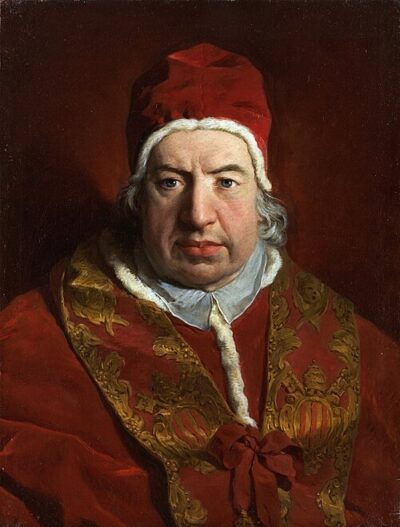
Benedict XIV
Benedict XIV was a pope of the Catholic Church from 1740 to 1758. Born March 31, 1675, in Bologna. Died May 3, 1758, in Rome. Positions held include Pope (1740–1758), Roman Catholic Archbishop of Bologna (1724–1754) and In pectore (1726–). Educated at Sapienza University of Rome.
Facts
21 facts · 2 confirmed by two sources · 7 cited · 12 from one source
Where this comes from
Papalocal keeps its own record. It started from these sources; what each one said is kept here as it was copied, so a change on their side never changes this page by itself. Tap one to read its version.
What Wikidata says · copied November 16, 2026 · revision 2569175026
- Described as
- pope of the Catholic Church from 1740 to 1758
- Other names
- Benedictus XIV, Benedictus PP. XIV, Benedikt XIV. Papst, Pope Benedict XIV, Prospero Lorenzo Lambertini, Prospero Lambertini
- Born
- March 31, 1675 · 10 references
- Died
- May 3, 1758 · 12 references
- Born in
- Bologna · 1 reference
- Died in
- Rome · 1 reference
- Buried in
- Tomb of Benedict XIV
- Name at birth
- Prospero Lorenzo Lambertini
- Citizen of
- Papal States · 1 reference
- Occupation
- Catholic priest; canon law jurist; Catholic bishop; jurist · 1 reference; historian · 1 reference
- Positions held
- Pope (1740–1758) · 1 reference; Roman Catholic Archbishop of Bologna (1724–1754) · 2 references; In pectore (1726–); cardinal (1728–) · 1 reference; titular archbishop (1724–) · 1 reference; Roman Catholic Bishop of Ancona and Numana (1727–) · 1 reference
- Education
- Sapienza University of Rome
- Field
- administration and management of the church · 1 reference
- Religion
- Catholic Church · 1 reference
- Wikipedias with a page
- 91
Wikidata item Q126711 (wikidata.org/wiki/Q126711), public domain (CC0). Copied November 16, 2026.
What Wikipedia says · copied November 16, 2026 · revision 1377940538
Pope Benedict XIV (Latin: Benedictus XIV; Italian: Benedetto XIV; 31 March 1675 – 3 May 1758), born Prospero Lorenzo Lambertini, was head of the Catholic Church and leader of the Papal States from 17 August 1740 to his death on 3 May 1758. His intellectualism and advocacy of science education earned him the nickname "the Enlightenment Pope".
Perhaps one of the best scholars to sit on the papal throne, yet often overlooked, he promoted scientific learning, the Baroque arts, reinvigoration of Thomism, and the study of the human form. Firmly committed to carrying out the decrees of the Council of Trent and Catholic teaching, Benedict removed changes previously made to the Breviary, sought peacefully to reverse growing secularism in European courts, invigorated ceremonies with great pomp, and throughout his life and his reign published numerous theological and ecclesiastical treatises. In governing the Papal States, he reduced taxation on some products, but also raised taxes on others; he also encouraged agriculture and supported free trade within the Papal States. A scholar, he created the Sacred and Profane Museums, now part of the present Vatican Museums. He can be considered a polymath due to his numerous studies of ancient literature, his publishing of ecclesiastical books and documents, his interest in the study of the human body, and his devotion to art and theology.
Towards the end of his papacy Benedict XIV was forced to contend with issues surrounding the Society of Jesus. He expelled them from Portugal at the behest of Joseph I in 1758, just before his death. The papacy reluctantly acceded to the anti-Jesuit demands while providing minimal theological justification for the suppressions.
Horace Walpole described him as "loved by papists, esteemed by Protestants, a priest without insolence or interest, a prince without favorites, a pope without nepotism, an author without vanity, a man whom neither intellect nor power could corrupt."
- Born, in its opening lines
- March 31, 1675
- Died, in its opening lines
- May 3, 1758
From the Wikipedia article “Pope Benedict XIV” (en.wikipedia.org/wiki/Pope_Benedict_XIV), by its contributors, under CC BY-SA 4.0 (creativecommons.org/licenses/by-sa/4.0/). Copied November 16, 2026; not changed.
Confirmed Two sources agree. Cited One source, and it names where it got it. One source One source, without a reference of its own. Sources disagree The sources disagree. We show the best-supported value and keep theirs below.
