
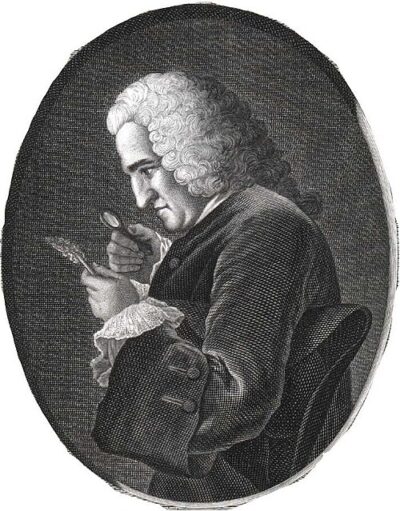
Bernard de Jussieu
Bernard de Jussieu was a French botanist. Born August 17, 1699, in Lyon. Died November 6, 1777, in Paris. Educated at Faculty of Medicine of Montpellier. Awards include Fellow of the Royal Society.
Facts
23 facts · 2 confirmed by two sources · 5 cited · 16 from one source
Where this comes from
Papalocal keeps its own record. It started from these sources; what each one said is kept here as it was copied, so a change on their side never changes this page by itself. Tap one to read its version.
What Wikidata says · copied November 18, 2026 · revision 2567456919
- Described as
- French botanist (1699-1777)
- Other names
- B.Juss.
- Born
- August 17, 1699 · 7 references
- Died
- November 6, 1777 · 8 references
- Born in
- Lyon · 1 reference
- Died in
- Paris · 1 reference
- Citizen of
- France
- Occupation
- botanist · 1 reference; physician · 2 references; naturalist; botanical collector · 1 reference
- Education
- Faculty of Medicine of Montpellier
- Member of
- Royal Society of London; Royal Swedish Academy of Sciences; French Academy of Sciences; Russian Academy of Sciences; Royal Prussian Academy of Sciences; Académie des sciences, belles-lettres et arts de Rouen
- Awards
- Fellow of the Royal Society
- Field
- botany
- Father
- Laurent de Jussieu
- Siblings
- Antoine de Jussieu; Joseph de Jussieu; Christophe de Jussieu
- Lived in
- France · 1 reference
- Wikipedias with a page
- 24
Wikidata item Q432734 (wikidata.org/wiki/Q432734), public domain (CC0). Copied November 18, 2026.
What Wikipedia says · copied November 18, 2026 · revision 1371975556
Bernard de Jussieu (French pronunciation: [bɛʁnaʁ də ʒysjø]; 17 August 1699 – 6 November 1777) was a French naturalist, younger brother of Antoine de Jussieu.
Bernard de Jussieu was born in Lyon. He took a medical degree at Montpellier and began practice in 1720, but finding the work uncongenial he gladly accepted his brother's invitation to Paris in 1722, when he succeeded Sébastien Vaillant (1669–1722) as sub-demonstrator of plants in the Jardin des Plantes. In 1725, he brought out a new edition of Joseph Pitton de Tournefort's Histoire des plantes qui naissent aux environs de Paris, 2 vols., which was afterwards translated into English by John Martyn, the original work being incomplete. In the same year he was admitted into the French Academy of Sciences, and communicated several papers to that body.Long before Abraham Trembley (1700–1784) published his Histoire des polypes d'eau douce, Jussieu maintained the doctrine that these organisms were in fact animals, and not the flowers of marine plants, which was the notion at the time; to confirm his views, he made three journeys to the coast of Normandy. Singularly modest and retiring, he published very little, but in 1759 he arranged the plants in the royal garden of the Grand Trianon in the Palace of Versailles, according to his own scheme of classification. This arrangement is printed in his nephew Antoine Laurent de Jussieu's Genera plantarum, and formed the basis of that work. He cared little for the credit of enunciating new discoveries, so long as the facts were made public. On the death of his brother Antoine, he could not be induced to succeed him as professor of botany at the Jardin des Plantes, but prevailed upon L. G. Lemonnier to assume the higher position.
He was elected a foreign member of the Royal Swedish Academy of Sciences in 1749.
The standard botanical author abbreviation B.Juss. is applied to plants described by de Jussieu.
- Born, in its opening lines
- August 17, 1699
- Died, in its opening lines
- November 6, 1777
From the Wikipedia article “Bernard de Jussieu” (en.wikipedia.org/wiki/Bernard_de_Jussieu), by its contributors, under CC BY-SA 4.0 (creativecommons.org/licenses/by-sa/4.0/). Copied November 18, 2026; not changed.
Confirmed Two sources agree. Cited One source, and it names where it got it. One source One source, without a reference of its own. Sources disagree The sources disagree. We show the best-supported value and keep theirs below.
