
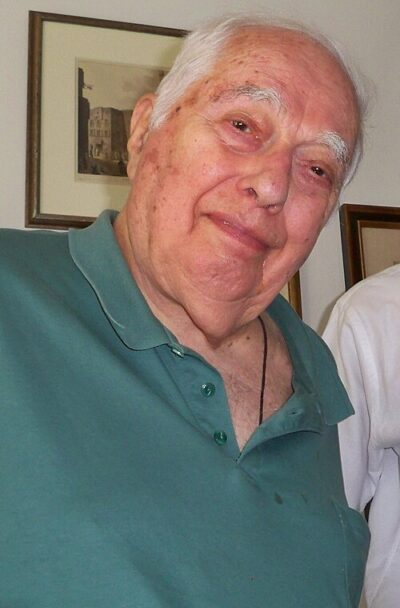
Bernard Lewis
Bernard Lewis was a British-American historian. Born May 31, 1916, in London. Died May 19, 2018, in Voorhees Township. Educated at Faculty of Arts of Paris and SOAS, University of London. Awards include National Humanities Medal, Harvey Prize and Jefferson Lecture.
Facts
37 facts · 2 confirmed by two sources · 15 cited · 20 from one source
Where this comes from
Papalocal keeps its own record. It started from these sources; what each one said is kept here as it was copied, so a change on their side never changes this page by itself. Tap one to read its version.
What Wikidata says · copied November 16, 2026 · revision 2555115867
- Described as
- British-American historian (1916–2018)
- Born
- May 31, 1916 · 8 references
- Died
- May 19, 2018 · 5 references
- Born in
- London · 1 reference
- Died in
- Voorhees Township · 1 reference
- Buried in
- Trumpeldor cemetery
- Citizen of
- United Kingdom · 3 references
- Occupation
- historian · 1 reference; university teacher · 1 reference; orientalist · 2 references; Islamicist · 1 reference
- Worked for
- Princeton University; SOAS, University of London; Institute for Advanced Study; University of London; Cornell University
- Education
- Faculty of Arts of Paris; SOAS, University of London
- Member of
- British Academy; American Academy of Arts and Sciences; American Philosophical Society (1973–) · 1 reference
- Awards
- National Humanities Medal (2006) · 1 reference; Harvey Prize (1978) · 1 reference; Jefferson Lecture (1990); Irving Kristol Award (2007) · 1 reference; honorary doctorate of Haifa University; honorary doctor of Tel Aviv University; honorary doctor of the Hebrew University of Jerusalem; Fellow of the British Academy; Thomas Jefferson Medal for Distinguished Achievement in the Arts, Humanities, and Social Sciences; Atatürk International Peace Prize (1998) · 1 reference
- Field
- history; political history · 1 reference; history of Islam · 1 reference; oriental studies · 1 reference; commentary · 1 reference
- Military branch
- British Army
- Lived in
- London
- Wikipedias with a page
- 48
Wikidata item Q501880 (wikidata.org/wiki/Q501880), public domain (CC0). Copied November 16, 2026.
What Wikipedia says · copied November 16, 2026 · revision 1381456427
Bernard Lewis (31 May 1916 – 19 May 2018) was a British-American historian who specialized in Oriental studies. He was also known as a public intellectual and political commentator. Lewis was the Cleveland E. Dodge Professor Emeritus of Near Eastern Studies at Princeton University. Lewis's expertise was in the history of Islam and the interaction between Islam and the West.
Lewis served as a soldier in the British Army in the Royal Armoured Corps and Intelligence Corps during the Second World War before being seconded to the Foreign Office. After the war, he returned to the School of Oriental and African Studies at the University of London and was appointed to the new chair in Near and Middle Eastern history.
In 2007, Lewis was called "the West's leading interpreter of the Middle East". Others have said Lewis's approach is essentialist and generalizing to the Muslim world, as well as his tendency to restate hypotheses that were challenged by more recent research. On a political level, Lewis's detractors say he revived the image of the cultural inferiority of Islam and of emphasizing the dangers of jihad. His advice was frequently sought by neoconservative policymakers, including the Bush administration. His active support of the Iraq War and neoconservative ideals have since come under scrutiny.
He was notable for his public debates with Edward Said, who said Lewis was a Zionist apologist and an Orientalist who "demeaned" Arabs, misrepresented Islam, and promoted Western imperialism, to which Lewis responded by saying Orientalism was a facet of humanism and that Said was politicizing the subject.
Lewis was also known for denying the Armenian genocide. His argument that there was no evidence of a deliberate genocide carried out against the Armenian people by the Ottoman Empire is rejected by other historians. He said that the mass killings resulted from a mutual struggle between two nationalistic movements, a view that has been criticized as "ahistorical".
- Born, in its opening lines
- May 31, 1916
- Died, in its opening lines
- May 19, 2018
From the Wikipedia article “Bernard Lewis” (en.wikipedia.org/wiki/Bernard_Lewis), by its contributors, under CC BY-SA 4.0 (creativecommons.org/licenses/by-sa/4.0/). Copied November 16, 2026; not changed.
Confirmed Two sources agree. Cited One source, and it names where it got it. One source One source, without a reference of its own. Sources disagree The sources disagree. We show the best-supported value and keep theirs below.
