
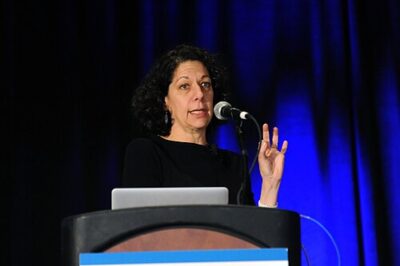
Bonnie L. Bassler
Bonnie L. Bassler is an American molecular biologist. Born 1962, in Chicago. Educated at Johns Hopkins University and University of California, Davis. Awards include MacArthur Fellows Program, L'Oréal-UNESCO Award For Women in Science and Pearl Meister Greengard Prize.
Facts
32 facts · 0 confirmed by two sources · 19 cited · 13 from one source
Where this comes from
Papalocal keeps its own record. It started from these sources; what each one said is kept here as it was copied, so a change on their side never changes this page by itself. Tap one to read its version.
What Wikidata says · copied November 15, 2026 · revision 2521471833
- Described as
- American molecular biologist
- Other names
- BL Bassler, Bonnie Lynn Bassler, B. L. Bassler, Bonnie Bassler, B.L. Bassler, B L Bassler, Bonnie L Bassler
- Born
- 1962 · 1 reference
- Born in
- Chicago
- Citizen of
- United States
- Occupation
- molecular biologist; university teacher; biochemist · 1 reference; microbiologist · 1 reference
- Worked for
- Princeton University (1994–); Howard Hughes Medical Institute (2005–)
- Education
- Johns Hopkins University; University of California, Davis
- Member of
- National Academy of Sciences (2006–) · 1 reference; American Academy of Arts and Sciences; American Philosophical Society; National Science Board (2010–2016) · 1 reference; Royal Society of London (2012) · 1 reference
- Awards
- MacArthur Fellows Program · 1 reference; L'Oréal-UNESCO Award For Women in Science (2012) · 1 reference; Pearl Meister Greengard Prize (2016) · 1 reference; Max Planck Research Award (2016); FASEB Excellence in Science Award (2016) · 1 reference; Richard Lounsbery Award (2011) · 1 reference; Dickson Prize in Medicine (2018) · 1 reference; Shaw Prize in Life Science and Medicine (2015) · 1 reference; Gruber Prize in Genetics (2020) · 1 reference; Genetics Society of America Medal (2020) · 1 reference; Wolf Prize in Chemistry (2022) · 1 reference; Clarivate Citation Laureates (2022) · 1 reference; Howard Taylor Ricketts Prize (2015) · 1 reference; Ernst Schering Prize (2018) · 1 reference; Canada Gairdner International Award (2023) · 1 reference
- Website
- https://scholar.princeton.edu/basslerlab
- Wikipedias with a page
- 24
Wikidata item Q60545293 (wikidata.org/wiki/Q60545293), public domain (CC0). Copied November 15, 2026.
What Wikipedia says · copied November 15, 2026 · revision 1381365180
Bonnie Lynn Bassler (born 1962) is an American molecular biologist; the Squibb Professor in Molecular Biology and chair of the Department of Molecular Biology at Princeton University; and a Howard Hughes Medical Institute Investigator. She has researched cell-to-cell chemical communication in bacteria and discovered key insights into the mechanism by which bacteria communicate, known as quorum sensing. She has contributed to the idea that disruption of chemical signaling can be used as an antimicrobial therapy.
Bassler has received numerous awards for her research, including the Princess of Asturias Award (2023), Paul Ehrlich and Ludwig Darmstaedter Prize (2021), the Pearl Meister Greengard Prize (2016), the L'Oreal-UNESCO award (2012), the Richard Lounsbery Award (2011), the Wiley Prize in Biomedical Sciences (2009), and a MacArthur Fellowship (2002).
She is an elected member of the National Academy of Sciences (as of 2006), a Foreign Member of the Royal Society (as of 2012), a former president of the American Society for Microbiology (2011) and served on the National Science Board with a term expiring May 10, 2016. She was an editor of the Annual Review of Genetics from 2012 to 2017.
From the Wikipedia article “Bonnie Bassler” (en.wikipedia.org/wiki/Bonnie_Bassler), by its contributors, under CC BY-SA 4.0 (creativecommons.org/licenses/by-sa/4.0/). Copied November 15, 2026; not changed.
Confirmed Two sources agree. Cited One source, and it names where it got it. One source One source, without a reference of its own. Sources disagree The sources disagree. We show the best-supported value and keep theirs below.
