
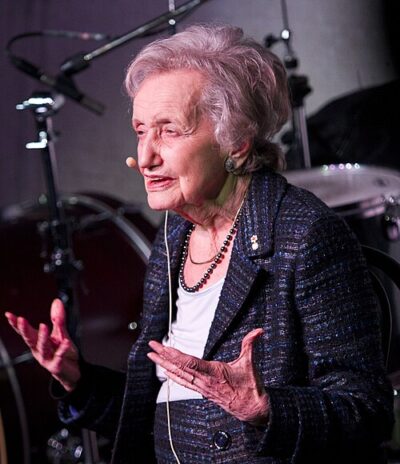
Brenda Milner
Brenda Milner is a Canada-based British neuroscientist and neuropsychologist. Born July 15, 1918, in Manchester. Educated at McGill University and Newnham College. Awards include Fellow of the Royal Society, Kavli Prize in Neuroscience and Companion of the Order of Canada.
Facts
33 facts · 1 confirmed by two sources · 11 cited · 21 from one source
Where this comes from
Papalocal keeps its own record. It started from these sources; what each one said is kept here as it was copied, so a change on their side never changes this page by itself. Tap one to read its version.
What Wikidata says · copied November 15, 2026 · revision 2565702553
- Described as
- Canada-based British neuroscientist and neuropsychologist
- Other names
- Brenda Atkinson Milner, Brenda Langford
- Born
- July 15, 1918
- Born in
- Manchester
- Citizen of
- Canada; United Kingdom
- Occupation
- neuroscientist; psychologist · 1 reference; university teacher
- Worked for
- McGill University
- Education
- McGill University (–1952) · 1 reference; Newnham College; Withington Girls' School
- Member of
- Royal Society of London (1979–); National Academy of Sciences (1976–) · 1 reference; American Academy of Arts and Sciences; Royal Society of Canada
- Awards
- Fellow of the Royal Society; Kavli Prize in Neuroscience (2014); Companion of the Order of Canada; Officer of the National Order of Quebec (1985) · 1 reference; Grand Officer of the National Order of Quebec (2009) · 1 reference; Balzan Prize (2009); Canada Gairdner International Award (2005); NAS Award in the Neurosciences (2004) · 1 reference; Pearl Meister Greengard Prize (2011); Karl Spencer Lashley Award (1979) · 1 reference; William James Fellow Award (1989) · 1 reference; Canadian Medical Hall of Fame (1997) · 1 reference; Neuronal Plasticity Prize (1995); Dan David Prize (2014) · 1 reference; APA Award for Distinguished Scientific Contributions to Psychology (1973) · 1 reference
- Field
- neuropsychology
- Spouse
- Peter Milner
- Lived in
- Montreal · 1 reference
- Wikipedias with a page
- 31
Wikidata item Q468228 (wikidata.org/wiki/Q468228), public domain (CC0). Copied November 15, 2026.
What Wikipedia says · copied November 15, 2026 · revision 1385652153
Brenda Milner (née Langford; born 15 July 1918) is a British-Canadian neuropsychologist who has contributed extensively to the research literature on various topics in the field of clinical neuropsychology. Milner is a professor in the Department of Neurology and Neurosurgery at McGill University and a professor of Psychology at the Montreal Neurological Institute. As of 2020, she holds more than 25 honorary degrees and she continued to work in her nineties. Her work covers many aspects of neuropsychology including her lifelong interest in the involvement of the temporal lobes in episodic memory. She is sometimes referred to as one of the founders of neuropsychology and has been essential in its development. She received the Balzan Prize for Cognitive Neuroscience in 2009, and the Kavli Prize in Neuroscience, together with John O'Keefe, and Marcus E. Raichle, in 2014. She turned 100 in July 2018.
- Born, in its opening lines
- July 15, 1918
From the Wikipedia article “Brenda Milner” (en.wikipedia.org/wiki/Brenda_Milner), by its contributors, under CC BY-SA 4.0 (creativecommons.org/licenses/by-sa/4.0/). Copied November 15, 2026; not changed.
Confirmed Two sources agree. Cited One source, and it names where it got it. One source One source, without a reference of its own. Sources disagree The sources disagree. We show the best-supported value and keep theirs below.
