
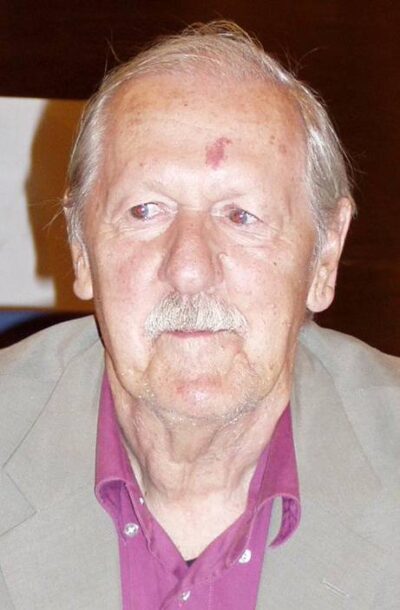
Brian Aldiss
Brian Aldiss was a British science fiction writer. Born August 18, 1925, in Dereham. Died August 19, 2017, in Oxford. Positions held include Booker Prize judge (1981). Known for Non-Stop and Hothouse. Educated at Framlingham College and West Buckland School. Awards include Officer of the Order of the British Empire, European Award of the Grand Prix de l'Imaginaire and Hugo Award for Best Short Story.
Facts
43 facts · 2 confirmed by two sources · 21 cited · 20 from one source
Where this comes from
Papalocal keeps its own record. It started from these sources; what each one said is kept here as it was copied, so a change on their side never changes this page by itself. Tap one to read its version.
What Wikidata says · copied November 16, 2026 · revision 2559764094
- Described as
- British science fiction writer (1925–2017)
- Other names
- Brian W. Aldiss, Jael Cracken, Dr. Peristyle, C. C. Shackleton, Brian Wilson Aldiss
- Born
- August 18, 1925 · 15 references
- Died
- August 19, 2017 · 11 references
- Born in
- Dereham · 1 reference
- Died in
- Oxford · 1 reference
- Name at birth
- Brian Wilson Aldiss
- Citizen of
- United Kingdom · 4 references
- Occupation
- science fiction writer · 1 reference; novelist · 1 reference; literary critic; writer · 2 references; screenwriter; artist · 2 references; military personnel · 1 reference; book dealer · 1 reference
- Positions held
- Booker Prize judge (1981) · 1 reference
- Education
- Framlingham College · 1 reference; West Buckland School · 1 reference
- Member of
- Royal Society of Literature
- Genre
- science fiction
- Known for
- Non-Stop; Hothouse
- Awards
- Officer of the Order of the British Empire; European Award of the Grand Prix de l'Imaginaire (2007) · 1 reference; Hugo Award for Best Short Story (1962) · 1 reference; Nebula Award for Best Novella (1966) · 1 reference; Pilgrim Award (1978); Hugo Award for Best Related Work (1987); John W. Campbell Memorial Award for Best Science Fiction Novel (1983); Tähtivaeltaja Award (1990); Damon Knight Memorial Grand Master Award (2000) · 1 reference; Fellow of the Royal Society of Literature; Science Fiction and Fantasy Hall of Fame (2004); BSFA Award for Best Novel (3 times) (1971, 1982, 1985); Ditmar Award; World Fantasy Convention Award
- Field
- journalism · 1 reference; science fiction · 1 reference; belletristic literature · 1 reference; science fiction literature · 1 reference
- Military branch
- British Army
- Military rank
- soldier · 1 reference
- Lived in
- Dereham
- Website
- http://www.brianaldiss.co.uk/
- Wikipedias with a page
- 54
Wikidata item Q238702 (wikidata.org/wiki/Q238702), public domain (CC0). Copied November 16, 2026.
What Wikipedia says · copied November 16, 2026 · revision 1383225681
Brian Wilson Aldiss (; 18 August 1925 – 19 August 2017) was an English writer, artist and anthology editor, best known for science-fiction novels and short stories. His byline reads either Brian W. Aldiss or simply Brian Aldiss, except for occasional pseudonyms during the mid-1960s.
Greatly influenced by science fiction pioneer H. G. Wells, Aldiss was a vice-president of the international H. G. Wells Society. He was co-president of the Birmingham Science Fiction Group with Harry Harrison. Aldiss was named a Grand Master by the Science Fiction Writers of America in 1999 and inducted by the Science Fiction Hall of Fame in 2004. He received two Hugo Awards, one Nebula Award and one John W. Campbell Memorial Award. He wrote the short story "Supertoys Last All Summer Long" (1969), the basis for the Stanley Kubrick-developed Steven Spielberg film A.I. Artificial Intelligence (2001). Aldiss was associated with the British New Wave of science fiction.
- Born, in its opening lines
- August 18, 1925
- Died, in its opening lines
- August 19, 2017
From the Wikipedia article “Brian Aldiss” (en.wikipedia.org/wiki/Brian_Aldiss), by its contributors, under CC BY-SA 4.0 (creativecommons.org/licenses/by-sa/4.0/). Copied November 16, 2026; not changed.
Confirmed Two sources agree. Cited One source, and it names where it got it. One source One source, without a reference of its own. Sources disagree The sources disagree. We show the best-supported value and keep theirs below.
