
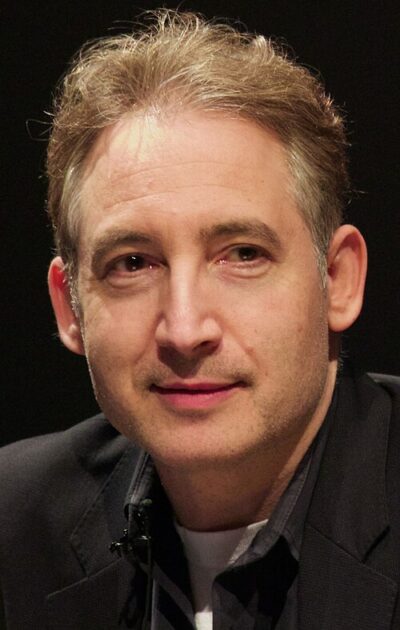
Brian Greene
Brian Greene is an American physicist. Born February 9, 1963, in New York City. Educated at Magdalen College and Harvard University. Awards include Andrew Gemant Award, Richtmyer Memorial Lecture Award and Rhodes Scholarship.
Facts
30 facts · 1 confirmed by two sources · 14 cited · 15 from one source
Where this comes from
Papalocal keeps its own record. It started from these sources; what each one said is kept here as it was copied, so a change on their side never changes this page by itself. Tap one to read its version.
What Wikipedia says · copied November 13, 2026 · revision 1383143846
Brian Randolph Greene (born February 9, 1963) is an American physicist known for his research on string theory. He is a professor of physics and mathematics at Columbia University, director of its center for theoretical physics, and the chairman of the World Science Festival, which he co-founded in 2008. Greene co-discovered mirror symmetry, relating two different Calabi–Yau manifolds. He also described the flop transition, a mild form of topology change, and the conifold transition, a more severe transformation of space, showing that topology can smoothly change in string theory.
His books The Elegant Universe (1999), The Fabric of the Cosmos (2004), The Hidden Reality (2011), and Until the End of Time (2020) were all top 10 New York Times bestsellers. Greene hosted two Emmy and Peabody Award Winning NOVA miniseries based on his books. He also appeared on The Big Bang Theory episode "The Herb Garden Germination", as well as in the films Frequency and The Last Mimzy. From 2015 to 2020, he served on the board of overseers of Harvard University, and is currently a member of the board of sponsors of the Bulletin of the Atomic Scientists.
- Born, in its opening lines
- February 9, 1963
From the Wikipedia article “Brian Greene” (en.wikipedia.org/wiki/Brian_Greene), by its contributors, under CC BY-SA 4.0 (creativecommons.org/licenses/by-sa/4.0/). Copied November 13, 2026; not changed.
What Wikidata says · copied November 14, 2026 · revision 2568965511
- Described as
- American physicist
- Other names
- Brian Randolph Greene
- Born
- February 9, 1963 · 4 references
- Born in
- New York City
- Name at birth
- Brian Randolph Greene
- Citizen of
- United States
- Occupation
- physicist · 2 references; writer · 2 references; professor · 1 reference; author · 1 reference; actor; theoretical physicist; mathematician · 1 reference
- Worked for
- Cornell University; Columbia University
- Education
- Magdalen College · 1 reference; Harvard University; Stuyvesant High School; University of Oxford · 1 reference
- Awards
- Andrew Gemant Award (2003); Richtmyer Memorial Lecture Award (2012) · 1 reference; Rhodes Scholarship (1984) · 1 reference
- Field
- superstring theory · 2 references; quantum gravity; theoretical physics · 1 reference; mathematics · 1 reference; universe · 1 reference; spacetime · 1 reference
- Religion
- agnosticism
- Lived in
- New York City
- Website
- http://www.briangreene.org/; http://briangreenewriter.blogspot.com/
- Wikipedias with a page
- 51
Wikidata item Q60815 (wikidata.org/wiki/Q60815), public domain (CC0). Copied November 14, 2026.
Confirmed Two sources agree. Cited One source, and it names where it got it. One source One source, without a reference of its own. Sources disagree The sources disagree. We show the best-supported value and keep theirs below.
