
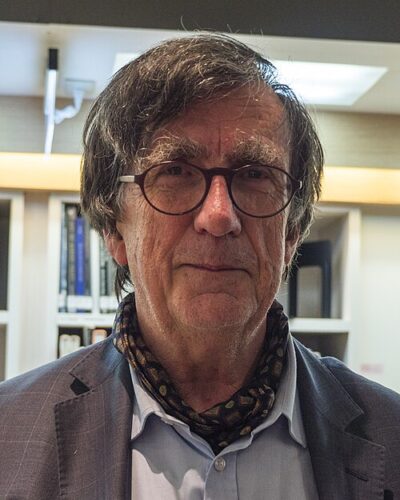
Bruno Latour
Bruno Latour was a French sociologist and philosopher. Born June 22, 1947, in Beaune. Died October 8, 2022, in 13th arrondissement of Paris. Positions held include Director of SPEAP (2012–2017) and chief scientific officer (2007–2012). Educated at Tours University and School for Advanced Studies in the Social Sciences. Awards include Knight of the Legion of Honour, Holberg International Memorial Prize and Albertus-Magnus professorate.
Facts
59 facts · 1 confirmed by two sources · 25 cited · 32 from one source · 1 where the sources disagree
What’s different
- Died: we show October 8, 2022 (Sources disagree). Wikipedia says October 9, 2022
Where this comes from
Papalocal keeps its own record. It started from these sources; what each one said is kept here as it was copied, so a change on their side never changes this page by itself. Tap one to read its version.
What Wikidata says · copied November 16, 2026 · revision 2562547873
- Described as
- French sociologist and philosopher (1947–2022)
- Born
- June 22, 1947 · 4 references
- Died
- October 8, 2022 · 2 references
- Born in
- Beaune · 2 references
- Died in
- 13th arrondissement of Paris · 1 reference
- Cause of death
- pancreatic cancer · 1 reference
- Name at birth
- Bruno Paul Louis Latour · 1 reference
- Citizen of
- France · 1 reference
- Occupation
- anthropologist · 1 reference; sociologist · 2 references; professor; philosopher · 3 references; writer; university teacher · 1 reference; science journalist · 1 reference
- Positions held
- Director of SPEAP (2012–2017); chief scientific officer (2007–2012)
- Worked for
- Paris Institute of Political Studies (2006–2017); Centre de Sociologie de l'Innovation (1982–2006); Conservatoire national des Arts et Métiers (1977–1982); Mines ParisTech (1982–2006)
- Education
- Tours University (1975) · 1 reference; School for Advanced Studies in the Social Sciences (–1987); Lycée Saint-Louis-de-Gonzague; University of Burgundy Europe (1966–1972) · 1 reference
- Member of
- American Academy of Arts and Sciences (2008–) · 1 reference; Royal Academy of Science, Letters and Fine Arts of Belgium (2014–); Royal Danish Academy of Sciences and Letters (2017–); British Academy (2018–)
- Awards
- Knight of the Legion of Honour (2011) · 1 reference; Holberg International Memorial Prize (2013) · 1 reference; Albertus-Magnus professorate (2015) · 1 reference; Siegfried Unseld Preis (2008); John Desmond Bernal Prize (1992); Officer of the National Order of Merit (2017) · 1 reference; prix Roberval Grand public (1992) · 1 reference; honorary doctorate of Lund University (1996) · 2 references; Honorary doctor of the University of Lausanne (2006) · 1 reference; honorary doctorate from the Université de Montréal (2008) · 1 reference; honorary doctor of the University of Gothenburg (2008) · 1 reference; doctor honoris causa of the University of Warwick (2009) · 1 reference; honorary doctor of the University of Edinburgh (2016); Officer of the French Order of Academic Palms (2002); prix Raymond-de-Boyer-de-Sainte-Suzanne (2014)
- Field
- contemporary philosophy; Western philosophy; continental philosophy; social constructionism; actor–network theory · 1 reference; sociology · 1 reference
- Spouse
- Chantal Latour
- Children
- Robinson Latour; Chloé Latour · 1 reference
- Father
- Louis-Noël Latour
- Mother
- Yvonne Latour
- Siblings
- Louis Latour; Mireille Chalvon-Demersay
- Religion
- Catholicism · 2 references
- Lived in
- Paris · 1 reference
- Website
- http://www.bruno-latour.fr
- Wikipedias with a page
- 51
Wikidata item Q355237 (wikidata.org/wiki/Q355237), public domain (CC0). Copied November 16, 2026.
What Wikipedia says · copied November 16, 2026 · revision 1385962149
Bruno Latour (; French: [latuʁ]; 22 June 1947 – 9 October 2022) was a French philosopher, anthropologist and sociologist. He was especially known for his work in the field of science and technology studies (STS). After teaching at the Centre de Sociologie de l'Innovation of the École des Mines de Paris from 1982 to 2006, he became a professor at Sciences Po Paris (2006–2017), where he was the scientific director of the Sciences Po Medialab. He retired from several university activities in 2017. He was also a Centennial Professor at the London School of Economics.
Latour is best known for his books We Have Never Been Modern (1991; English translation, 1993), Laboratory Life (with Steve Woolgar, 1979) and Science in Action (1987). He was best known for withdrawing from the subjective/objective division and redeveloping the approach to work in practice. Latour said in 2017 that he is interested in helping to rebuild trust in science and that some of the authority of science needs to be regained. Along with Michel Callon, Madeleine Akrich, and John Law, Latour is one of the primary developers of actor–network theory (ANT), a constructionist approach influenced by the ethnomethodology of Harold Garfinkel, the generative semiotics of Algirdas Julien Greimas, and the sociology of Émile Durkheim's rival Gabriel Tarde.
- Born, in its opening lines
- June 22, 1947
- Died, in its opening lines
- October 9, 2022
From the Wikipedia article “Bruno Latour” (en.wikipedia.org/wiki/Bruno_Latour), by its contributors, under CC BY-SA 4.0 (creativecommons.org/licenses/by-sa/4.0/). Copied November 16, 2026; not changed.
Confirmed Two sources agree. Cited One source, and it names where it got it. One source One source, without a reference of its own. Sources disagree The sources disagree. We show the best-supported value and keep theirs below.
