
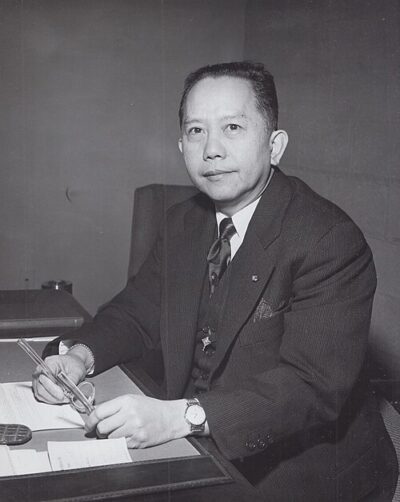
Carlos P. Romulo
Carlos P. Romulo was a Filipino politician and diplomat. Born January 14, 1899, in Manila. Died December 15, 1985, in Manila. Positions held include President of the United Nations General Assembly (1949–1950), Secretary of Foreign Affairs (1968–1984) and Resident Commissioner of the Philippines (1944–1947). Educated at University of the Philippines and Columbia University. Awards include Presidential Medal of Merit, Purple Heart and National Artist of the Philippines.
Facts
37 facts · 2 confirmed by two sources · 13 cited · 21 from one source · 1 where the sources disagree
What’s different
- Born in: we show Manila (Sources disagree). Wikidata also lists Camiling
Where this comes from
Papalocal keeps its own record. It started from these sources; what each one said is kept here as it was copied, so a change on their side never changes this page by itself. Tap one to read its version.
What Wikidata says · copied November 17, 2026 · revision 2567069507
- Described as
- Filipino politician and diplomat (1899-1985)
- Other names
- Carlos Romulo, Carlos Peña Romulo, Carlos Rómulo y Peña
- Born
- January 14, 1899 · 4 references
- Died
- December 15, 1985 · 4 references
- Born in
- Camiling; Manila · 1 reference
- Died in
- Manila · 1 reference
- Buried in
- Libingan ng mga Bayani · 1 reference
- Name at birth
- Carlos Rómulo y Peña · 1 reference
- Citizen of
- Philippines
- Occupation
- diplomat · 1 reference; journalist · 1 reference; politician · 1 reference
- Positions held
- President of the United Nations General Assembly (1949–1950); Secretary of Foreign Affairs (1968–1984); Resident Commissioner of the Philippines (1944–1947); President of the University of the Philippines (1962–1968); ambassador; non-voting member of the U.S. House of Representatives; ambassador of the Philippines to the United States (2 times) (1952–1962) · 1 reference
- Education
- University of the Philippines; Columbia University; Manila High School
- Awards
- Presidential Medal of Merit; Purple Heart; National Artist of the Philippines; Pulitzer Prize for Correspondence (1942) · 1 reference; National Order of Merit Carlos Manuel de Céspedes · 1 reference; James Cardinal Gibbons Medal; Grand Cross of the Order of Isabella the Catholic (1950) · 1 reference; honorary doctor of the University of Madrid Complutense (1964) · 1 reference; Grand Cross of the Civil Order of Alfonso X the Wise (1974) · 1 reference; United Nations Peace Medal (1981); honorary doctorate from University of Paris-II (1981) · 1 reference; Grand Cross of the Order of Charles III (1982) · 1 reference; Presidential Medal of Freedom (1984) · 1 reference
- Spouse
- Virginia Romulo (1924–1968) · 2 references
- Children
- Roberto Romulo · 1 reference
- Father
- Gregorio Romulo · 1 reference
- Military rank
- general
- Wikipedias with a page
- 26
Wikidata item Q737664 (wikidata.org/wiki/Q737664), public domain (CC0). Copied November 17, 2026.
What Wikipedia says · copied November 17, 2026 · revision 1378219170
Carlos Peña Rómulo Sr. (January 14, 1899 – December 15, 1985) was a Filipino diplomat, statesman, soldier, journalist and author. He was a co-founder of the Boy Scouts of the Philippines, a general in the US Army and the Philippine Army, university president, and president of the United Nations General Assembly.
He has been named as one of the Philippines's national artists in literature, and was the recipient of many other honors and honorary degrees.
Romulo believed in anti-colonialism and internationalism, and held Pro-American, anti-communist, anti-fascist, and economically and politically liberal beliefs.
- Born, in its opening lines
- January 14, 1899
- Died, in its opening lines
- December 15, 1985
From the Wikipedia article “Carlos P. Romulo” (en.wikipedia.org/wiki/Carlos_P._Romulo), by its contributors, under CC BY-SA 4.0 (creativecommons.org/licenses/by-sa/4.0/). Copied November 17, 2026; not changed.
Confirmed Two sources agree. Cited One source, and it names where it got it. One source One source, without a reference of its own. Sources disagree The sources disagree. We show the best-supported value and keep theirs below.
