
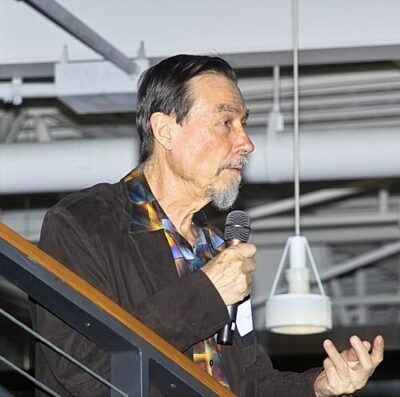
Carver Mead is an American computer scientist. Born May 1, 1934, in Bakersfield. Educated at California Institute of Technology. Awards include National Medal of Technology and Innovation, Lemelson–MIT Prize and John Price Wetherill Medal.
Facts
35 facts · 1 confirmed by two sources · 16 cited · 18 from one source
Where this comes from
Papalocal keeps its own record. It started from these sources; what each one said is kept here as it was copied, so a change on their side never changes this page by itself. Tap one to read its version.
What Wikidata says · copied November 18, 2026 · revision 2569213453
- Described as
- American computer scientist (born 1934)
- Other names
- Carver Andress Mead
- Born
- May 1, 1934 · 2 references
- Born in
- Bakersfield · 1 reference
- Citizen of
- United States
- Occupation
- computer scientist · 1 reference; physicist; inventor; engineer; businessperson · 1 reference; electrical engineer · 1 reference; university teacher · 1 reference
- Worked for
- California Institute of Technology
- Education
- California Institute of Technology
- Member of
- National Academy of Sciences; American Academy of Arts and Sciences; National Academy of Engineering; American Physical Society · 1 reference
- Awards
- National Medal of Technology and Innovation (2002) · 1 reference; Lemelson–MIT Prize (1999); John Price Wetherill Medal (1985) · 1 reference; IEEE John von Neumann Medal (1996); Harold Pender Award (1984) · 1 reference; National Inventors Hall of Fame (2009) · 1 reference; Computer History Museum Fellow; ACM-AAAI Allen Newell Award (1997) · 1 reference; Phil Kaufman Award (1996); Harry H. Goode Memorial Award (1985) · 1 reference; BBVA Foundation Frontiers of Knowledge Award (2011); Dickson Prize in Science (2002); Fellow of the American Physical Society; IEEE Neural Networks Pioneer Award; Kyoto Prize in Advanced Technology (2022) · 1 reference
- Field
- microelectronics · 1 reference; classical electromagnetism · 1 reference; artificial neural network · 1 reference; simulation · 1 reference
- Wikipedias with a page
- 19
Wikidata item Q62910 (wikidata.org/wiki/Q62910), public domain (CC0). Copied November 18, 2026.
What Wikipedia says · copied November 18, 2026 · revision 1383602227
Carver Andress Mead (born 1 May 1934) is an American scientist and engineer. He is the Gordon and Betty Moore Professor Emeritus of Engineering and Applied Science at the California Institute of Technology (Caltech), having taught there for over 40 years.
A pioneer of modern microelectronics, Mead has made contributions to the development and design of semiconductors, digital chips, and silicon compilers, technologies which form the foundations of modern very-large-scale integration chip design. Mead has also been involved in the founding of more than 20 companies.
In the 1980s, Mead focused on electronic modeling of human neurology and biology, creating "neuromorphic electronic systems." He has called for the reconceptualization of modern physics, revisiting the theoretical debates of Niels Bohr, Albert Einstein and others in light of later experiments and developments in instrumentation.
Mead's contributions as a teacher include the classic textbook Introduction to VLSI Systems (1980), which he coauthored with Lynn Conway. He also taught Deborah Chung, the first female engineering graduate of Caltech, and advised Louise Kirkbride, the school's first female electrical engineering student.
- Born, in its opening lines
- May 1, 1934
From the Wikipedia article “Carver Mead” (en.wikipedia.org/wiki/Carver_Mead), by its contributors, under CC BY-SA 4.0 (creativecommons.org/licenses/by-sa/4.0/). Copied November 18, 2026; not changed.
Confirmed Two sources agree. Cited One source, and it names where it got it. One source One source, without a reference of its own. Sources disagree The sources disagree. We show the best-supported value and keep theirs below.
