
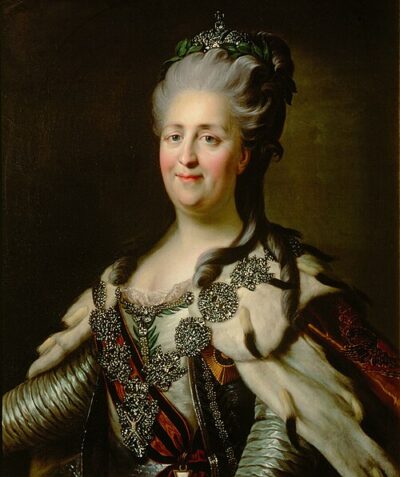
Catherine II of Russia
Catherine II of Russia was an eighth Emperor of Russia, called the Great, r. 1762–1796 (lived 1729-1796). Born May 2, 1729, in Szczecin. Died November 6, 1796, in Tsarskoye Selo. Positions held include Emperor of all the Russias (1762–1796). Known for Hermitage Museum. Awards include Knight of the Order of St. Alexander Nevsky, Order of the White Eagle and Order of the Black Eagle.
Facts
45 facts · 1 confirmed by two sources · 6 cited · 37 from one source · 1 where the sources disagree
What’s different
- Died: we show November 6, 1796 (Sources disagree). Wikipedia says November 17, 1796
Where this comes from
Papalocal keeps its own record. It started from these sources; what each one said is kept here as it was copied, so a change on their side never changes this page by itself. Tap one to read its version.
What Wikidata says · copied November 16, 2026 · revision 2567480976
- Described as
- eighth Emperor of Russia, called the Great, r. 1762–1796 (lived 1729-1796)
- Other names
- Catharine II, the Great, Catherine Romanova, Ekaterina Alexeyevna of Russia, Catherine II, Empress of Russia, Sophie Friederike Auguste of Anhalt-Zerbst, Sophie of Anhalt-Zerbst, Catherine II, Czarina of Russia, Catharine II., Catherine the Great, Catherine Alexeievna Romanova, Ekaterina II of Russia, Ekaterina Alexeyevna Romanova
- Born
- May 2, 1729 · 3 references
- Died
- November 6, 1796 · 2 references
- Born in
- Szczecin · 1 reference
- Died in
- Tsarskoye Selo · 1 reference
- Buried in
- Peter and Paul Cathedral
- Cause of death
- stroke
- Name at birth
- Sophie Friederike Auguste von Anhalt-Zerbst
- Citizen of
- Russian Empire (1745–) · 1 reference; Kingdom of Prussia (1729–1745)
- Occupation
- politician · 3 references; monarch; art collector · 1 reference; aristocrat
- Positions held
- Emperor of all the Russias (1762–1796)
- Member of
- Royal Prussian Academy of Sciences; Accademia delle Arti del Disegno
- Known for
- Hermitage Museum
- Awards
- Knight of the Order of St. Alexander Nevsky; Order of the White Eagle; Order of the Black Eagle; Order of St. Vladimir, 1st class; Order of St. Andrew; Order of Saint Catherine; Order of St. George; Order of Saint Anna; Royal Order of the Seraphim (1763); Order of St. Vladimir · 1 reference; Order of Saint Alexander Nevsky · 1 reference
- Spouse
- Peter III of Russia (1745–1762) · 1 reference
- Children
- Paul I of Russia · 1 reference; Anna Petrovna · 1 reference; Alexey Bobrinsky; Elizabeth Grigoryevna Temkina · 1 reference
- Father
- Christian August, Prince of Anhalt-Zerbst
- Mother
- Joanna Elisabeth of Holstein-Gottorp
- Siblings
- Frederick Augustus, Prince of Anhalt-Zerbst; Wilhelm Christian Friedrich von Anhalt-Zerbst; Auguste von Anhalt-Zerbst; Elisabeth von Anhalt-Zerbst
- Religion
- Lutheranism (–1744); Russian Orthodox Church (1744–)
- Military branch
- Russian Imperial Guard
- Military rank
- colonel
- Lived in
- Szczecin; Saint Petersburg
- Wikipedias with a page
- 154
Wikidata item Q36450 (wikidata.org/wiki/Q36450), public domain (CC0). Copied November 16, 2026.
What Wikipedia says · copied November 16, 2026 · revision 1384377234
Catherine II (born Sophie Auguste Friederike von Anhalt-Zerbst; 2 May 1729 – 17 November 1796), known as Catherine the Great, was Empress of Russia from 9 July 1762 until her death in 1796. Before her accession, Catherine had been a royal consort as the wife of Emperor Peter III, whom she overthrew in a coup d'état. Her reign of over 34 years saw an era of prosperity during the Enlightenment in which many new cities, universities and theatres were established; large-scale immigration from the rest of Europe occurred; and the Russian Empire was recognised as a great power of Europe.
Born a German princess, Catherine married Peter, a grandson of Peter the Great, at the age of 16. Peter became Emperor of Russia in 1762, reigning for seven months before his deposition and possible assassination at the hands of Catherine. During her reign, she often maintained close alliances with noble favourites such as Count Grigory Orlov and Grigory Potemkin. She appointed and worked with several highly successful generals such as Alexander Suvorov and Pyotr Rumyantsev and admirals such as Samuel Greig and Fyodor Ushakov. She governed at a time when the Russian Empire was expanding rapidly by conquest and diplomacy. In the west, she installed her former lover to the throne of Poland, which was eventually partitioned. In the south, the Crimean Khanate was annexed following victories over the Bar Confederation and the Ottoman Empire in the Russo-Turkish War. With the support of Great Britain, Russia colonised the territories of New Russia along the coasts of the Black and Azov seas. In the east, Russians became the first Europeans to colonise Alaska, establishing Russian America.
Many cities and towns were founded on Catherine's orders in the newly conquered lands, most notably Yekaterinoslav, Kherson, Nikolayev, and Sevastopol. An admirer of Peter the Great, Catherine continued to modernise Russia along Western European culture. However, military conscription and the economy continued to depend on serfdom, and the increasing demands of the state and of private landowners intensified the exploitation of serf labour. This was one of the chief reasons behind rebellions, including Pugachev's Rebellion of Cossacks, nomads, peoples of the Volga, and peasants.
The Manifesto on Freedom of the Nobility, issued during the short reign of Peter III and confirmed by Catherine, freed Russian nobles from compulsory military or state service. The construction of many mansions of the nobility in the classical style endorsed by the empress changed the face of the country. She is often included in the ranks of the enlightened despots. Catherine presided over the age of the Russian Enlightenment and established the Smolny Institute of Noble Maidens, the first state-financed higher education institution for women in Europe. Her reign promoted the institutionalisation of provincial administration, and the development of public education, including the establishment a state-organised school system.
Catherine was the first Russian ruler to bring the abolition of serfdom into public debate and enacted measures restricting the expansion of serf status, leaving birth and the granting of state peasants to private landowners as its two remaining legal sources.Catherine supported the Free Economic Society and the spread of potato cultivation, established foundling homes and widows' annuity arrangements, and introduced provincial public welfare institutions. She also promoted smallpox inoculation, undergoing the procedure herself in 1768.In 1783, Catherine appointed Princess Yekaterina Dashkova director of the Saint Petersburg Academy of Sciences, making her the first woman to head a national academy of sciences. Together, they established the Russian Academy, dedicated to the study of the Russian language and literature, with Dashkova as its first president. In 1795, Catherine founded the Imperial Public Library, Russia's first state public library, which opened to the public in 1814.
- Born, in its opening lines
- May 2, 1729
- Died, in its opening lines
- November 17, 1796
From the Wikipedia article “Catherine the Great” (en.wikipedia.org/wiki/Catherine_the_Great), by its contributors, under CC BY-SA 4.0 (creativecommons.org/licenses/by-sa/4.0/). Copied November 16, 2026; not changed.
Confirmed Two sources agree. Cited One source, and it names where it got it. One source One source, without a reference of its own. Sources disagree The sources disagree. We show the best-supported value and keep theirs below.
