
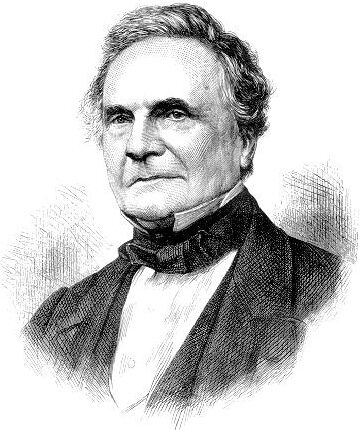
Charles Babbage
Charles Babbage was an English mathematician, philosopher, and engineer. Born December 26, 1791, in Walworth. Died October 18, 1871, in Marylebone. Positions held include Lucasian Professor of Mathematics (1829–1839). Known for analytical engine, On the Economy of Machinery and Manufactures and Reflections on the Decline of Science in England, and on Some of Its Causes. Educated at Peterhouse and Trinity College. Awards include Fellow of the Royal Society, Gold Medal of the Royal Astronomical Society and Fellow of the Royal Society of Edinburgh.
Facts
52 facts · 2 confirmed by two sources · 16 cited · 33 from one source · 1 where the sources disagree
What’s different
- Buried in: we show Kensal Green Cemetery (Sources disagree). Wikidata also lists Tomb of Charles Babbage
Where this comes from
Papalocal keeps its own record. It started from these sources; what each one said is kept here as it was copied, so a change on their side never changes this page by itself. Tap one to read its version.
What Wikidata says · copied November 16, 2026 · revision 2568730639
- Described as
- English mathematician, philosopher, and engineer (1791–1871)
- Born
- December 26, 1791 · 12 references
- Died
- October 18, 1871 · 11 references
- Born in
- Walworth · 1 reference
- Died in
- Marylebone · 2 references
- Buried in
- Kensal Green Cemetery · 1 reference; Tomb of Charles Babbage
- Cause of death
- kidney failure
- Citizen of
- United Kingdom of Great Britain and Ireland
- Occupation
- mathematician · 1 reference; computer scientist; inventor; economist; philosopher · 1 reference; university teacher; engineer; astronomer · 1 reference
- Positions held
- Lucasian Professor of Mathematics (1829–1839) · 1 reference
- Worked for
- University of Cambridge (1827–1839) · 1 reference
- Education
- Peterhouse (–1814) · 1 reference; Trinity College (1810–) · 1 reference; Totnes Grammar School (1801–1803) · 2 references; Alphington Primary School · 2 references; Forty Hill CofE Primary School (1803–1806) · 2 references
- Member of
- Royal Society of London; Bavarian Academy of Sciences and Humanities; Saint Petersburg Academy of Sciences; Hungarian Academy of Sciences; American Academy of Arts and Sciences (1832–); Royal Society of Edinburgh (1820–) · 1 reference; Royal Statistical Society (1834–) · 1 reference; Analytical Society (1812–); Royal Astronomical Society (1820–); Academy of Sciences of Turin (1841–) · 1 reference
- Known for
- analytical engine; On the Economy of Machinery and Manufactures; Reflections on the Decline of Science in England, and on Some of Its Causes; difference engine; Passages from the Life of a Philosopher.; Laws of mechanical notation (for consideration) / [C. Babbage]; Ninth Bridgewater Treatise; On the Mathematical Powers of the Calculating Engine
- Awards
- Fellow of the Royal Society (1816) · 1 reference; Gold Medal of the Royal Astronomical Society (1824) · 1 reference; Fellow of the Royal Society of Edinburgh (1820) · 1 reference; Fellow of the American Academy of Arts and Sciences (1832) · 1 reference; Knight of the Royal Order of the Welfs (1832) · 1 reference
- Field
- mathematics; analytic philosophy; computer science
- Spouse
- Georgiana Whitmore (1814–1827) · 1 reference
- Children
- Benjamin Babbage; Henry Babbage
- Religion
- Christianity
- Wikipedias with a page
- 114
Wikidata item Q46633 (wikidata.org/wiki/Q46633), public domain (CC0). Copied November 16, 2026.
What Wikipedia says · copied November 16, 2026 · revision 1383106637
Charles Babbage (; 26 December 1791 – 18 October 1871) was an English polymath. A mathematician, philosopher, inventor and mechanical engineer, Babbage originated the concept of a digital programmable computer.
Babbage is considered by some to merit the title of "father of the computer". He is credited with inventing the first mechanical computer, the difference engine, that eventually led to more complex electronic designs, though all the essential ideas of modern computers are to be found in his analytical engine, programmed using a principle openly borrowed from the Jacquard loom. As part of his computer work, he also designed the first computer printers. He had a broad range of interests in addition to his work on computers, covered in his 1832 book Economy of Manufactures and Machinery. He was an important figure in the social scene in London, and is credited with importing the "scientific soirée" from France with his well-attended Saturday evening soirées. His varied work in other fields has led him to be described as "pre-eminent" among the many polymaths of his century.
Babbage, who died before the complete successful engineering of many of his designs, including his Difference Engine and Analytical Engine, remained a prominent figure in the ideating of computing. Parts of his incomplete mechanisms are on display in the Science Museum in London. In 1991, a functioning difference engine was constructed from the original plans. Built to tolerances achievable in the 19th century, the success of the finished engine indicated that Babbage's machine would have worked.
- Born, in its opening lines
- December 26, 1791
- Died, in its opening lines
- October 18, 1871
From the Wikipedia article “Charles Babbage” (en.wikipedia.org/wiki/Charles_Babbage), by its contributors, under CC BY-SA 4.0 (creativecommons.org/licenses/by-sa/4.0/). Copied November 16, 2026; not changed.
Confirmed Two sources agree. Cited One source, and it names where it got it. One source One source, without a reference of its own. Sources disagree The sources disagree. We show the best-supported value and keep theirs below.
