
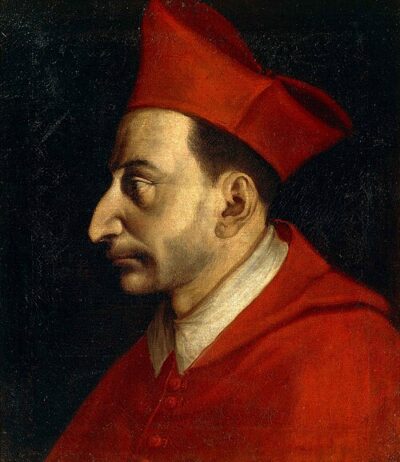
Charles Borromeo
Charles Borromeo was an Italian Roman Catholic prelate and saint. Born October 2, 1538, in Arona. Died November 3, 1584, in Milan. Positions held include Roman Catholic Archbishop of Milan (1564–1584), Cardinal Secretary of State (1560–1584) and Camerlengo of the Sacred College of Cardinals (1575–1576). Educated at University of Pavia.
Facts
28 facts · 2 confirmed by two sources · 14 cited · 12 from one source
Where this comes from
Papalocal keeps its own record. It started from these sources; what each one said is kept here as it was copied, so a change on their side never changes this page by itself. Tap one to read its version.
What Wikidata says · copied November 16, 2026 · revision 2567491437
- Described as
- Italian Roman Catholic prelate and saint (1538–1584)
- Other names
- Saint Charles Borromeo, Carlo Borromeo, Carolus Borromeus, Saint Karol Boromeusz, Saint Carlo Borromeo, Charles, Saint Borromeo, San Carlo Borromeo, Saint Carolus Borromaeus, St. Carlo Borromeo, Charles Borromeus, Charles Borromée, Saint Charles Borromée
- Born
- October 2, 1538 · 3 references
- Died
- November 3, 1584 · 12 references
- Born in
- Arona · 1 reference
- Died in
- Milan · 2 references
- Buried in
- Milan Cathedral
- Occupation
- Catholic archbishop (1563–) · 1 reference; Catholic deacon (1560–) · 1 reference; archbishop · 2 references; diplomat; inquisitor; preacher · 1 reference; Catholic priest · 1 reference; Catholic theologian · 1 reference
- Positions held
- Roman Catholic Archbishop of Milan (1564–1584) · 2 references; Cardinal Secretary of State (1560–1584); Camerlengo of the Sacred College of Cardinals (1575–1576); cardinal priest (1560–) · 2 references; cardinal-nephew; cardinal (1560–) · 4 references; Major Penitentiary · 2 references
- Education
- University of Pavia
- Field
- administration and management of the church · 1 reference; preaching · 1 reference; Christian ministry; homiletics · 1 reference
- Father
- Giberto II Borromeo
- Mother
- Margherita Medici
- Religion
- Catholic Church · 1 reference
- Wikipedias with a page
- 56
Wikidata item Q216946 (wikidata.org/wiki/Q216946), public domain (CC0). Copied November 16, 2026.
What Wikipedia says · copied November 16, 2026 · revision 1385624768
Charles Borromeo (Italian: Carlo Borromeo; Latin: Carolus Borromeus; 2 October 1538 – 3 November 1584) was an Italian Catholic prelate who served as Archbishop of Milan from 1564 to 1584. He was made a cardinal in 1560.
Borromeo founded the Confraternity of Christian Doctrine and was a leading figure of the Counter-Reformation together with Ignatius of Loyola and Philip Neri. In that role, he was responsible for significant reforms in the Catholic Church, including the founding of seminaries for the education of priests. He was canonized in 1610 and his feast day is 4 November.
- Born, in its opening lines
- October 2, 1538
- Died, in its opening lines
- November 3, 1584
From the Wikipedia article “Charles Borromeo” (en.wikipedia.org/wiki/Charles_Borromeo), by its contributors, under CC BY-SA 4.0 (creativecommons.org/licenses/by-sa/4.0/). Copied November 16, 2026; not changed.
Confirmed Two sources agree. Cited One source, and it names where it got it. One source One source, without a reference of its own. Sources disagree The sources disagree. We show the best-supported value and keep theirs below.
