
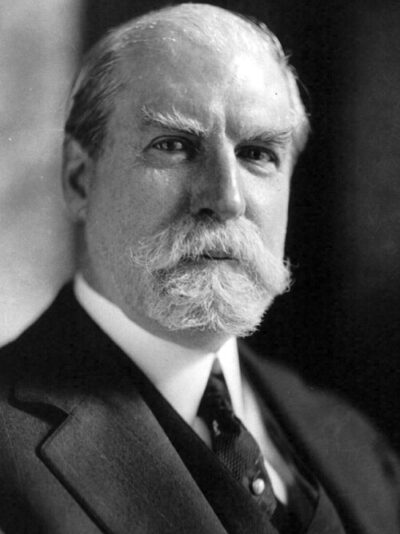
Charles Evans Hughes
Charles Evans Hughes was an American jurist; Chief Justice of the United States from 1930 to 1941. Born April 11, 1862, in Glens Falls. Died August 27, 1948, in Osterville. Positions held include Chief Justice of the United States (1930–1941), United States Secretary of State (1921–1925) and Associate Justice of the Supreme Court of the United States (1910–1916). Educated at Colgate University and Brown University.
Facts
37 facts · 2 confirmed by two sources · 11 cited · 24 from one source
Where this comes from
Papalocal keeps its own record. It started from these sources; what each one said is kept here as it was copied, so a change on their side never changes this page by itself. Tap one to read its version.
What Wikidata says · copied November 13, 2026 · revision 2565544274
- Described as
- American jurist; Chief Justice of the United States from 1930 to 1941 (1862–1948)
- Other names
- Chas. E. Hughes, Charles Evans Hughes Sr., Governor Hughes, Charles Hughes, Charles E. Hughes
- Born
- April 11, 1862 · 8 references
- Died
- August 27, 1948 · 8 references
- Born in
- Glens Falls · 1 reference
- Died in
- Osterville · 1 reference
- Buried in
- Woodlawn Cemetery · 1 reference
- Cause of death
- pneumonia
- Citizen of
- United States
- Occupation
- politician · 2 references; jurist · 2 references; judge · 2 references; lawyer; diplomat; governor · 1 reference; foreign minister · 1 reference
- Positions held
- Chief Justice of the United States (1930–1941); United States Secretary of State (1921–1925); Associate Justice of the Supreme Court of the United States (1910–1916); Governor of New York (1907–1910); board member (1927–1930)
- Political party
- Republican Party
- Worked for
- Cornell University
- Education
- Colgate University; Brown University; Columbia Law School; Thirteenth Street School · 1 reference
- Member of
- American Academy of Arts and Sciences; Phi Beta Kappa Society; Institut de Droit International (1931–); American Philosophical Society (1926–); Delta Upsilon
- Spouse
- Antoinette Carter Hughes
- Children
- Charles Evans Hughes Jr. · 1 reference; Elizabeth Hughes Gossett · 1 reference; Helen Hughes; Catherine Hughes Waddell
- Mother
- Mary Catherine Hughes · 1 reference
- Religion
- Baptists
- Wikipedias with a page
- 44
Wikidata item Q313252 (wikidata.org/wiki/Q313252), public domain (CC0). Copied November 13, 2026.
What Wikipedia says · copied November 13, 2026 · revision 1379062053
Charles Evans Hughes (April 11, 1862 – August 27, 1948) was an American politician, academic, and jurist who served as the 11th chief justice of the United States from 1930 to 1941. A member of the Republican Party, he previously was the 36th governor of New York (1907–1910), an associate justice of the Supreme Court (1910–1916), and 44th U.S. secretary of state (1921–1925). He was the Republican nominee in the 1916 presidential election, narrowly losing to incumbent president Woodrow Wilson.
Born to a Welsh immigrant preacher and his wife in Glens Falls, New York, Hughes graduated from Brown University and Columbia Law School and practiced law in New York City. After working in private practice for several years, in 1905 he led successful state investigations into public utilities and the life insurance industry. He won election as the governor of New York in 1906, and implemented several progressive reforms. In 1910, President William Howard Taft appointed Hughes as an associate justice of the Supreme Court of the United States. During his tenure on the Supreme Court, Hughes often joined Associate Justice Oliver Wendell Holmes Jr. in voting to uphold state and federal regulations.
Hughes served as an associate justice until 1916, when he resigned from the bench to accept the Republican presidential nomination. Though Hughes was widely viewed as the favorite in the race against incumbent Democratic president Woodrow Wilson, Wilson won a narrow victory. After Warren G. Harding won the 1920 presidential election, Hughes accepted Harding's invitation to serve as secretary of state. Serving under Harding and Calvin Coolidge, he negotiated the Washington Naval Treaty, which was designed to prevent a naval arms race among the United States, the United Kingdom and Japan. Hughes left office in 1925 and returned to private practice, becoming one of the most prominent attorneys in the country.
In 1930, President Herbert Hoover appointed him to succeed Chief Justice Taft. Along with Associate Justice Owen Roberts, Hughes emerged as a key swing vote on the bench, positioned between the liberal Three Musketeers and the conservative Four Horsemen. The Hughes Court struck down several New Deal programs in the early and the mid-1930s; 1937 marked a turning point for the Supreme Court and the New Deal as Hughes and Roberts joined with the Three Musketeers to uphold the Wagner Act and a state minimum wage law. That same year saw the defeat of the Judicial Procedures Reform Bill of 1937, which would have expanded the size of the Supreme Court. Hughes served until 1941, when he retired and was succeeded by Associate Justice Harlan F. Stone.
- Born, in its opening lines
- April 11, 1862
- Died, in its opening lines
- August 27, 1948
From the Wikipedia article “Charles Evans Hughes” (en.wikipedia.org/wiki/Charles_Evans_Hughes), by its contributors, under CC BY-SA 4.0 (creativecommons.org/licenses/by-sa/4.0/). Copied November 13, 2026; not changed.
Confirmed Two sources agree. Cited One source, and it names where it got it. One source One source, without a reference of its own. Sources disagree The sources disagree. We show the best-supported value and keep theirs below.
