
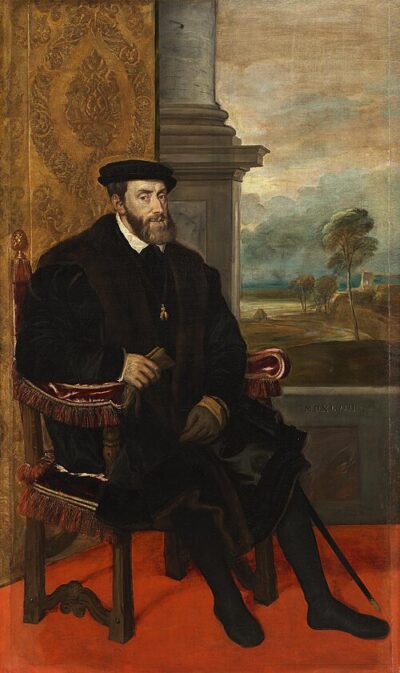
Charles V, Holy Roman Emperor
Charles V, Holy Roman Emperor was a Holy Roman Emperor from 1519 to 1556. Born February 24, 1500, in Ghent. Died September 21, 1558, in Monastery of Yuste. Positions held include monarch of the Crown of Aragon (1516–1556), Monarch of Castile and Leon (1516–1556) and Holy Roman Emperor (1519–1556). Awards include Knight of the Order of the Golden Fleece, Order of Alcántara and Order of Calatrava.



Facts
40 facts · 2 confirmed by two sources · 14 cited · 24 from one source
Where this comes from
Papalocal keeps its own record. It started from these sources; what each one said is kept here as it was copied, so a change on their side never changes this page by itself. Tap one to read its version.
What Wikidata says · copied November 16, 2026 · revision 2564068909
- Described as
- Holy Roman Emperor from 1519 to 1556 (1500–1558)
- Other names
- Karl V., Holy Roman Emperor Charles V, King Carlos I, King Charles I, Emperor Charles V, Charles I of Spain, Don Carlos, King Charles, Carlos I, Charles I, Carlos V, King Carlos
- Born
- February 24, 1500 · 4 references
- Died
- September 21, 1558 · 4 references
- Born in
- Ghent · 4 references
- Died in
- Monastery of Yuste · 1 reference
- Buried in
- Royal Crypt of the Royal Monastery of San Lorenzo de El Escorial
- Cause of death
- malaria
- Citizen of
- Holy Roman Empire
- Occupation
- monarch · 2 references
- Positions held
- monarch of the Crown of Aragon (1516–1556); Monarch of Castile and Leon (1516–1556); Holy Roman Emperor (1519–1556); Lord of the Netherlands; King of Sardinia (1516–1556)
- Awards
- Knight of the Order of the Golden Fleece; Order of Alcántara; Order of Calatrava; Order of Santiago; Knight of the Garter (1508); illustrious son · 1 reference
- Field
- politics · 1 reference
- Spouse
- Isabella of Portugal (1526–1539) · 2 references
- Children
- Philip II of Spain · 1 reference; Maria of Austria, Holy Roman Empress · 1 reference; Infante Fernando of Austria · 1 reference; Joanna of Austria, Princess of Portugal · 1 reference; Isabel of Castile; Margaret of Parma; Tadea of Austria; John of Austria; Juan Austria y Portugal; Cornelis de Hooghe
- Father
- Philip I of Castile · 1 reference
- Mother
- Juana I of Castile · 1 reference
- Siblings
- Eleanor of Austria · 1 reference; Mary of Hungary; Catherine of Austria, Queen of Portugal; Isabella of Austria; Ferdinand I, Holy Roman Emperor · 1 reference; Rietje Koane
- Religion
- Catholic Church
- Wikipedias with a page
- 127
Wikidata item Q32500 (wikidata.org/wiki/Q32500), public domain (CC0). Copied November 16, 2026.
What Wikipedia says · copied November 16, 2026 · revision 1385624733
Charles V (24 February 1500 – 21 September 1558) was Holy Roman Emperor and Archduke of Austria from 1519 to 1556, King of Spain (as Charles I) from 1516 to 1556, King of Sicily and Naples from 1516 to 1554, and also Lord of the Netherlands and titular Duke of Burgundy (as Charles II) from 1506 to 1555. He was heir to and then head of the rising House of Habsburg. His dominions in Europe included the Holy Roman Empire, extending from Germany to northern Italy with rule over the Austrian hereditary lands and Burgundian Low Countries, and Spain with its possessions of the southern Italian kingdoms of Sicily, Naples, and Sardinia. In the Americas, he oversaw the continuation of Spanish colonisation and a short-lived German colonisation. The personal union of the European and American territories he ruled was the first collection of realms labelled "the empire on which the sun never sets".
Charles was born in Flanders to Habsburg Archduke Philip the Handsome, son of Maximilian I, Holy Roman Emperor and Mary of Burgundy, and Joanna of Castile, third child of Isabella I of Castile and Ferdinand II of Aragon, the Catholic Monarchs of Spain. Heir of his grandparents, Charles inherited his family's dominions at a young age. After his father's death in 1506, he inherited the Habsburg Netherlands in the Low Countries. In 1516, he became King of Spain as co-monarch of Castile and Aragon with his mother. Spain's possessions included the Castilian colonies of the Spanish West Indies and the Spanish Main, as well as Naples, Sicily and Sardinia. At the death of his paternal grandfather Maximilian in 1519, he inherited the Austrian hereditary lands and was elected as Holy Roman Emperor. He adopted the Imperial name of Charles V as his main title, and styled himself as a new Charlemagne.
Charles revitalised the medieval concept of universal monarchy. With no fixed capital, he made 40 journeys through the different entities he ruled and spent a quarter of his reign travelling within his realms. Although his empire came to him peacefully, he spent most of his life waging war, exhausting his revenues and leaving debts in his attempt to defend the integrity of the Holy Roman Empire from the Protestant Reformation, the expansion of the Ottoman Empire, and in wars with France. Charles borrowed money from German and Italian bankers and, to repay them, relied on the wealth of the Low Countries and the flow of silver from New Spain and Peru, brought under his rule following the Spanish conquest of the Aztec and Inca empires, which caused widespread inflation. He supported the Magellan expedition, which resulted in the first circumnavigation of the world.
Crowned King of Germany in Aachen, Charles sided with Pope Leo X and declared Martin Luther an outlaw at the Diet of Worms in 1521. The same year, Francis I of France, surrounded by the Habsburg possessions, started a war in Italy that led to his capture in the Battle of Pavia (1525). In 1527, Rome was sacked by an army of Charles's mutinous soldiers. Charles then defended Vienna from the Ottoman Turks and obtained coronations as King of Italy and Holy Roman Emperor from Pope Clement VII. In 1535, he took possession of Milan and captured Tunis. However, the loss of Buda during the struggle for Hungary and the Algiers expedition in the early 1540s frustrated his anti-Ottoman policies. After years of negotiations, Charles came to an agreement with Pope Paul III for the organisation of the Council of Trent (1545). The refusal of the Lutheran Schmalkaldic League to recognise the council's validity led to a war, won by Charles. However, Henry II of France offered new support to the Lutheran cause and strengthened the Franco-Ottoman alliance with Suleiman the Magnificent.
Ultimately, Charles conceded the Peace of Augsburg and abandoned his multi-national project with abdications in 1556 that divided his hereditary and imperial domains between the Spanish Habsburgs, headed by his son Philip II of Spain, and the Austrian Habsburgs, headed by his brother Ferdinand. In 1557, Charles retired to the Monastery of Yuste in Extremadura and died there a year later.
- Born, in its opening lines
- February 24, 1500
- Died, in its opening lines
- September 21, 1558
From the Wikipedia article “Charles V, Holy Roman Emperor” (en.wikipedia.org/wiki/Charles_V,_Holy_Roman_Emperor), by its contributors, under CC BY-SA 4.0 (creativecommons.org/licenses/by-sa/4.0/). Copied November 16, 2026; not changed.
Confirmed Two sources agree. Cited One source, and it names where it got it. One source One source, without a reference of its own. Sources disagree The sources disagree. We show the best-supported value and keep theirs below.
