
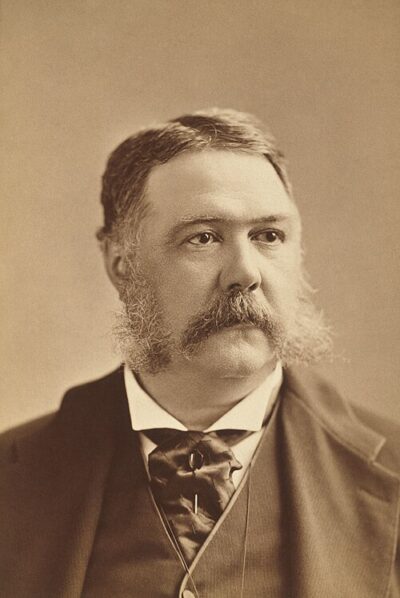
Chester A. Arthur
Chester A. Arthur was a president of the United States from 1881 to 1885. Born October 5, 1829, in Fairfield. Died November 18, 1886, in New York City. Positions held include President of the United States (1881–1885), Vice President of the United States (1881) and Collector of the Port of New York. Educated at Union College and State and National Law School.
Facts
33 facts · 2 confirmed by two sources · 8 cited · 23 from one source
Where this comes from
Papalocal keeps its own record. It started from these sources; what each one said is kept here as it was copied, so a change on their side never changes this page by itself. Tap one to read its version.
What Wikidata says · copied November 13, 2026 · revision 2568745642
- Described as
- president of the United States from 1881 to 1885
- Other names
- Chester Arthur, President Arthur, C. A. Arthur, C. Arthur, Chester Alan Arthur
- Born
- October 5, 1829 · 8 references
- Died
- November 18, 1886 · 9 references
- Born in
- Fairfield
- Died in
- New York City · 1 reference
- Buried in
- Albany Rural Cemetery
- Cause of death
- stroke · 1 reference
- Name at birth
- Chester Alan Arthur
- Citizen of
- United States
- Occupation
- military officer; lawyer · 1 reference; politician · 2 references; statesperson; educator
- Positions held
- President of the United States (1881–1885); Vice President of the United States (1881); Collector of the Port of New York; president · 1 reference
- Political party
- Republican Party (1854–1886); Whig Party (–1854)
- Education
- Union College (–1848); State and National Law School (–1853) · 1 reference
- Member of
- Phi Beta Kappa Society
- Spouse
- Ellen Lewis Herndon Arthur (1859–1880) · 1 reference
- Children
- Chester Alan Arthur II; William Lewis Herndon Arthur · 1 reference; Ellen Herndon Arthur · 1 reference
- Father
- William Arthur
- Mother
- Malvina Stone · 1 reference
- Siblings
- Mary Arthur McElroy
- Religion
- Episcopal Church
- Military branch
- Union Army
- Military rank
- general
- Height
- 1.88 m (6 ft 2 in) · 1 reference
- Wikipedias with a page
- 133
Wikidata item Q35498 (wikidata.org/wiki/Q35498), public domain (CC0). Copied November 13, 2026.
What Wikipedia says · copied November 13, 2026 · revision 1382776912
Chester Alan Arthur (October 5, 1829 – November 18, 1886) was the 21st president of the United States, serving from 1881 to 1885. A Republican from New York, he served as the 20th vice president under President James A. Garfield in 1881, assuming the presidency after Garfield's assassination. Arthur's administration saw the largest expansion of the U.S. Navy, the end of the so-called "spoils system", and the implementation of harsher restrictions for migrants entering from abroad.
Arthur was born in Fairfield, Vermont, and practiced law in New York City. He served as quartermaster general of the New York Militia during the American Civil War. Following the war, he devoted more time to New York Republican politics and quickly rose in Senator Roscoe Conkling's political organization. President Ulysses S. Grant appointed him as Collector of the Port of New York in 1871, and he was an important supporter of Conkling and the Stalwart faction of the Republican Party. In 1878, following bitter disputes between Conkling and President Rutherford B. Hayes over control of patronage in New York, Hayes fired Arthur as part of a plan to reform the federal patronage system.
During the 1880 Republican National Convention, the extended contest between Grant, identified with the Stalwarts, and James G. Blaine, the candidate of the Half-Breed faction, led to the compromise selection of James Garfield as the nominee for president. Republicans then nominated Arthur for vice president to balance the ticket geographically and to placate Stalwarts disappointed by Grant's defeat. Garfield and Arthur won the 1880 presidential election and took office in March 1881. Four months into his term, Garfield was shot by an assassin; he died 11 weeks later, and Arthur assumed the presidency.
As president, Arthur presided over the rebirth of the U.S. Navy, but he was criticized for failing to alleviate the federal budget surplus which had been accumulating since the end of the Civil War. Arthur vetoed the first version of the 1882 Chinese Exclusion Act, arguing that its twenty-year ban on Chinese immigrants to the United States violated the Burlingame Treaty, but he signed a second version, which included a ten-year ban. He appointed Horace Gray and Samuel Blatchford to the Supreme Court. He also enforced the Immigration Act of 1882 to impose more restrictions on immigrants and the Tariff of 1883 to attempt to reduce tariffs. Arthur signed into law the Pendleton Civil Service Reform Act of 1883, which came as a surprise to reformers who held a negative opinion of Arthur as a Stalwart and product of Conkling's organization.
Suffering from poor health, Arthur made only a limited effort to secure the Republican Party's nomination in 1884, and he retired at the end of his term. Arthur's failing health and political temperament combined to make his administration less active than a modern presidency, yet he earned praise among contemporaries for his solid performance in office.
- Born, in its opening lines
- October 5, 1829
- Died, in its opening lines
- November 18, 1886
From the Wikipedia article “Chester A. Arthur” (en.wikipedia.org/wiki/Chester_A._Arthur), by its contributors, under CC BY-SA 4.0 (creativecommons.org/licenses/by-sa/4.0/). Copied November 13, 2026; not changed.
Confirmed Two sources agree. Cited One source, and it names where it got it. One source One source, without a reference of its own. Sources disagree The sources disagree. We show the best-supported value and keep theirs below.
