
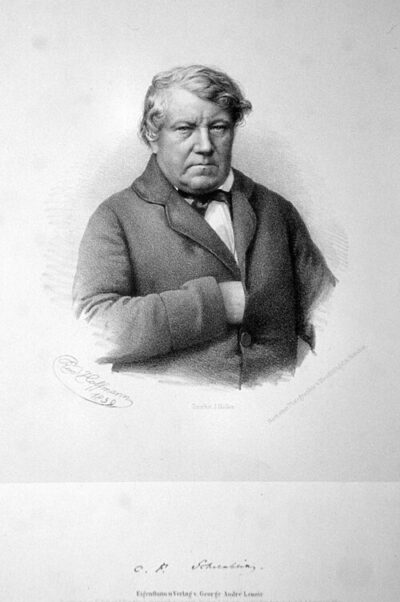
Christian Friedrich Schönbein
Christian Friedrich Schönbein was a German-Swiss chemist, discoverer of guncotton and ozone. Born October 18, 1799, in Metzingen. Died August 29, 1868, in Baden-Baden. Positions held include rector of the University of Basel. Educated at University of Tübingen and University of Erlangen–Nuremberg. Awards include Royal Order of Vasa, honorary doctor of the University of Freiburg and honorary doctorate of the University of Basel.
Facts
30 facts · 2 confirmed by two sources · 3 cited · 24 from one source · 1 where the sources disagree
What’s different
- Born in: we show Metzingen (Sources disagree). Wikidata also lists Residential and commercial building Reutlinger Straße 2 (Metzingen)
Where this comes from
Papalocal keeps its own record. It started from these sources; what each one said is kept here as it was copied, so a change on their side never changes this page by itself. Tap one to read its version.
What Wikidata says · copied November 16, 2026 · revision 2569046839
- Described as
- German-Swiss chemist, discoverer of guncotton and ozone (1799-1868)
- Other names
- Christian Friedrich Schoenbein
- Born
- October 18, 1799 · 6 references
- Died
- August 29, 1868 · 6 references
- Born in
- Metzingen · 1 reference; Residential and commercial building Reutlinger Straße 2 (Metzingen)
- Died in
- Baden-Baden · 1 reference
- Buried in
- Wolfgottesacker
- Citizen of
- Switzerland; Kingdom of Württemberg
- Occupation
- chemist · 1 reference; politician; university teacher; physicist · 1 reference
- Positions held
- rector of the University of Basel
- Worked for
- University of Basel
- Education
- University of Tübingen; University of Erlangen–Nuremberg · 1 reference
- Member of
- Royal Prussian Academy of Sciences; German Academy of Sciences Leopoldina; French Academy of Sciences; Bavarian Academy of Sciences and Humanities; Göttingen Academy of Sciences and Humanities in Lower Saxony; Silesian Society for the Culture of the Fatherland; Royal Society of Edinburgh; Burschenschaft Germania Tübingen
- Awards
- Royal Order of Vasa; honorary doctor of the University of Freiburg; honorary doctorate of the University of Basel; Fellow of the Royal Society of Edinburgh; honorary member of the Physics Association (Frankfurt am Main, Germany) (1846)
- Children
- Fanny Rognon-Schönbein
- Lived in
- Rheinlust building (1844–1868) · 1 reference
- Wikipedias with a page
- 32
Wikidata item Q61319 (wikidata.org/wiki/Q61319), public domain (CC0). Copied November 16, 2026.
What Wikipedia says · copied November 16, 2026 · revision 1371981354
Christian Friedrich Schönbein HFRSE (18 October 1799 – 29 August 1868) was a German-Swiss chemist who is best known for inventing the fuel cell (1838) at the same time as William Robert Grove and his discoveries of guncotton and ozone. He also created the concept of geochemistry in 1838.
- Born, in its opening lines
- October 18, 1799
- Died, in its opening lines
- August 29, 1868
From the Wikipedia article “Christian Friedrich Schönbein” (en.wikipedia.org/wiki/Christian_Friedrich_Schönbein), by its contributors, under CC BY-SA 4.0 (creativecommons.org/licenses/by-sa/4.0/). Copied November 16, 2026; not changed.
Confirmed Two sources agree. Cited One source, and it names where it got it. One source One source, without a reference of its own. Sources disagree The sources disagree. We show the best-supported value and keep theirs below.
