
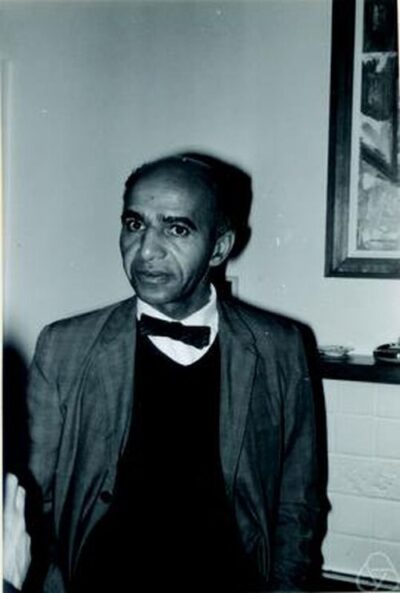
David Blackwell
David Blackwell was an American mathematician. Born April 24, 1919, in Centralia. Died July 8, 2010, in Berkeley. Positions held include chairperson (2 times) (1956–1977). Known for Rao–Blackwell theorem, Blackwell channel and A renewal theorem. Educated at University of Illinois Urbana-Champaign. Awards include John von Neumann Theory Prize, National Medal of Science and Fellow of the American Statistical Association.
Facts
35 facts · 2 confirmed by two sources · 19 cited · 14 from one source
Where this comes from
Papalocal keeps its own record. It started from these sources; what each one said is kept here as it was copied, so a change on their side never changes this page by itself. Tap one to read its version.
What Wikidata says · copied November 18, 2026 · revision 2571614665
- Described as
- American mathematician (1919–2010)
- Other names
- David H. Blackwell, David Harold Blackwell
- Born
- April 24, 1919 · 4 references
- Died
- July 8, 2010 · 5 references
- Born in
- Centralia · 2 references
- Died in
- Berkeley · 2 references
- Cause of death
- stroke · 1 reference
- Name at birth
- David Harold Blackwell · 1 reference
- Citizen of
- United States
- Occupation
- mathematician · 1 reference; statistician; university teacher
- Positions held
- chairperson (2 times) (1956–1977) · 1 reference
- Worked for
- University of California, Berkeley (1954–1989) · 1 reference; Howard University (1944–1954) · 1 reference; Institute for Advanced Study (1941–1942) · 1 reference; Southern University (1942–1943) · 1 reference; Clark College (1943–1944)
- Education
- University of Illinois Urbana-Champaign (1935–1941) · 2 references
- Member of
- National Academy of Sciences (1965–) · 1 reference; American Academy of Arts and Sciences (1969–) · 1 reference; Alpha Phi Alpha; American Philosophical Society (1990–) · 1 reference; American Association for the Advancement of Science (1969–) · 1 reference; Institute of Mathematical Statistics (1947–) · 1 reference
- Known for
- Rao–Blackwell theorem; Blackwell channel; A renewal theorem
- Awards
- John von Neumann Theory Prize (1979); National Medal of Science (2012); Fellow of the American Statistical Association (1962) · 1 reference; honorary doctor of Syracuse University; honorary doctor of the University of Michigan (1969); Fellow of the Institute of Mathematical Statistics (1947) · 1 reference
- Field
- probability theory; game theory · 1 reference; Bayesian statistics · 1 reference
- Wikipedias with a page
- 18
Wikidata item Q525037 (wikidata.org/wiki/Q525037), public domain (CC0). Copied November 18, 2026.
What Wikipedia says · copied November 18, 2026 · revision 1378979915
David Harold Blackwell (April 24, 1919 – July 8, 2010) was an American statistician and mathematician who made significant contributions to game theory, probability theory, information theory, and statistics. He is one of the eponyms of the Rao–Blackwell theorem, and is also known for the Blackwell channel, Blackwell's contraction mapping theorem, Blackwell's approachability theorem, and the Blackwell order. He wrote one of the first Bayesian statistics textbooks, his 1969 Basic Statistics. He was the first African American inducted into the National Academy of Sciences, the first African American full professor with tenure at the University of California, Berkeley, and the seventh African American to receive a Ph.D. in mathematics. By the time he retired, he had published more than 90 papers and books on dynamic programming, game theory, and mathematical statistics. In 2012, President Barack Obama posthumously awarded Blackwell the National Medal of Science.
- Born, in its opening lines
- April 24, 1919
- Died, in its opening lines
- July 8, 2010
From the Wikipedia article “David Blackwell” (en.wikipedia.org/wiki/David_Blackwell), by its contributors, under CC BY-SA 4.0 (creativecommons.org/licenses/by-sa/4.0/). Copied November 18, 2026; not changed.
Confirmed Two sources agree. Cited One source, and it names where it got it. One source One source, without a reference of its own. Sources disagree The sources disagree. We show the best-supported value and keep theirs below.
