
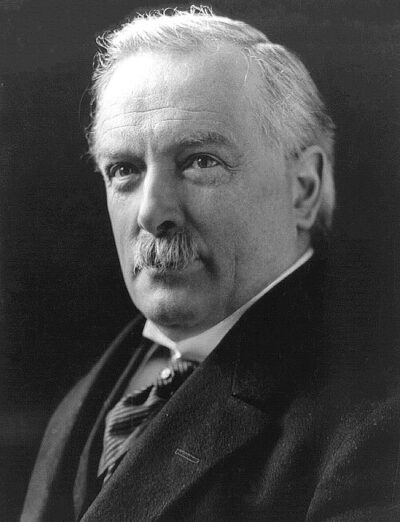
David Lloyd George
David Lloyd George was a Prime Minister of the United Kingdom from 1916 to 1922. Born January 17, 1863, in Manchester. Died March 26, 1945, in Llanystumdwy. Positions held include Prime Minister of the United Kingdom (1916–1922), leader of the Liberal Party (1926–1931) and Secretary of State for War (1916). Awards include Order of Merit, Cross of Liberty and Grand Cross of the Legion of Honour.
Facts
53 facts · 2 confirmed by two sources · 27 cited · 24 from one source
Where this comes from
Papalocal keeps its own record. It started from these sources; what each one said is kept here as it was copied, so a change on their side never changes this page by itself. Tap one to read its version.
What Wikidata says · copied November 16, 2026 · revision 2567482387
- Described as
- Prime Minister of the United Kingdom from 1916 to 1922
- Other names
- David Lloyd George, 1st Earl Lloyd-George of Dwyfor, George David Lloyd, George Lloyd, Earl Lloyd-George, Lord Lloyd-George, Lloyd George
- Born
- January 17, 1863 · 7 references
- Died
- March 26, 1945 · 7 references
- Born in
- Manchester · 2 references
- Died in
- Llanystumdwy · 1 reference
- Buried in
- grave of David Lloyd George
- Cause of death
- brain tumor
- Name at birth
- David Lloyd George
- Citizen of
- United Kingdom (1927–); United Kingdom of Great Britain and Ireland (–1927)
- Occupation
- politician · 2 references; diplomat; solicitor; writer · 1 reference; official · 1 reference; jurist · 1 reference; head of government · 1 reference; author · 1 reference
- Positions held
- Prime Minister of the United Kingdom (1916–1922); leader of the Liberal Party (1926–1931); Secretary of State for War (1916); Minister of Munitions (1915–1916); Chancellor of the Exchequer (1908–1915); President of the Board of Trade (1905–1908); Member of the Privy Council of the United Kingdom (1906–); member of the 37th Parliament of the United Kingdom (1935–1945) · 1 reference; member of the 36th Parliament of the United Kingdom (1931–1935) · 1 reference; member of the 35th Parliament of the United Kingdom (1929–1931) · 1 reference; member of the 34th Parliament of the United Kingdom (1924–1929) · 1 reference; member of the 33rd Parliament of the United Kingdom (1923–1924) · 1 reference; member of the 32nd Parliament of the United Kingdom (1922–1923) · 1 reference; member of the 31st Parliament of the United Kingdom (1918–1922) · 1 reference; member of the 30th Parliament of the United Kingdom (1910–1918) · 1 reference
- Political party
- Liberal Party
- Worked for
- University of Edinburgh
- Member of
- World Brotherhood Federation (1919–) · 1 reference
- Awards
- Order of Merit · 1 reference; Cross of Liberty · 1 reference; Grand Cross of the Legion of Honour; Knight Grand Cross of the Order of Saints Maurice and Lazarus; Knight of Grace of the Order of Saint John
- Spouse
- Margaret Lloyd George (1888–1941) · 2 references; Frances Lloyd George, Countess Lloyd-George (1943–1945) · 2 references
- Children
- Gwilym Lloyd George, 1st Viscount Tenby · 1 reference; Megan Lloyd George · 1 reference; Richard Lloyd George, 2nd Earl Lloyd-George of Dwyfor · 1 reference; Mair Eluned Lloyd George · 1 reference; Olwen Elizabeth Lloyd George · 1 reference; Jennifer Mary Stevenson · 1 reference
- Father
- William George · 1 reference
- Mother
- Elizabeth Lloyd · 1 reference
- Siblings
- William George; Mary Ellen Lloyd George
- Religion
- Baptists
- Wikipedias with a page
- 110
Wikidata item Q134982 (wikidata.org/wiki/Q134982), public domain (CC0). Copied November 16, 2026.
What Wikipedia says · copied November 16, 2026 · revision 1385654228
David Lloyd George, 1st Earl Lloyd-George of Dwyfor (17 January 1863 – 26 March 1945), was Prime Minister of the United Kingdom from 1916 to 1922. A Liberal Party politician from Wales, he was known for leading the United Kingdom during the First World War, for social-reform policies, for his role in the Paris Peace Conference, and for negotiating the establishment of the Irish Free State.
Born in Chorlton-on-Medlock, Manchester, and raised in Llanystumdwy, Carnarvonshire, Lloyd George gained a reputation as an orator and proponent of a Welsh blend of radical Liberal ideas that included support for Welsh devolution, the disestablishment of the Church of England in Wales, equality for labourers and tenant farmers, and reform of land ownership. He won an 1890 by-election to become the Member of Parliament for Caernarvon Boroughs, and was continuously re-elected to the seat for 55 years. He served in Henry Campbell-Bannerman's cabinet from 1905. After H. H. Asquith succeeded to the premiership in 1908, Lloyd George replaced him as Chancellor of the Exchequer. To fund extensive welfare reforms, he proposed taxes on land ownership and high incomes in the 1909 People's Budget, which the Conservative-dominated House of Lords rejected. The resulting constitutional crisis was only resolved after elections in 1910 and passage of the Parliament Act 1911. His budget was enacted in 1910, with the National Insurance Act 1911 and other measures helping to establish the modern welfare state. He was embroiled in the 1913 Marconi scandal but remained in office and secured the disestablishment of the Church of England in Wales.
In 1915, Lloyd George became Minister of Munitions and expanded artillery shell production for the war. In 1916, he was appointed Secretary of State for War but was frustrated by his limited power and clashes with Army commanders over strategy. Asquith proved ineffective as prime minister and was replaced by Lloyd George in December 1916. He centralised authority by creating a smaller war cabinet. To combat food shortages caused by U-boats, he implemented the convoy system, established rationing, and stimulated farming. After supporting the disastrous French Nivelle offensive in 1917, he had to reluctantly approve Field Marshal Douglas Haig's plans for the Battle of Passchendaele, which resulted in huge casualties with little strategic benefit. Opposed by British military commanders, he was finally able to see the Allies brought under one command in March 1918. The war effort turned in the Allies' favour and was won in November. Following the December 1918 "Coupon" election, he and the Conservatives maintained their coalition with popular support.
Lloyd George was a leading participant at the Paris Peace Conference of 1919, but the situation in Ireland worsened, erupting into the Irish War of Independence, which lasted until Lloyd George negotiated independence for the Irish Free State in 1921. At home, he initiated education and housing reforms, but trade-union militancy rose to record levels, the economy became depressed in 1920 and unemployment rose; spending cuts followed in 1921–22, and in 1922 he became embroiled in a scandal over the sale of honours and the Chanak Crisis. The Carlton Club meeting decided the Conservatives should end the coalition and contest the next election alone. Lloyd George resigned as prime minister, but continued as the leader of a Liberal faction. After an awkward reunion with Asquith's faction in 1923, Lloyd George led the weak Liberal Party from 1926 to 1931. He proposed innovative schemes for public works and other reforms, but made only modest gains in the 1929 election. After 1931, he was a mistrusted figure heading a small rump of breakaway Liberals opposed to the National Government. In 1940, he refused to serve in Churchill's War Cabinet. He was elevated to the peerage in 1945 but died before he could take his seat in the House of Lords.
- Born, in its opening lines
- January 17, 1863
- Died, in its opening lines
- March 26, 1945
From the Wikipedia article “David Lloyd George” (en.wikipedia.org/wiki/David_Lloyd_George), by its contributors, under CC BY-SA 4.0 (creativecommons.org/licenses/by-sa/4.0/). Copied November 16, 2026; not changed.
Confirmed Two sources agree. Cited One source, and it names where it got it. One source One source, without a reference of its own. Sources disagree The sources disagree. We show the best-supported value and keep theirs below.
