
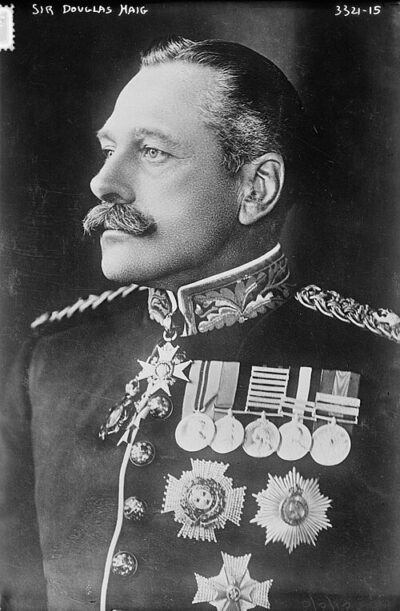
Douglas Haig, 1st Earl Haig
Douglas Haig, 1st Earl Haig was a British senior officer during the First World War. Born June 19, 1861, in Charlotte Square. Died January 29, 1928, in Princes Gate. Positions held include member of the House of Lords. Educated at Brasenose College and Clifton College. Awards include Knight Grand Cross of the Order of the Bath, Knight Grand Cross of the Royal Victorian Order and Order of Michael the Brave, 1st class.
Facts
39 facts · 2 confirmed by two sources · 15 cited · 22 from one source
Where this comes from
Papalocal keeps its own record. It started from these sources; what each one said is kept here as it was copied, so a change on their side never changes this page by itself. Tap one to read its version.
What Wikidata says · copied November 16, 2026 · revision 2570023189
- Described as
- British senior officer during the First World War (1861-1928)
- Other names
- Butcher of the Somme, Field Marshal Douglas Haig, 1st Earl Haig, Douglas Haig, Earl Haig
- Born
- June 19, 1861 · 9 references
- Died
- January 29, 1928 · 7 references
- Born in
- Charlotte Square · 1 reference
- Died in
- Princes Gate · 1 reference
- Buried in
- Dryburgh Abbey · 1 reference
- Citizen of
- United Kingdom
- Occupation
- politician · 1 reference; army officer
- Positions held
- member of the House of Lords
- Education
- Brasenose College (1880–) · 1 reference; Clifton College (1875–) · 1 reference; Royal Military College, Sandhurst; Edinburgh Collegiate School
- Awards
- Knight Grand Cross of the Order of the Bath; Knight Grand Cross of the Royal Victorian Order; Order of Michael the Brave, 1st class (1919); Order of St. George, 4th class; Knight Commander of the Order of the Indian Empire; Order of the Thistle · 1 reference; Order of Merit · 1 reference; Inter-Allied Victory Medals · 1 reference; Médaille militaire · 1 reference; Croix de guerre 1914–1918 · 1 reference; Distinguished Service Medal · 1 reference; Order of the Star of Karađorđe · 1 reference; Miloš Obilić Medal of Bravery · 1 reference; Order of the Rising Sun with Paulownia Flowers, 1st class · 1 reference; Order of Rama · 1 reference
- Spouse
- Dorothy Maud Vivian (1905–) · 2 references
- Children
- Irene Astor, Baroness Astor of Hever · 1 reference; George Haig, 2nd Earl Haig · 1 reference; Lady Alexandra Haig · 2 references; Lady Victoria Haig · 2 references
- Father
- John Haig · 2 references
- Mother
- Rachel Mackerras Veitch · 2 references
- Siblings
- George Ogilvy Haig · 1 reference; Henrietta Frances Haig · 1 reference
- Military branch
- British Army (1884–1920)
- Military rank
- field marshal
- Wikipedias with a page
- 51
Wikidata item Q312564 (wikidata.org/wiki/Q312564), public domain (CC0). Copied November 16, 2026.
What Wikipedia says · copied November 16, 2026 · revision 1383356147
Field Marshal Douglas Haig, 1st Earl Haig (; 19 June 1861 – 29 January 1928) was a senior officer of the British Army. During the First World War he commanded the British Expeditionary Force (BEF) on the Western Front from late 1915 until the end of the war.
Haig's military career included service in the War Office, where he was instrumental in the creation of the Territorial Force in 1908. In January 1917 he was promoted to the rank of field marshal, subsequently leading the BEF during the final Hundred Days Offensive. This campaign, in combination with the Kiel mutiny, the Wilhelmshaven mutiny, the proclamation of a republic on 9 November 1918 and revolution across Germany, led to the armistice of 11 November 1918. It is considered by some historians to be one of the greatest victories ever achieved by a British-led army.
Haig gained a favourable reputation during the immediate post-war years, with his funeral a day of national mourning. However he also had some prominent contemporary detractors and, beginning in the 1960s, has been widely criticised for his wartime leadership. He was nicknamed "Butcher Haig" for the two million British casualties under his command. The Canadian War Museum comments: "His epic but costly offensives at the Somme (1916) and Passchendaele (1917) have become nearly synonymous with the carnage and futility of First World War battles." Since the 1980s many historians have argued that the public hatred of Haig failed to recognise the adoption of new tactics and technologies by forces under his command, the important role played by British forces in the allied victory of 1918, and that high casualties were a consequence of the tactical and strategic realities of the time.
- Born, in its opening lines
- June 19, 1861
- Died, in its opening lines
- January 29, 1928
From the Wikipedia article “Douglas Haig, 1st Earl Haig” (en.wikipedia.org/wiki/Douglas_Haig,_1st_Earl_Haig), by its contributors, under CC BY-SA 4.0 (creativecommons.org/licenses/by-sa/4.0/). Copied November 16, 2026; not changed.
Confirmed Two sources agree. Cited One source, and it names where it got it. One source One source, without a reference of its own. Sources disagree The sources disagree. We show the best-supported value and keep theirs below.
