
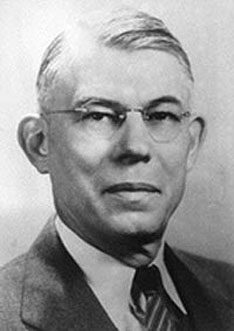
Edward Adelbert Doisy
Edward Adelbert Doisy was an American biochemist. Born November 13, 1893, in Hume. Died October 23, 1986, in St. Louis. Known for vitamin K. Educated at Harvard University and University of Illinois Urbana-Champaign. Awards include Nobel Prize in Physiology or Medicine, Willard Gibbs Award and doctor honoris causa from the University of Paris.
Facts
24 facts · 2 confirmed by two sources · 7 cited · 15 from one source
Where this comes from
Papalocal keeps its own record. It started from these sources; what each one said is kept here as it was copied, so a change on their side never changes this page by itself. Tap one to read its version.
What Wikidata says · copied November 13, 2026 · revision 2567340660
- Described as
- American biochemist (1893-1986)
- Other names
- Edward Doisy, Edward A. Doisy
- Born
- November 13, 1893 · 6 references
- Died
- October 23, 1986 · 6 references
- Born in
- Hume
- Died in
- St. Louis · 1 reference
- Buried in
- Oak Hill Cemetery · 1 reference
- Citizen of
- United States
- Occupation
- biochemist · 1 reference; physician; university teacher; chemist
- Worked for
- Washington University in St. Louis; Saint Louis University · 1 reference
- Education
- Harvard University (1920); University of Illinois Urbana-Champaign (1916)
- Member of
- Pontifical Academy of Sciences · 1 reference; American Academy of Arts and Sciences; National Academy of Sciences; American Philosophical Society (1942–)
- Known for
- vitamin K
- Awards
- Nobel Prize in Physiology or Medicine (1943) · 2 references; Willard Gibbs Award (1941) · 1 reference; doctor honoris causa from the University of Paris (1945) · 1 reference
- Field
- chemistry; biochemistry
- Wikipedias with a page
- 59
Wikidata item Q230612 (wikidata.org/wiki/Q230612), public domain (CC0). Copied November 13, 2026.
What Wikipedia says · copied November 13, 2026 · revision 1381402655
Edward Adelbert Doisy (November 13, 1893 – October 23, 1986) was an American biochemist. He received the Nobel Prize in Physiology or Medicine in 1943 with Henrik Dam for their discovery of vitamin K (K from "Koagulations-Vitamin" in German) and its chemical structure.
Doisy was born in Hume, Illinois, on November 13, 1893. He completed his A.B. degree in 1914 and his M.S. degree in 1916 from the University of Illinois at Urbana-Champaign. He completed his Ph.D. in 1920 from Harvard University.
In 1919 he accepted a faculty appointment in the Department of Biochemistry at Washington University School of Medicine, where he rose in rank to associate professor. In 1923, he moved to Saint Louis University as professor and chairman of the new Department of Biochemistry. He served as professor and chairman of that department until he retired in 1965. Saint Louis University renamed the department the E.A. Doisy Department of Biochemistry, in his honor. More recently, the department has again been renamed. It is now known as the E.A. Doisy Department of Biochemistry and Molecular Biology.
In 1940, he was a lecturer in medicine at the University of Chicago School of Medicine.
He also competed with Adolf Butenandt in the discovery of estrone in 1930. They discovered the substance independently, but only Butenandt was awarded the Nobel Prize in Chemistry in 1939.
Doisy was elected to the United States National Academy of Sciences in 1938, the American Philosophical Society in 1942, and the American Academy of Arts and Sciences in 1948.
Following his death in 1986, his family endowed the Edward A. and Margaret Doisy College of Health Sciences. The Edward A. Doisy Research Center was built and named in his honor in 2007, following a $30,000,000 gift from the Doisy family.
- Born, in its opening lines
- November 13, 1893
- Died, in its opening lines
- October 23, 1986
From the Wikipedia article “Edward Adelbert Doisy” (en.wikipedia.org/wiki/Edward_Adelbert_Doisy), by its contributors, under CC BY-SA 4.0 (creativecommons.org/licenses/by-sa/4.0/). Copied November 13, 2026; not changed.
Confirmed Two sources agree. Cited One source, and it names where it got it. One source One source, without a reference of its own. Sources disagree The sources disagree. We show the best-supported value and keep theirs below.
