
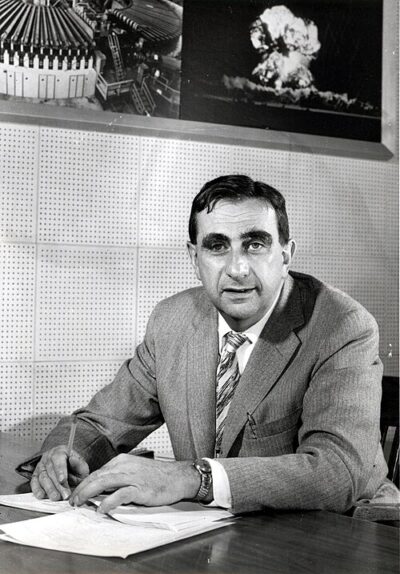
Edward Teller
Edward Teller was a Hungarian-American Jewish nuclear physicist. Born January 15, 1908, in Budapest. Died September 9, 2003, in Stanford. Educated at Leipzig University and University of Göttingen. Awards include Harvey Prize, Albert Einstein Award and Presidential Medal of Freedom.
Facts
38 facts · 2 confirmed by two sources · 15 cited · 21 from one source
Where this comes from
Papalocal keeps its own record. It started from these sources; what each one said is kept here as it was copied, so a change on their side never changes this page by itself. Tap one to read its version.
What Wikidata says · copied November 13, 2026 · revision 2568843402
- Described as
- Hungarian-American Jewish nuclear physicist (1908–2003)
- Other names
- E. Teller, Teller Ede
- Born
- January 15, 1908 · 8 references
- Died
- September 9, 2003 · 8 references
- Born in
- Budapest · 3 references
- Died in
- Stanford · 3 references
- Citizen of
- Hungary · 1 reference; United States · 2 references
- Occupation
- nuclear physicist · 1 reference; non-fiction writer; university teacher; theoretical physicist; inventor · 1 reference; physicist · 1 reference
- Worked for
- University of California, Berkeley; University of Chicago; University of Göttingen · 1 reference
- Education
- Leipzig University (–1930); University of Göttingen (–1933) · 1 reference; Fasori Gimnázium
- Member of
- National Academy of Sciences · 1 reference; Hungarian Academy of Sciences; International Academy of Quantum Molecular Science; American Academy of Arts and Sciences; American Association for the Advancement of Science · 1 reference
- Awards
- Harvey Prize (1975) · 1 reference; Albert Einstein Award (1958); Presidential Medal of Freedom (2003) · 1 reference; Eringen Medal (1980) · 1 reference; Enrico Fermi Award (1962) · 1 reference; National Medal of Science (1982); Ig Nobel Prize (1991) · 1 reference; honorary citizen of Budapest (2012); Remsen Award (1959) · 1 reference; Golden Plate Award (1961) · 1 reference
- Field
- theoretical physics
- Spouse
- Augusta H. Teller (1934–2000) · 1 reference
- Father
- Max Teller
- Religion
- Judaism; agnosticism
- Wikipedias with a page
- 84
Wikidata item Q6733 (wikidata.org/wiki/Q6733), public domain (CC0). Copied November 13, 2026.
What Wikipedia says · copied November 13, 2026 · revision 1384564172
Edward Teller (Hungarian: Teller Ede; 15 January 1908 – 9 September 2003) was a Hungarian-American theoretical physicist and chemical engineer who is known colloquially as "the father of the hydrogen bomb" and one of the creators of the Teller–Ulam design inspired by Stanisław Ulam.
Born in Austria-Hungary in 1908, Teller emigrated to the US in the 1930s, one of the many so-called "Martians", a group of Hungarian scientist émigrés. He made numerous contributions to nuclear and molecular physics, spectroscopy, and surface physics. His extension of Enrico Fermi's theory of beta decay, in the form of Gamow–Teller transitions, provided an important stepping stone in its application, while the Jahn–Teller effect and Brunauer–Emmett–Teller (BET) theory have retained their original formulation and are mainstays in physics and chemistry.
Teller made contributions to Thomas–Fermi theory, the precursor of density functional theory, a standard tool in the quantum mechanical treatment of complex molecules. In 1953, with Nicholas Metropolis, Arianna Rosenbluth, Marshall Rosenbluth, and Augusta Teller, Teller co-authored a paper that is a starting point for the application of the Monte Carlo method to statistical mechanics and the Markov chain Monte Carlo literature in Bayesian statistics. Teller was an early member of the Manhattan Project, which developed the atomic bomb. He made a concerted push to develop fusion-based weapons, but ultimately fusion bombs only appeared after World War II. To get support for the hydrogen bomb project, Teller supported and worked on the George shot of the Operation Greenhouse nuclear tests, resulting in the world's first thermonuclear burn. He co-founded the Lawrence Livermore National Laboratory and was its director or associate director.
Teller continued to find support from the US government and military research establishment, particularly for his advocacy for nuclear power development, a strong nuclear arsenal, and a vigorous nuclear testing program. In his later years, he advocated controversial technological solutions to military and civilian problems, including a plan to excavate an artificial harbor in Alaska using a thermonuclear explosive in what was called Project Chariot, and Ronald Reagan's Strategic Defense Initiative. Teller was a recipient of the Enrico Fermi Award and Albert Einstein Award. He died in 2003, at 95.
- Born, in its opening lines
- January 15, 1908
- Died, in its opening lines
- September 9, 2003
From the Wikipedia article “Edward Teller” (en.wikipedia.org/wiki/Edward_Teller), by its contributors, under CC BY-SA 4.0 (creativecommons.org/licenses/by-sa/4.0/). Copied November 13, 2026; not changed.
Confirmed Two sources agree. Cited One source, and it names where it got it. One source One source, without a reference of its own. Sources disagree The sources disagree. We show the best-supported value and keep theirs below.
