
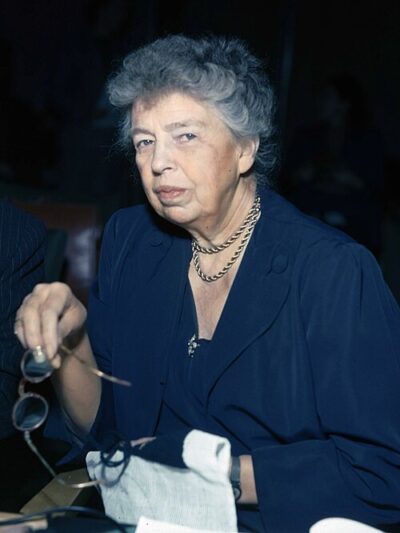
Eleanor Roosevelt
Eleanor Roosevelt was an American diplomat and activist, First Lady of the United States from 1933 to 1945. Born October 11, 1884, in Manhattan. Died November 7, 1962, in Upper East Side. Positions held include United Nations General Assembly (1945–1952), First Lady of the United States (1933–1945) and ambassador. Educated at The New School and Allenswood Boarding Academy. Awards include United Nations Prize in the Field of Human Rights, Gandhi Peace Award and National Women's Hall of Fame.
Facts
52 facts · 2 confirmed by two sources · 22 cited · 28 from one source
Where this comes from
Papalocal keeps its own record. It started from these sources; what each one said is kept here as it was copied, so a change on their side never changes this page by itself. Tap one to read its version.
What Wikidata says · copied November 13, 2026 · revision 2567175187
- Described as
- American diplomat and activist, First Lady of the United States from 1933 to 1945 (1884–1962)
- Other names
- Anna Eleanor Roosevelt, Anna Roosevelt, Elaenore Roosevelt, Eleanor Roosevelt Roosevelt, First Lady of the world, Anna Eleanor Roosevelt Roosevelt
- Born
- October 11, 1884 · 14 references
- Died
- November 7, 1962 · 14 references
- Born in
- Manhattan · 2 references
- Died in
- Upper East Side
- Buried in
- Home of Franklin D. Roosevelt National Historic Site · 1 reference
- Cause of death
- tuberculosis
- Name at birth
- Anna Eleanor Roosevelt · 2 references
- Citizen of
- United States · 2 references
- Occupation
- diplomat · 3 references; writer · 4 references; autobiographer; politician · 2 references; women's rights activist; journalist · 1 reference; peace activist · 1 reference; human rights defender · 1 reference
- Positions held
- United Nations General Assembly (1945–1952) · 1 reference; First Lady of the United States (1933–1945); ambassador
- Political party
- Democratic Party
- Worked for
- Brandeis University; United Nations
- Education
- The New School; Allenswood Boarding Academy (1899–1902)
- Member of
- Daughters of the American Revolution; Alpha Kappa Alpha
- Awards
- United Nations Prize in the Field of Human Rights (1968) · 1 reference; Gandhi Peace Award (1960); National Women's Hall of Fame (1973) · 1 reference; Nansen Refugee Award (1954); Deshikottam (1952) · 1 reference; honorary doctor of the University of Utrecht (1948) · 1 reference; honorary doctor of Brandeis University; doctor honoris causa from the University of Lyon (1948) · 2 references
- Field
- human rights; politics; philanthropy
- Spouse
- Franklin Delano Roosevelt (1905–1945) · 3 references
- Children
- Elliott Roosevelt · 3 references; Franklin Delano Roosevelt Jr. · 2 references; John Aspinwall Roosevelt · 2 references; James Roosevelt · 3 references; Anna Roosevelt Halsted · 3 references; Franklin Delano Roosevelt · 3 references
- Father
- Elliott Bulloch Roosevelt · 2 references
- Mother
- Anna Hall Roosevelt · 2 references
- Siblings
- Hall Roosevelt
- Religion
- Episcopal Church
- Lived in
- New York City; Washington, D.C.; Hyde Park; Garden City · 1 reference
- Wikipedias with a page
- 150
Wikidata item Q83396 (wikidata.org/wiki/Q83396), public domain (CC0). Copied November 13, 2026.
What Wikipedia says · copied November 13, 2026 · revision 1384759949
Anna Eleanor Roosevelt ( EL-in-or ROH-zə-velt; October 11, 1884 – November 7, 1962) was an American political figure, diplomat, and activist. She was the longest-serving first lady of the United States, during her husband Franklin D. Roosevelt's four terms as president from 1933 to 1945. Through her travels, public engagement, and advocacy, she largely redefined the role. Widowed in 1945, she served as a United States delegate to the United Nations General Assembly from 1945 to 1952, and took a leading role in designing the text and gaining international support for the Universal Declaration of Human Rights. In 1948, she was given a standing ovation by the assembly upon their adoption of the declaration. President Harry S. Truman called her the "First Lady of the World" in tribute to her human rights achievements.
Roosevelt was a member of the prominent and wealthy Roosevelt and Livingston families and a niece of President Theodore Roosevelt. She had an unhappy childhood, having suffered the deaths of both parents and one of her brothers at a young age. At 15, she attended Allenswood Boarding Academy in London and was deeply influenced by its founder and director Marie Souvestre. Returning to the U.S., she married her fifth cousin once removed, Franklin Delano Roosevelt, in 1905. Between 1906 and 1916 she gave birth to six children, one of whom died in infancy. The Roosevelts' marriage became complicated after Eleanor discovered her husband's affair with her social secretary, Lucy Mercer, in 1918. Due to mediation by her mother-in-law, Sara, the liaison was ended officially. After that, both partners started to keep independent agendas, and Eleanor joined the Women's Trade Union League and became active in the New York state Democratic Party. Roosevelt helped persuade her husband to stay in politics after he was stricken with a paralytic illness in 1921. Following Franklin's election as governor of New York in 1928, and throughout the remainder of Franklin's political career, Roosevelt regularly made public appearances on his behalf; and as first lady, while her husband served as president, she greatly influenced the present scope and future of the role.
Roosevelt was, in her time, one of the world's most widely admired and powerful women. Nevertheless, in her early years in the White House she was controversial for her outspokenness, particularly with respect to her promotion of civil rights for African Americans. She was the first presidential spouse to hold regular press conferences, write a daily newspaper column, write a monthly magazine column, host a weekly radio show, and speak at a national party convention. On a few occasions, she publicly disagreed with her husband's policies. She launched an experimental community at Arthurdale, West Virginia, for the families of unemployed miners, later widely regarded as a failure. She advocated for expanded roles for women in the workplace, the civil rights of African Americans and Asian Americans, and the rights of World War II refugees.
Following her husband's death in 1945, Roosevelt pressed the United States to join and support the United Nations and became its first delegate to the committee on Human Rights. She served as the first chair of the UN Commission on Human Rights and oversaw the drafting of the Universal Declaration of Human Rights. Later, she chaired the John F. Kennedy administration's Presidential Commission on the Status of Women until her death in 1962. By the time of her death, Roosevelt was regarded as "one of the most esteemed women in the world"; The New York Times called her "the object of almost universal respect" in her obituary. In 1999, Roosevelt was ranked ninth in the top ten of Gallup's List of Most Widely Admired People of the 20th Century, and was found to rank as the most admired woman in thirteen different years between 1948 and 1961 in Gallup's annual most admired woman poll. Periodic surveys conducted by the Siena College Research Institute have consistently seen historians assess Roosevelt as the greatest American first lady.
- Born, in its opening lines
- October 11, 1884
- Died, in its opening lines
- November 7, 1962
From the Wikipedia article “Eleanor Roosevelt” (en.wikipedia.org/wiki/Eleanor_Roosevelt), by its contributors, under CC BY-SA 4.0 (creativecommons.org/licenses/by-sa/4.0/). Copied November 13, 2026; not changed.
Confirmed Two sources agree. Cited One source, and it names where it got it. One source One source, without a reference of its own. Sources disagree The sources disagree. We show the best-supported value and keep theirs below.
