
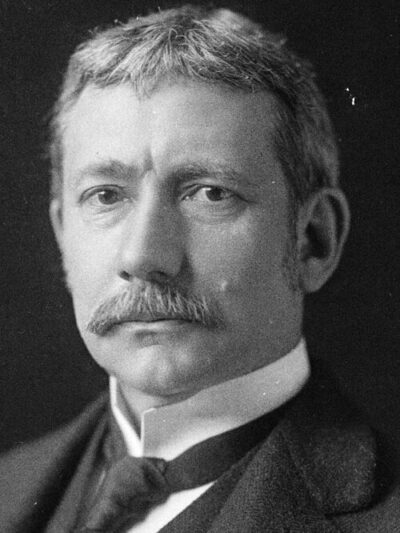
Elihu Root
Elihu Root was an American politician. Born February 15, 1845, in Clinton. Died February 7, 1937, in New York City. Positions held include United States Secretary of State (1905–1909), United States Secretary of War (1899–1904) and United States senator (1909–1915). Educated at Hamilton College and New York University School of Law. Awards include Nobel Peace Prize, Grand Cross of the Order of the Crown and Fellow of the American Statistical Association.
Facts
40 facts · 2 confirmed by two sources · 16 cited · 22 from one source
Where this comes from
Papalocal keeps its own record. It started from these sources; what each one said is kept here as it was copied, so a change on their side never changes this page by itself. Tap one to read its version.
What Wikidata says · copied November 13, 2026 · revision 2565497255
- Described as
- American politician (1845-1937)
- Other names
- Hon. Elihu Root
- Born
- February 15, 1845 · 10 references
- Died
- February 7, 1937 · 9 references
- Born in
- Clinton · 1 reference
- Died in
- New York City · 1 reference
- Buried in
- Hamilton College Cemetery · 1 reference
- Citizen of
- United States
- Occupation
- politician · 1 reference; lawyer · 1 reference; diplomat; jurist · 2 references
- Positions held
- United States Secretary of State (1905–1909); United States Secretary of War (1899–1904); United States senator (1909–1915) · 1 reference; senator · 1 reference
- Political party
- Republican Party
- Education
- Hamilton College; New York University School of Law; Columbia University; Williston Northampton School · 1 reference
- Member of
- American Academy of Arts and Sciences; Phi Beta Kappa Society; American Philosophical Society (1906–) · 1 reference; American Academy of Arts and Letters; Institut de Droit International (1912–)
- Awards
- Nobel Peace Prize (1912) · 2 references; Grand Cross of the Order of the Crown; Fellow of the American Statistical Association; Honorary doctor of Leiden University (1913) · 1 reference; doctor honoris causa from the University of Paris (1920) · 1 reference
- Field
- law · 1 reference; politics · 1 reference; diplomacy · 1 reference
- Spouse
- Clara Frances Wales · 1 reference
- Children
- Edith Root · 1 reference; Elihu Root Jr.; Edward Wales Root
- Father
- Oren Root
- Mother
- Nancy Whitney Buttrick
- Siblings
- Oren Root Jr.; Edward Walstein Root
- Wikipedias with a page
- 59
Wikidata item Q220619 (wikidata.org/wiki/Q220619), public domain (CC0). Copied November 13, 2026.
What Wikipedia says · copied November 13, 2026 · revision 1384228230
Elihu Root (; February 15, 1845 – February 7, 1937) was an American lawyer, Republican politician, and statesman who served as the 41st United States Secretary of War under presidents William McKinley and Theodore Roosevelt and the 38th United States Secretary of State, also under Roosevelt. In both positions as well as a long legal career, he pioneered the American practice of international law. Root is sometimes considered the prototype of the 20th-century political "wise man", advising presidents on a range of foreign and domestic issues. He also served as a United States Senator from New York and received the 1912 Nobel Peace Prize.
Root was a leading New York City lawyer who moved frequently between high-level appointed government positions in Washington, D.C., and private-sector legal practice in New York. He headed organizations such as the Carnegie Endowment for International Peace and the American Society of International Law.
As Secretary of War from 1899 to 1904, Root administered colonial possessions won in the Spanish–American War. Root favored a paternalistic approach to colonial administration, emphasizing technology, engineering, and disinterested public service. He helped craft the Foraker Act of 1900, the Platt Amendment of 1901, and the Philippine Organic Act (1902). Root also modernized the Army into a professional military apparatus with a general staff, restructured the National Guard, and established the U.S. Army War College.
Root returned to the Roosevelt administration as Secretary of State from 1905 to 1909. He modernized the consular service by minimizing patronage, maintained the Open Door Policy in China, promoted friendly relations with Latin America, and resolved frictions with Japan over the immigration and treatment of Japanese citizens to the West Coast of the United States. He negotiated 24 bilateral international arbitration treaties, which led to the creation of the Permanent Court of International Justice.
As a United States senator from New York, Root was a conservative supporter of President William Howard Taft, playing a central role in Taft's nomination to a second term at the 1912 Republican National Convention. By 1916, he was a leading proponent of military preparedness with the expectation that the United States would enter World War I. President Woodrow Wilson sent him to Russia in 1917 in an unsuccessful effort to establish an alliance with the new revolutionary government that had replaced the Czar. Root supported Wilson's vision of the League of Nations but with reservations along the lines proposed by Republican senator Henry Cabot Lodge.
- Born, in its opening lines
- February 15, 1845
- Died, in its opening lines
- February 7, 1937
From the Wikipedia article “Elihu Root” (en.wikipedia.org/wiki/Elihu_Root), by its contributors, under CC BY-SA 4.0 (creativecommons.org/licenses/by-sa/4.0/). Copied November 13, 2026; not changed.
Confirmed Two sources agree. Cited One source, and it names where it got it. One source One source, without a reference of its own. Sources disagree The sources disagree. We show the best-supported value and keep theirs below.
