
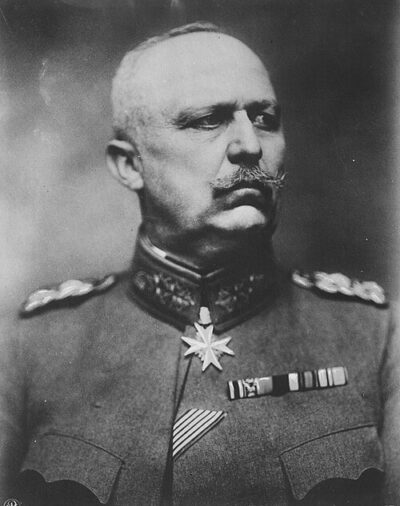
Erich Ludendorff
Erich Ludendorff was a German general and politician. Born April 9, 1865, in Kruszewnia. Died December 20, 1937, in Munich. Positions held include member of the Reichstag of the Weimar Republic (1920–1928). Educated at Royal Prussian Main Cadet Institute. Awards include Pour le Mérite, Military Merit Cross I. Class and Large Military Merit Medal.
Facts
39 facts · 2 confirmed by two sources · 16 cited · 21 from one source
Where this comes from
Papalocal keeps its own record. It started from these sources; what each one said is kept here as it was copied, so a change on their side never changes this page by itself. Tap one to read its version.
What Wikidata says · copied November 16, 2026 · revision 2568737939
- Described as
- German general and politician (1865–1937)
- Other names
- Erich Friedrich Wilhelm Ludendorff, Ludendorff, Erich
- Born
- April 9, 1865 · 13 references
- Died
- December 20, 1937 · 14 references
- Born in
- Kruszewnia
- Died in
- Munich · 2 references
- Buried in
- Neuer Friedhof Tutzing
- Cause of death
- liver cancer
- Citizen of
- Kingdom of Prussia; Nazi Germany
- Occupation
- politician · 2 references; military officer · 1 reference; autobiographer · 1 reference; writer · 1 reference; military leader · 1 reference; author · 1 reference; soldier · 1 reference
- Positions held
- member of the Reichstag of the Weimar Republic (1920–1928)
- Political party
- German Völkisch Freedom Party; National Socialist Freedom Movement (1924–1925)
- Education
- Royal Prussian Main Cadet Institute · 1 reference
- Awards
- Pour le Mérite; Military Merit Cross I. Class; Large Military Merit Medal; Grand Cross of the Iron Cross (1914) (1918) · 2 references; Military Order of Max Joseph; honorary citizen of Düsseldorf (1917); Blood Order · 1 reference; Grand Cross of the Order of the Cross of Liberty (1918) · 1 reference; Sachsen-Meiningen Cross for Merit in War
- Field
- World War I · 1 reference; military affairs · 1 reference; politics · 1 reference; memoir literature · 1 reference
- Spouse
- Mathilde Ludendorff (1926–) · 1 reference; Margarethe Ludendorff (1909–1925) · 1 reference
- Father
- Wilhelm Ludendorff · 1 reference
- Mother
- Klara von Tempelhoff · 1 reference
- Military branch
- Imperial German Army · 1 reference
- Military rank
- general · 2 references; general of the infantry (Bundeswehr)
- Wikipedias with a page
- 74
Wikidata item Q58579 (wikidata.org/wiki/Q58579), public domain (CC0). Copied November 16, 2026.
What Wikipedia says · copied November 16, 2026 · revision 1384905663
Erich Friedrich Wilhelm Ludendorff (German: [ˈeːʁɪç ˈfʁiːdʁɪç ˈvɪlhɛlm ˈluːdn̩dɔʁf] ; 9 April 1865 – 20 December 1937) was a Prussian-born German general and politician. He achieved fame during World War I (1914–1918) for his central role in the German victories at Liège and Tannenberg in 1914. After his appointment as First Quartermaster General of the Great General Staff in 1916, Ludendorff oversaw virtually all decisions regarding Germany's strategy and war effort until the country's defeat in 1918. Later during the years of the Weimar Republic, he took part in the failed 1920 Kapp Putsch and Adolf Hitler's 1923 Beer Hall Putsch, thereby contributing significantly to Adolf Hitler's rise to power.
Ludendorff came from a non-noble family in Kruszewnia in the Prussian Province of Posen. Upon completing his education as a cadet, he was commissioned as a junior officer in 1885. In 1893, he was admitted to the prestigious German War Academy, and only a year later was recommended by its commandant to the General Staff Corps. By 1904, he had rapidly risen in rank to become a member of the Army's Great General Staff, where he helped oversee the development of the Schlieffen Plan.
Despite being removed from the Great General Staff for meddling in politics, Ludendorff restored his standing in the army through his success as a commander in World War I. In August 1914, he led the successful German assault on Liège, earning him the Pour le Mérite. On the Eastern Front under the command of General Paul von Hindenburg, Ludendorff was instrumental in inflicting a series of crushing defeats against the Russians, notably at Tannenberg and the Masurian Lakes.
By the end of August 1916, Ludendorff successfully lobbied for Hindenburg's appointment as head of the Supreme Army Command and his own promotion to the rank of First Quartermaster General. Once he and Hindenburg established a military dictatorship in all but name, Ludendorff directed Germany's entire military strategy and war effort for the rest of the conflict. In this capacity, he secured Russia's defeat on the Eastern Front and launched a new wave of offensives on the Western Front resulting in advances not seen since the war's outbreak. However, by late 1918, all improvements in Germany's fortunes were reversed after a string of defeats culminating in the Allies' Hundred Days Offensive. Faced with the war effort's collapse and a growing popular revolution, Kaiser Wilhelm II forced Ludendorff to resign.
After the war, Ludendorff became a prominent nationalist leader and a promoter of the stab-in-the-back myth, which posited that Germany's defeat and the settlement reached at Versailles were the result of a treasonous conspiracy by Marxists, Freemasons and Jews. He also took part in the failed 1920 Kapp Putsch and 1923 Beer Hall Putsch before unsuccessfully standing in the 1925 election for president. Thereafter, he retired from politics and devoted his final years to the study of military theory. His most famous work in this field was The Total War, where he argued that a nation's entire physical and moral resources should remain forever poised for mobilisation because peace was merely an interval in a never-ending chain of wars. Following his death from liver cancer in Munich in 1937, Ludendorff was given—against his explicit wishes—a state funeral organised and attended by Hitler.
- Born, in its opening lines
- April 9, 1865
- Died, in its opening lines
- December 20, 1937
From the Wikipedia article “Erich Ludendorff” (en.wikipedia.org/wiki/Erich_Ludendorff), by its contributors, under CC BY-SA 4.0 (creativecommons.org/licenses/by-sa/4.0/). Copied November 16, 2026; not changed.
Confirmed Two sources agree. Cited One source, and it names where it got it. One source One source, without a reference of its own. Sources disagree The sources disagree. We show the best-supported value and keep theirs below.
