
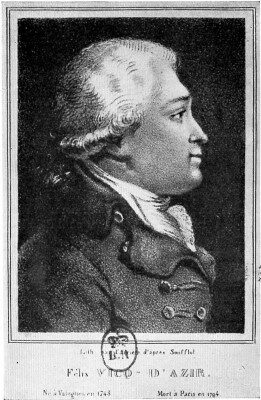
Félix Vicq-d'Azyr
Félix Vicq-d'Azyr was a French anatomist. Born April 23, 1748, in Valognes. Died June 20, 1794, in Paris. Positions held include Member of the Académie française (1788–1794). Educated at University of Paris.
Facts
18 facts · 2 confirmed by two sources · 6 cited · 10 from one source
Where this comes from
Papalocal keeps its own record. It started from these sources; what each one said is kept here as it was copied, so a change on their side never changes this page by itself. Tap one to read its version.
What Wikidata says · copied November 18, 2026 · revision 2568665531
- Described as
- French anatomist (1748-1794)
- Other names
- Felix Vicq d’Azyr
- Born
- April 23, 1748 · 3 references
- Died
- June 20, 1794 · 5 references
- Born in
- Valognes · 1 reference
- Died in
- Paris · 1 reference
- Cause of death
- tuberculosis
- Citizen of
- France
- Occupation
- anatomist · 1 reference; physician · 1 reference; zoologist · 1 reference; naturalist · 1 reference
- Positions held
- Member of the Académie française (1788–1794) · 1 reference
- Education
- University of Paris
- Member of
- Société Philomathique de Paris; Académie Française (1788–1794) · 1 reference; French Academy of Sciences (1773–); German Academy of Sciences Leopoldina; Société royale de médecine
- Lived in
- France · 1 reference
- Wikipedias with a page
- 22
Wikidata item Q961753 (wikidata.org/wiki/Q961753), public domain (CC0). Copied November 18, 2026.
What Wikipedia says · copied November 18, 2026 · revision 1371996684
Félix Vicq d'Azyr (French: [feliks vik daziʁ]; 23 April 1748 – 20 June 1794) was a French physician and anatomist, the originator of comparative anatomy and discoverer of the theory of homology in biology.
- Born, in its opening lines
- April 23, 1748
- Died, in its opening lines
- June 20, 1794
From the Wikipedia article “Félix Vicq-d'Azyr” (en.wikipedia.org/wiki/Félix_Vicq-d'Azyr), by its contributors, under CC BY-SA 4.0 (creativecommons.org/licenses/by-sa/4.0/). Copied November 18, 2026; not changed.
Confirmed Two sources agree. Cited One source, and it names where it got it. One source One source, without a reference of its own. Sources disagree The sources disagree. We show the best-supported value and keep theirs below.
