
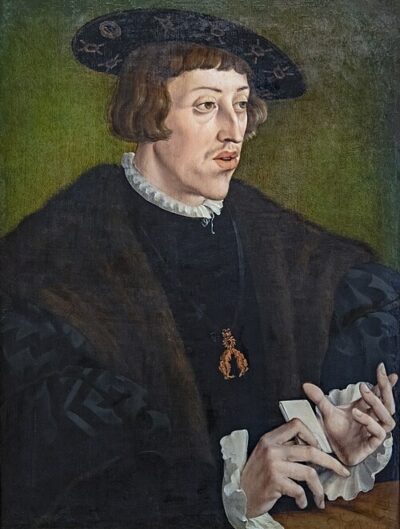
Ferdinand I, Holy Roman Emperor
Ferdinand I, Holy Roman Emperor was a Holy Roman Emperor from 1556 to 1564. Born March 10, 1503, in Alcalá de Henares. Died July 25, 1564, in Vienna. Positions held include Holy Roman Emperor (1556–1564), Prince-Elector and King of Bohemia (1526–1564). Awards include Knight of the Order of the Golden Fleece and Knight of the Garter.
Facts
37 facts · 2 confirmed by two sources · 13 cited · 22 from one source
Where this comes from
Papalocal keeps its own record. It started from these sources; what each one said is kept here as it was copied, so a change on their side never changes this page by itself. Tap one to read its version.
What Wikidata says · copied November 16, 2026 · revision 2568733340
- Described as
- Holy Roman Emperor from 1556 to 1564 (1503-1564)
- Other names
- Ferdinand I
- Born
- March 10, 1503 · 9 references
- Died
- July 25, 1564 · 10 references
- Born in
- Alcalá de Henares · 1 reference
- Died in
- Vienna · 3 references
- Buried in
- St. Vitus Cathedral
- Citizen of
- Holy Roman Empire · 1 reference
- Occupation
- aristocrat; monarch; politician
- Positions held
- Holy Roman Emperor (1556–1564); Prince-Elector; King of Bohemia (1526–1564); Apostolic King of Hungary (1526–1564) · 1 reference
- Awards
- Knight of the Order of the Golden Fleece; Knight of the Garter (1522) · 1 reference
- Spouse
- Anne of Bohemia and Hungary (1521–1547) · 2 references
- Children
- Elizabeth of Austria; Maximilian II, Holy Roman Emperor · 1 reference; Archduchess Anna of Austria · 1 reference; Ferdinand II, Archduke of Austria; Archduchess Maria of Austria; Archduchess Magdalena of Austria; Catherine of Austria; Archduchess Eleanor of Austria; Margaret of Austria · 1 reference; John of Habsburg · 1 reference; Archduchess Barbara of Austria; Charles II, Archduke of Austria · 1 reference
- Father
- Philip I of Castile · 1 reference
- Mother
- Juana I of Castile · 1 reference
- Siblings
- Charles V, Holy Roman Emperor · 1 reference; Eleanor of Austria · 1 reference; Mary of Hungary; Catherine of Austria, Queen of Portugal; Isabella of Austria; Rietje Koane
- Religion
- Catholic Church
- Wikipedias with a page
- 78
Wikidata item Q150611 (wikidata.org/wiki/Q150611), public domain (CC0). Copied November 16, 2026.
What Wikipedia says · copied November 16, 2026 · revision 1383263532
Ferdinand I (10 March 1503 – 25 July 1564) was Holy Roman Emperor from 1556, King of Bohemia, Hungary, and Croatia from 1526, and Archduke of Austria from 1521 until his death in 1564. Before his accession as emperor, he ruled the Austrian hereditary lands of the House of Habsburg in the name of his elder brother, Emperor Charles V, and often served as Charles' representative in developing encouraging relationships with German princes. In addition, Ferdinand also developed valuable relationships with the German banking house of Jakob Fugger and the Castilian bank of Palenzuela's Vienveniste Ha Levi Ha Kahana family.
Ferdinand was born and raised in Spain. The key events during Ferdinand's reign were the conflict with the Ottoman Empire, which in the 1520s began a great advance into Central Europe, and the Protestant Reformation, which resulted in several wars of religion. Although not a military leader, Ferdinand was a capable organiser with institutional imagination, who focused on building a centralised government for Austria, Hungary, and Bohemia instead of striving for a universal monarchy. He reintroduced major innovations of his grandfather Maximilian I such as the Hofrat (court council) with a chancellery and a treasury attached to it (this time, the structure would last until the reform of Maria Theresa) and added innovations of his own such as the Raitkammer (collections office) and the Hofkriegsrat, conceived to counter the threat from the Ottoman Empire, while also successfully subduing the most radical of his rebellious Austrian subjects and turning the political class in Bohemia and Hungary into Habsburg partners. While he was able to introduce uniform models of administration, the governments of Austria, Bohemia, and Hungary remained distinct. His approach to Imperial problems, including governance, human relations and religious matters, was generally flexible, moderate and tolerant. Ferdinand's motto was Fiat iustitia, et pereat mundus: "Let justice be done, though the world perish".
- Born, in its opening lines
- March 10, 1503
- Died, in its opening lines
- July 25, 1564
From the Wikipedia article “Ferdinand I, Holy Roman Emperor” (en.wikipedia.org/wiki/Ferdinand_I,_Holy_Roman_Emperor), by its contributors, under CC BY-SA 4.0 (creativecommons.org/licenses/by-sa/4.0/). Copied November 16, 2026; not changed.
Confirmed Two sources agree. Cited One source, and it names where it got it. One source One source, without a reference of its own. Sources disagree The sources disagree. We show the best-supported value and keep theirs below.
