
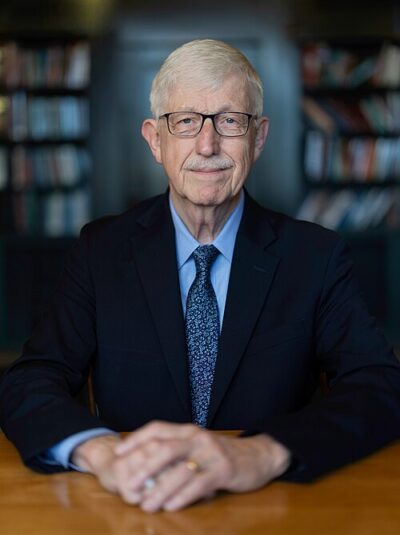
Francis Collins
Francis Collins is an American geneticist and director of the National Institutes of Health. Born April 14, 1950, in Staunton. Positions held include director (2009–2021) and Science Advisor to the President (2022). Educated at University of Virginia and Yale University. Awards include Presidential Medal of Freedom, Princess of Asturias Award for Technical and Scientific Research and Arthur S. Flemming Award.
Facts
45 facts · 0 confirmed by two sources · 13 cited · 31 from one source · 1 where the sources disagree
What’s different
- Born: we show April 14, 1950 (Sources disagree). Wikipedia says April 15, 1950
Where this comes from
Papalocal keeps its own record. It started from these sources; what each one said is kept here as it was copied, so a change on their side never changes this page by itself. Tap one to read its version.
What Wikidata says · copied November 13, 2026 · revision 2563019272
- Described as
- American geneticist and director of the National Institutes of Health
- Other names
- Francis S. Collins, F S Collins, F. S. Collins, Francis S Collins, Francis Sellers Collins
- Born
- April 14, 1950 · 3 references
- Born in
- Staunton · 1 reference
- Name at birth
- Francis Sellers Collins
- Citizen of
- United States
- Occupation
- geneticist; physician · 1 reference; author; physicist; chemist; human geneticist · 1 reference
- Positions held
- director (2009–2021); Science Advisor to the President (2022) · 1 reference
- Worked for
- University of Michigan (1984–1993); United States National Institutes of Health (1993–2025)
- Education
- University of Virginia; Yale University; University of North Carolina at Chapel Hill; Staunton High School · 1 reference; University of North Carolina School of Medicine
- Member of
- Pontifical Academy of Sciences; National Academy of Sciences (1993–); American Academy of Arts and Sciences; National Academy of Medicine; American Association for the Advancement of Science · 1 reference; International Society for Science and Religion · 1 reference; White House Coronavirus Task Force (2020–) · 1 reference; Royal Society of London (2020–) · 1 reference
- Awards
- Presidential Medal of Freedom (2007) · 1 reference; Princess of Asturias Award for Technical and Scientific Research (2001); Arthur S. Flemming Award; Canada Gairdner International Award (2002); AMA Scientific Achievement Award (2001); National Medal of Science (2008); Albany Medical Center Prize (2010); Dickson Prize in Medicine (1992); Wilbur Cross Medal (1999) · 1 reference; ASHG Lifetime Achievement Award (2005); Biotechnology Heritage Award (2001); Philip Hauge Abelson Prize (2009) · 1 reference; Mendel Medal (1998) · 1 reference; Stanley J. Korsmeyer Award (2005) · 1 reference; E. Mead Johnson Award (1992) · 1 reference
- Field
- genetics; public administration
- Website
- http://www.nih.gov/about/director/index.htm
- Wikipedias with a page
- 44
Wikidata item Q336658 (wikidata.org/wiki/Q336658), public domain (CC0). Copied November 13, 2026.
What Wikipedia says · copied November 13, 2026 · revision 1385278032
Francis Sellers Collins (born April 15, 1950) is an American physician-scientist who discovered the genes associated with a number of diseases and led the Human Genome Project. He served as director of the National Institutes of Health (NIH) in Bethesda, Maryland, from 17 August 2009 to 19 December 2021, serving under three presidents. Collins announced his retirement publicly from the NIH on March 1, 2025, after 32 years of service.
Before being appointed director of the NIH, Collins led the Human Genome Project and other genomics research initiatives as director of the National Human Genome Research Institute (NHGRI), one of the 27 institutes and centers at NIH. Before joining NHGRI, he earned a reputation as a gene hunter at the University of Michigan. He has been elected to the Institute of Medicine and the National Academy of Sciences, and has received the Presidential Medal of Freedom and the National Medal of Science.
Collins has written books on science, medicine, and religion, including the New York Times bestseller The Language of God: A Scientist Presents Evidence for Belief. After leaving the directorship of NHGRI and before becoming director of the NIH, he founded and served as president of The BioLogos Foundation, which promotes discourse on the relationship between science and religion and advocates the perspective that belief in Christianity can be reconciled with acceptance of evolution and science, especially through the theistic evolution idea that the Creator brought about his plan through the processes of evolution. In 2009, Pope Benedict XVI appointed Collins to the Pontifical Academy of Sciences.
On October 5, 2021, Collins announced that he would resign as NIH director by the end of the year. Four months later in February 2022, he joined the Cabinet of Joe Biden as Acting Science Advisor to the President, replacing Eric Lander.
- Born, in its opening lines
- April 15, 1950
From the Wikipedia article “Francis Collins” (en.wikipedia.org/wiki/Francis_Collins), by its contributors, under CC BY-SA 4.0 (creativecommons.org/licenses/by-sa/4.0/). Copied November 13, 2026; not changed.
Confirmed Two sources agree. Cited One source, and it names where it got it. One source One source, without a reference of its own. Sources disagree The sources disagree. We show the best-supported value and keep theirs below.
