
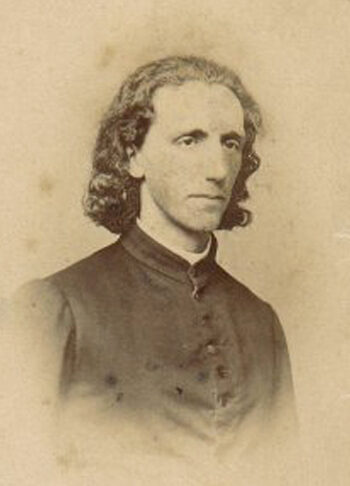
Franz Brentano
Franz Brentano was a German philosopher and psychologist as well as refounder of the theory of intentionality. Born January 16, 1838, in Boppard. Died March 17, 1917, in Zurich. Known for Psychology from an Empirical Standpoint. Educated at LMU Munich and University of Würzburg.
Facts
29 facts · 2 confirmed by two sources · 12 cited · 15 from one source
Where this comes from
Papalocal keeps its own record. It started from these sources; what each one said is kept here as it was copied, so a change on their side never changes this page by itself. Tap one to read its version.
What Wikidata says · copied November 16, 2026 · revision 2569296606
- Described as
- German philosopher and psychologist as well as refounder of the theory of intentionality (1838–1917)
- Other names
- Franz Clemens Honoratus Hermann Brentano, Franz Clemens Brentano, Franz Clemens Honoratus Hermann Josef Brentano
- Born
- January 16, 1838 · 12 references
- Died
- March 17, 1917 · 12 references
- Born in
- Boppard · 1 reference
- Died in
- Zurich · 3 references
- Buried in
- Altstadtfriedhof Aschaffenburg · 1 reference
- Name at birth
- Franz Clemens Honoratus Hermann Brentano
- Citizen of
- Kingdom of Prussia · 1 reference
- Occupation
- philosopher · 1 reference; psychologist · 1 reference; university teacher · 1 reference
- Worked for
- University of Vienna (1874–1895) · 1 reference; University of Würzburg (1866–1874) · 1 reference
- Education
- LMU Munich · 1 reference; University of Würzburg (–1866); University of Tübingen (–1862) · 1 reference; Humboldt-Universität zu Berlin · 1 reference; University of Münster · 1 reference
- Member of
- Royal Prussian Academy of Sciences · 1 reference
- Known for
- Psychology from an Empirical Standpoint · 2 references
- Field
- philosophy
- Spouse
- Ida Brentano · 1 reference; Emilie Brentano; Emilie Brentano
- Children
- Johannes Brentano · 1 reference
- Father
- Christian Brentano · 2 references
- Mother
- Emilie Brentano · 2 references
- Siblings
- Lujo Brentano · 2 references
- Religion
- Catholic Church (1838–1873) · 1 reference; irreligion (1873–) · 1 reference
- Wikipedias with a page
- 50
Wikidata item Q57196 (wikidata.org/wiki/Q57196), public domain (CC0). Copied November 16, 2026.
What Wikipedia says · copied November 16, 2026 · revision 1385951612
Franz Clemens Honoratus Hermann Josef Brentano (; German: [bʁɛnˈtaːno]; 16 January 1838 – 17 March 1917) was a German philosopher and psychologist. His 1874 Psychology from an Empirical Standpoint, considered his magnum opus, is credited with having reintroduced the medieval scholastic concept of intentionality into contemporary philosophy.
Originally a Catholic priest, Brentano withdrew from the priesthood in 1873 due to the dogmatic definition of papal infallibility in Pastor aeternus. Working subsequently as a non-denominational professor, his teaching triggered research in a wide array of fields such as linguistics, logic, mathematics and experimental psychology through the young generation of philosophers who were gathered as the School of Brentano.
- Born, in its opening lines
- January 16, 1838
- Died, in its opening lines
- March 17, 1917
From the Wikipedia article “Franz Brentano” (en.wikipedia.org/wiki/Franz_Brentano), by its contributors, under CC BY-SA 4.0 (creativecommons.org/licenses/by-sa/4.0/). Copied November 16, 2026; not changed.
Confirmed Two sources agree. Cited One source, and it names where it got it. One source One source, without a reference of its own. Sources disagree The sources disagree. We show the best-supported value and keep theirs below.
