
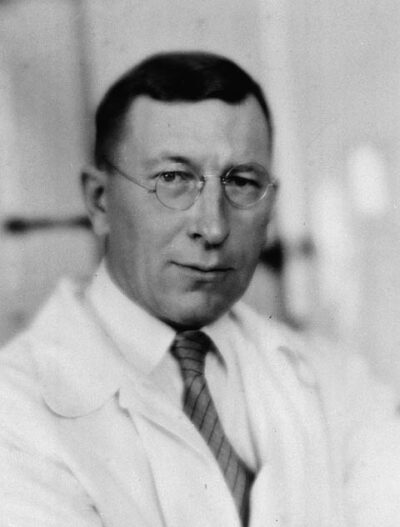
Frederick Banting
Frederick Banting was a Canadian medical scientist and doctor. Born November 14, 1891, in Alliston. Died February 21, 1941, in Musgrave Harbour. Educated at University of Toronto and Temerty Faculty of Medicine. Awards include Nobel Prize in Physiology or Medicine, Canadian Medical Hall of Fame and Knight Commander of the Order of the British Empire.
Facts
40 facts · 2 confirmed by two sources · 9 cited · 29 from one source
Where this comes from
Papalocal keeps its own record. It started from these sources; what each one said is kept here as it was copied, so a change on their side never changes this page by itself. Tap one to read its version.
What Wikidata says · copied November 13, 2026 · revision 2567630587
- Described as
- Canadian medical scientist and doctor (1891-1941)
- Other names
- Banting, F. G., Sir Frederick Grant Banting, Frederick Grant Banting, Sir Frederick Banting
- Born
- November 14, 1891 · 9 references
- Died
- February 21, 1941 · 6 references
- Born in
- Alliston
- Died in
- Musgrave Harbour
- Buried in
- Mount Pleasant Cemetery · 1 reference
- Cause of death
- aviation accident
- Citizen of
- Canada
- Occupation
- physician; pharmacologist; researcher; writer; physiologist · 1 reference
- Worked for
- Hospital for Sick Children; University of Toronto; University of Western Ontario
- Education
- University of Toronto; Temerty Faculty of Medicine
- Member of
- Royal Society of London; German Academy of Sciences Leopoldina; Royal Society of Canada; Royal Academy of Medicine of Belgium
- Awards
- Nobel Prize in Physiology or Medicine (1923) · 2 references; Canadian Medical Hall of Fame (1994) · 1 reference; Knight Commander of the Order of the British Empire (1935); Person of National Historic Significance; National Inventors Hall of Fame (2004) · 1 reference; Fellow of the Royal Society (1935); Military Cross · 1 reference; Flavelle Medal (1931); Fellow of the Royal Society of Canada; John Scott Award (1923) · 1 reference; Cameron Prize of the University of Edinburgh (1927); Honorary Fellow of the Royal College of Surgeons (1930) · 1 reference; F.N.G. Starr Award (1936) · 1 reference
- Field
- physiology; pharmacology
- Spouse
- Marion Robertson; Henrietta Banting
- Military branch
- Royal Canadian Army Medical Corps
- Military rank
- Major · 1 reference
- Wikipedias with a page
- 78
Wikidata item Q180350 (wikidata.org/wiki/Q180350), public domain (CC0). Copied November 13, 2026.
What Wikipedia says · copied November 13, 2026 · revision 1385407815
Sir Frederick Grant Banting (; November 14, 1891 – February 21, 1941) was a Canadian pharmacologist, orthopedist, and field surgeon. For his co-discovery of insulin and its therapeutic potential, Banting was awarded the Nobel Prize in Physiology or Medicine with John Macleod.
Banting and his student, Charles Best, isolated insulin at the University of Toronto in the lab of Scottish physiologist John Macleod. When he and Macleod received the 1923 Nobel Prize in Physiology or Medicine, Banting shared the honours and award money with Best. That same year, the Government of Canada granted Banting a lifetime annuity to continue his work. He is the youngest Nobel laureate for Physiology/Medicine, at 32.
- Born, in its opening lines
- November 14, 1891
- Died, in its opening lines
- February 21, 1941
From the Wikipedia article “Frederick Banting” (en.wikipedia.org/wiki/Frederick_Banting), by its contributors, under CC BY-SA 4.0 (creativecommons.org/licenses/by-sa/4.0/). Copied November 13, 2026; not changed.
Confirmed Two sources agree. Cited One source, and it names where it got it. One source One source, without a reference of its own. Sources disagree The sources disagree. We show the best-supported value and keep theirs below.
